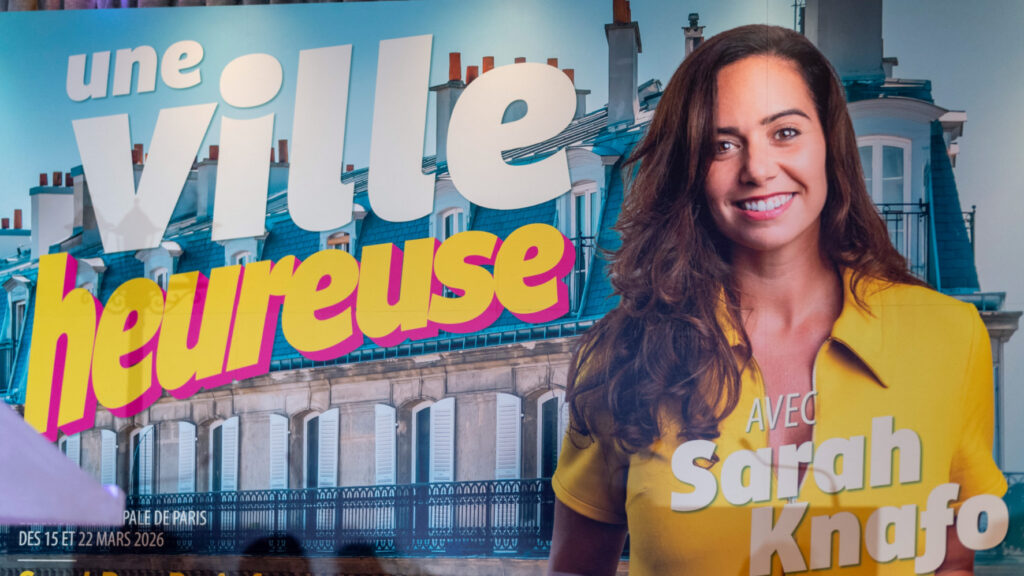
Sarah Knafo mayoral campaign poster
No sooner had a post resurfaced showing Zohran Mamdani’s top housing aide calling homeownership a “weapon of white supremacy” than the writer François Valentin, a friend, pointed his X followers to a confounding parallel. Paris that day, January 7th, had met a long-shot mayoral candidate of its own. Her comic-book visuals recalled those that had taken the Big Apple’s freshly sworn-in mayor to City Hall, only weeks prior. Sarah Knafo’s campaign site flashes a mid-aerial view of the Eiffel Tower amidst staple Metro placards and feel-good slogans in shiny marigold, vowing to make Paris a “happy city.” The 32-year-old is running to succeed the two-term socialist Anne Hidalgo as mayor in late March. Not yet halfway through her first term in the European Parliament’s rightmost faction, Knafo’s fiery sovereigntist philippics against the Brussels blob have been fuel to her lightning ascent at home. Granted, Parisian politics is another matter. Yet, as it craves a jolt out of its political stasis, Knafo’s bid for maire may prove reinvigorating to France—and to Europe.
She has since owned the visual ring and even held up Mamdani’s shock victory in New York as proof that machine politics can be defied in Paris, too. The cue belies a stark polarity, though: a cleavage around which urban politics, from Gotham to Paname, has begun to revolve, potentially drawing our broader Western politics into the dragnet.
Knafo is, in many ways, the European anti-Mamdani. One shocked his city’s Democratic primary with appeals to Gaza, housing, and DEI; the other staked her rise against open borders, wasteful spending, and the Islamo-left’s transnational affinities, from Hamas to Algeria’s FLN. Mamdani’s worldview borrows from the latter terror group, as the writer Zineb Riboua has remarked. Knafo’s Jewish family, meanwhile, fled Morocco upon the Six-Day War and has been blacklisted by Abdelmadjid Tebboune’s neighboring regime for probing France’s wasteful aid to Algiers. Beyond the substance, their life paths are almost inverted. Zohran hides his elite credentials behind a faux Third-Worldism bred amidst upper-class Ugandan and South Asian émigrés. Knafo grew up in the low-income, crime-ridden Seine Saint-Denis department (93)—as did Marine Le Pen’s right hand, Jordan Bardella—before assimilated Jewish families like hers were cleansed by imported antisemitism from the Maghreb. In a traumatic shock that shaped her grit and drive thereafter, when Knafo was a child, a thug kicked her pregnant mother in the womb. Sarah’s younger brother, born disabled, died in 2018 of the fetal injury.
She labored her way into SciencesPo, joining its Euroskeptic club, and, upon completing the ENA, entered France’s elite mandarinate—the énarchie—at the rough equivalent of the U.S. Government Accountability Office, as a magistrate à la Cour des Comptes. Too restless even for Gallic parochialism, she completed the Claremont Institute’s Lincoln Fellowship on a recent U.S. tour, pledging to emulate its reading-based model for her party’s youth ranks. She beats many a Macronist minister in media acumen, her put-downs instant hits across France’s bustling non-leftist TV bubble. She was last suspected of nepotism on prime time for sharing her life with Éric Zemmour—the acclaimed essayist and founder of their party, Reconquête—ahead of the last EU parliamentary race, in June 2024, when she won her MEP seat. The early-30s anchor daring to ask the question was left with the look of regretting the flop. Knafo lacks any family connections to the Parisian elite. The interviewer, her classmate at SciencesPo, is a scion of one of France’s journalistic dynasties.
A beaming ‘Sarah’ launched her campaign two weeks ago in downtown Paris to a crowd four times the expected size. She is Reconquête’s only elected official; four other MEPs, led by Marion Maréchal, parted ways with Zemmour over strategy after the party’s astounding result from June. The snap legislative race that loomed in France shortly after precipitated the fissure, and Reconquête’s ensuing dismal score deprives it of national MPs to this day. Knafo is running a ‘citizen campaign’ this time, with even Zemmour—the two run the party in tandem—in a discreet support role. Her platform is a flexible blend of law and order, techno-futurism, appeals to Parisian schmaltz, and 5th-Republic-style populism.
Growing up, Paris was to Knafo the paragon of chic, refinement, and high culture—one of many disillusions with the right-thinking beau-monde that unraveled with age. She decried in her speech that Parisian ladies are scared to be seductive amidst taunts and insults by marauding ethnic youth, while longing that young local couples would fill the city with baby strollers again. True to her watchdog style of politics, she has crunched the town hall’s spending figures, pledging to “privatize everything that needs to be,” abolish its clientele of activist NGOs, and cut in half its staff of 53,000—already about the size of the European Commission’s. This would allow her to reduce the reviled taxe foncière, Paris’ sky-high property tax, by the same rate.
She has pledged to use AI to tackle crime and other urban ills—you can already hear the cries of racial profiling—and usher Paris into a new “golden age” of innovation. This is not unlike what successive tandems of mayors and regional premiers promised since the Brexit-triggered race to become the EU’s next megalopolis, particularly with ongoing plans for “Le Grand Paris” and its set of infrastructure mega-works. Knafo would be sure to give a hardline law-and-order and fiscally hawkish twist to whatever she inherits.
Channeling a French disquiet over forms of rule, she has pledged a local version of the Gaullist, plebiscitarian template enshrined by the 5th Republic. She means turning referendums on major issues into a “Parisian tradition,” one in which the many unpopular things decreed today would, admittedly, balance out those for which Knafo, given adverse demographics, may lack buy-in. She relies indeed on a concentrated bourgeois base previewed by Zemmour’s scores in western, wealthy Paris in the last two national races, presidential (2022) and legislative (2024). Braving class animosities, her speech even ventured praise for a tax haven: she wants Parisian politicos to be servants as in Switzerland, ruling at the voter’s whims. Some claim direct Swiss democracy only works for small countries, but Knafo made clear she views Paris in just that way: a small nation to befit her statesmanly ambitions, which some intuit aim higher in the long run. Contra her doubters, she has even invoked Jacques Chirac’s mayoral win against the odds in 1977 (naturally omitting his team’s corruption later on).
Just what electorate wants her devoted service is Knafo’s nagging question. The right-of-center Les Républicains (LR) and Marine le Pen’s Rassemblement National (RN) drew their big guns for the race—a first round is slated for March 15—in the names of Macron’s culture minister, Rachida Dati, and the MEP Thierry Mariani, respectively. The familiar kerfuffle around intra-right unity has already re-emerged. Only this time, the first-round favorite to be beaten in the run-off, on March 22, is Emmanuel Grégoire, who wrested the pan-leftist nomination from Hidalgo’s socialist heir in a primary that excluded the hard-left France Insoumise (LFI). This pushes Macronism, in the name of Pierre-Yves Bournazel, into the contending fold of opposition. Knafo shot up to 9% in the polls upon announcing—now head-to-head with Bournazel and LFI’s Sophia Chirkou—and, crucially, past Thierry Mariani, thus emerging as ‘the far-right candidate.’ Still, claims that Knafo is splitting the Right’s vote have not abated but swelled. Dati, narrowly behind Grégoire’s 30% in most polls, is prima facie best placed to break the Left’s 25-year grip on the city, with even some claim to right-wing probity as Sarkozy’s former justice minister and now maire d’arrondissement on the side. But Dati now serves a free-falling Macron and leads Knafo in name recognition by only a few points. With meritocratic eagerness one of her strengths, the newcomer’s challenge is to dispel the sense of Johnny-come-lately around her bid.
Knafo’s policy chops should help. But rather than dwell on the hard-right stances that make her popular—in a crowded field, she is furthest right on Islam and insecurity—she seems to leave the pointless weighing on non-local matters, a socialist favorite, to her rivals. To sum up her platform, she’s hammered the idiom “mettre l’Église au centre du village”—“putting the Church back in the village’s center”—perhaps as metaphor that the unlivable state that Paris is in lies downstream from a deeper form of moral decay.
Knafo appeals, indeed, to a bourgeois, Judeo-Catholic coalition at once socially conservative and economically liberal, skeptical of welfare generally—for natives too. It is unlikely that this calculus played no role in her choice to run. Her bid looks more ambitious still, in coalitional terms, than Zemmour’s (failed) urge to unite the French Right’s historic strands on a national scale. Knafo hopes that the same Reconquête base that turned woefully insufficient France-wide will snap into something larger at the city level, absorbing disaffected LR voters and even Macronists. With working-class quarters gentrified away, the high-brow talk that tanked Zemmour’s fortunes in the hinterland in 2022 may even favor Knafo in Paris, her youth and background striking an aspirational chord with first-time voters.
Part of Knafo’s feel-good vibe involves stroking local pride, too. She vows to restore the savoir-vivre and charm that once radiated out of Paris but that now seem sullied and forsaken and shrouded in mundane blight. Her speech dwelled on Georges-Eugène Haussmann—the urban planner and architect of Paris’ 19th-century renewal—labeling Hidalgo his counter-model and enthroning him as her campaign’s maître à penser. When medieval Paris became unfit for the industrial age, Knafo claimed, “Baron Haussmann” made it again “harmonious, luminous, elegant, coherent,” the exact opposite of Hidalgo’s record of trash and rats and faulty transit and ballooning debt and nightmarish traffic. “We want Haussmann to look down from up high and say: good job!” she said. If not always upper-class trads, Knafo’s potential base is stitched together by a shared sense that something of Paris is indeed lost. These groups may disagree on who or what is to blame, but again, Knafo doesn’t need to pledge deportations nor a revamp of France’s rapport with Islam to win—however much those would help Paris.
These stances don’t need to be disowned, either. Knafo’s bid amounts to a shortcut, from the periphery of French politics to its nerve center, where the kind of concessions, often felt as betrayal, that may sap right-populists elsewhere would be not just unwise but unneeded. Parisians are being given a rare chance to elect a competent, fresh-looking, elite-trained manager who every so often cares to remind the French that they’re being replaced, their millennial homeland prey to Islamization. In balancing the sense of urban disrepair—of tarnished sheen—with the competence to outdo the stale machine politics of old, Knafo’s bid fully inverts Mamdani’s revolution. One is bringing down the West, at the scale of its Empire City. The other seeks to take over one of the West’s urban jewels, halt its decay, and restore it to grandeur.