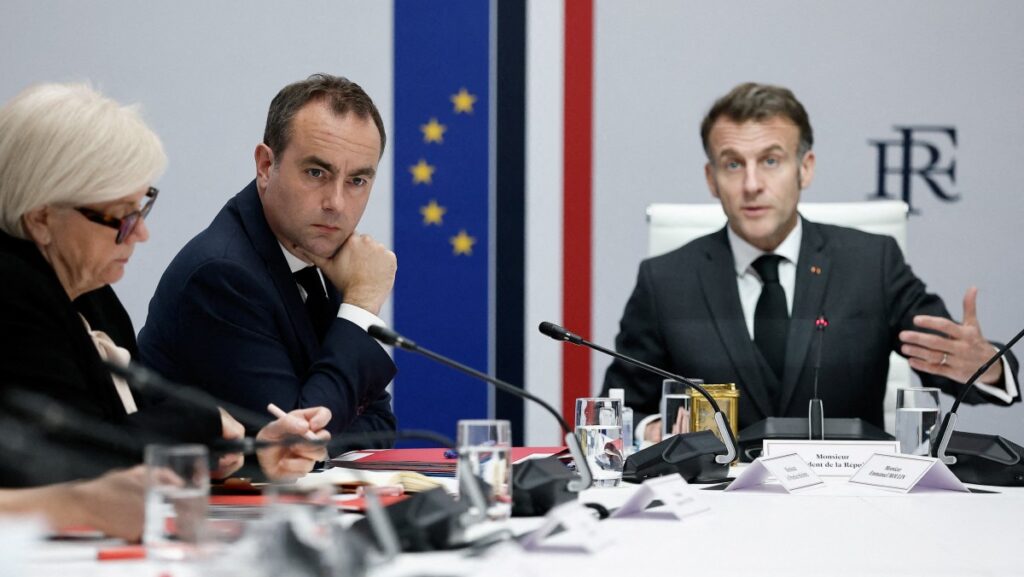
France’s Prime Minister Sebastien Lecornu looks on as France’s President Emmanuel Macron (C) speaks during a national defense council meeting on Middle East war at the Élysée Palace in Paris on March 17, 2026.
BENOIT TESSIER / POOL / AFP
France has increased its presence in the Eastern Mediterranean through naval deployments and expanded defense cooperation with Greece and Cyprus. The deployment of the aircraft carrier Charles de Gaulle and the consolidation of the Franco-Greek defense agreement have reinforced France’s visibility in a region shaped by maritime disputes, energy competition, and instability in the Middle East.
This development reflects a structural feature of European security: France remains the only European Union member state with both global naval capabilities and an independent nuclear deterrent. In operational terms, this gives Paris a capacity to project power that no other EU country can match.
The key issue, however, is not capability but use. For much of the past decade, France possessed these means without consistently employing them to shape developments in the Eastern Mediterranean. Naval presence was episodic rather than sustained, and political signaling did not always translate into long-term strategic engagement.
The recent increase in activity suggests a shift in how these capabilities are used. French naval deployments now serve both operational and signaling purposes, supporting partners such as Cyprus and Greece while reinforcing France’s position in European security debates. In this context, military presence functions as both an instrument of policy and a tool of political positioning.
Recent nuclear policy developments further illustrate this dual dynamic. President Emmanuel Macron has proposed expanding France’s nuclear deterrent and opening a discussion on its European dimension. These proposals signal an effort to position France as a central pillar of European security at a time of growing uncertainty. At the same time, control over the nuclear arsenal remains exclusively in Paris, and European allies continue to rely primarily on the United States’ deterrence framework. The nuclear debate therefore highlights both France’s ambition to lead and the structural limits of that ambition.
This strategic repositioning also intersects with domestic political considerations. Macron operates in a fragmented political environment marked by pressure from both the Right and the Left, as well as ongoing debates over France’s international role, sovereignty, and defense policy. Questions about strategic autonomy, national influence, and Europe’s dependence on external security guarantees have become central themes in French political discourse.
Within this context, the visible use of military assets, particularly the navy and the nuclear deterrent, serves not only operational purposes but also a domestic political function. Naval deployments and references to nuclear policy allow the French presidency to project continuity with France’s traditional role as a major power at a time when that role is increasingly contested both domestically and internationally.
This dynamic is reinforced by the nature of France’s institutional system. The presidency remains closely associated with defense and foreign policy, areas where executive authority is strongest. As a result, external security initiatives provide one of the few domains in which the French executive can act decisively and visibly, even in a politically constrained domestic environment.
Simultaneously, the emphasis on military capabilities can be understood as part of a broader effort to respond to competing political narratives. On the one hand, segments of the political Right call for a stronger assertion of national sovereignty and a more independent foreign policy. On the other, debates on the Left often focus on the risks of military engagement and the limits of power projection. By highlighting France’s strategic capabilities without committing to sustained military operations, the current approach allows the government to project strength while avoiding deeper involvement in conflict.
This helps explain the timing and visibility of recent initiatives. The increased emphasis on naval deployments and nuclear policy does not reflect the sudden emergence of new capabilities but rather a shift in how existing capabilities are presented and employed. In this sense, external security policy functions both as a strategic instrument and as a means of reinforcing domestic political authority.
The Franco-Greek relationship illustrates a similar pattern. The 2021 defense agreement formalized closer military cooperation and created a framework for coordination in a region marked by recurring tensions. For Greece, this provides an additional element of deterrence. For France, it offers access, presence, and influence along Europe’s southeastern flank.
At the same time, this engagement remains selective. France’s presence increases during periods of crisis but has not yet developed into a permanent strategic posture. The distinction between episodic deployment and sustained presence remains central to assessing France’s role.
This raises a broader question about European strategy. France acts as the primary European security actor in the Eastern Mediterranean not because of a coordinated European policy but because of the absence of one. The current dynamic reflects national initiative, rather than collective strategy.
Against this backdrop, the sustainability of France’s approach depends on whether current patterns of engagement evolve into a more consistent strategy. A sustained presence would require regular deployments, long-term coordination with regional partners, and clearer integration of military and political objectives.
Several questions follow from this assessment. Does France intend to maintain a continuous naval presence in the Eastern Mediterranean, or will deployments remain tied to specific crises? Can Paris translate bilateral partnerships, such as the one with Greece, into a broader European framework? And to what extent can French capabilities compensate for the absence of a coordinated European strategy?
France’s evolving role in the Eastern Mediterranean also has implications for the broader transatlantic balance. While the United States remains the central security actor in the region, Washington has increasingly encouraged European allies to assume greater responsibility for regional stability. In this context, French naval and nuclear capabilities can complement American presence, particularly where sustained U.S. engagement fluctuates.
Simultaneously, reliance on a single European actor highlights the limits of Europe’s current strategic framework. Without broader coordination, France’s role risks remaining a substitute rather than a foundation for a more coherent European security approach. This tension ultimately defines the scope of France’s role in the region.
In conclusion, France’s naval and nuclear capabilities provide the means to shape developments in the Eastern Mediterranean. Whether they become the basis of a sustained strategic role will depend on how consistently those capabilities are used and whether they are embedded in a longer-term vision that extends beyond moments of political visibility.