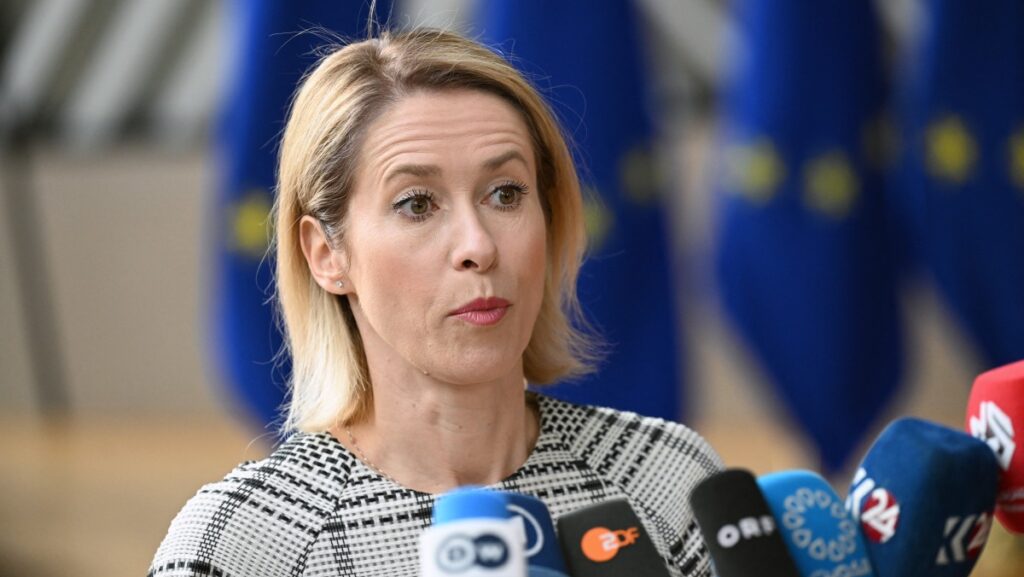
EU High Representative and Vice-President for Foreign Affairs and Security Policy Kaja Kallas makes a statement as she arrives for a Foreign Affairs Council of Defence in Brussels on May 12, 2026.
Nicolas TUCAT / AFP
The Marshall Plan did not end in 2026. The post-Marshall illusion did.
The European Recovery Program of 1948 has been told too long as morality when its deeper grammar was mastery. American capital in the foundations of the continent, Atlantic security in the walls, European integration as the wiring. The European Coal and Steel Community, and the European Union (EU) it later became, were not spiritual awakenings. They were instruments of containment: bind France and Germany, stabilise the West, keep the periphery manageable beneath a strategic ceiling drawn in Washington. The arrangement worked. It produced, however, a managed order rather than a civilisation governing itself.
The wiring is now exposed. The United States is withdrawing roughly five thousand troops from Germany, with further reductions signalled. A 25% tariff hangs over EU cars and lorries. The Strait of Hormuz absorbs Pentagon attention. And in Brussels, the institutional reflex is to summon Article 42(7) of the Treaty on European Union (TEU), the mutual assistance clause, as if a provision could substitute for a sovereign.
Europe has handbooks. It has simulations. It has the vocabulary of solidarity. The organ it lacks is command.
The legal hierarchy matters, and most of the present debate confuses it.
Chapter VII of the United Nations (UN) Charter is not a mutual defence mechanism. It is the collective security architecture of the Security Council, triggered by an Article 39 determination of a threat to the peace, breach of the peace, or act of aggression, and operating through measures under Articles 41 and 42. Article 51 sits alongside, preserving the inherent right of individual and collective self-defence until the Council has acted. None of this is automatic. Article 27 requires nine affirmative votes, including the concurring voices of the
five permanent members, which is the legal pedigree of the veto and the reason global legality is, in practice, a geometry of consent among great powers.
Article 5 of the North Atlantic Treaty, founding instrument of the North Atlantic Treaty Organisation (NATO), commits each Ally to “such action as it deems necessary,” armed force included. Its credibility rests not on its prose but on sixty years of integrated planning, command structure, interoperability, pre-positioned logistics, and the American backbone that gives the alliance its mass.
Article 42(7) TEU is something else again. It binds Member States to render aid and assistance “by all the means in their power” once one of them has suffered armed aggression on its territory, expressly without prejudice to NATO commitments for those that belong to the alliance. It depends, however, on national capitals, national forces, national budgets, and national constitutions. There is no EU general staff, no shared divisional logistics, no integrated planning cycle. France’s invocation in November 2015, after the Paris attacks of the previous week, remains the only precedent, and that precedent produced bilateral assistance rather than collective action.
Article 42(7) TEU is therefore not legally empty. It is strategically undercapitalised. It promises in the grammar of solidarity what only sovereigns can deliver in the grammar of force.
The drafters left a wall where the federalists prefer a corridor. Article 4(2) TEU obliges the Union to respect the national identities of member states and their essential state functions, including territorial integrity, the maintenance of law and order, and the safeguarding of national security, which “remains the sole responsibility of each Member State.” Article 42(2) TEU then closes the door from the defence side: any progression towards a common defence requires the European Council acting unanimously and adoption by Member States in accordance with their respective constitutional requirements.
This is decisive for how the May 2026 simulations should be read. The three-phase exercise rolled out in Brussels to test an operational response mechanism for Article 42(7) is a constitutional event mislabelled as a technical drill. Each rehearsal moves the centre of gravity in defence policy a millimetre away from capitals and towards the Berlaymont. The risk is not that the clause exists; it is that its operationalisation becomes the bridge by which defence federalisation is delivered under emergency doctrine, without the democratic, constitutional, or military foundations that a sovereign posture requires.
Competence creep through fear is still competence creep.
The context surrounding the provision is not abstract. It is the dossier of the past three weeks.
On the Atlantic side, the Pentagon presents the German drawdown as a force-posture adjustment. The strategic reading is harder to avoid. Iran-Hormuz pressure, congressional scrutiny over the cost and munitions footprint of the recent Iran operation, and a months-long campaign over European burden-sharing converge on a single message. Secretary-General Mark Rutte’s concession that European leaders had heard the American signal “loud and clear” was an accurate translation of a moment requiring no further interpretation.
On the economic side, the 25% tariff threat on EU automotive exports completes a dependency triad. Eurostat reports an EU energy import rate of 57% for 2024, dominated by oil and gas. A continent that does not produce its own deterrence, its own energy, or its own market access has limited room to issue communiqués with strategic weight.
On the eastern side, the Council finalised a €90 billion support loan to Ukraine on 23 April, after Hungary lifted its veto, with sixty of those billions earmarked for defence industrial capacity. The Victory Day truce of 8 to 10 May, brokered in Washington rather than Brussels, was honoured in form, contested in substance, and violated almost immediately by both belligerents. President Putin chose the scaled-back Red Square parade of 9 May to denounce NATO directly. The first EU-Armenia summit at Yerevan on 4 and 5 May produced a €2.5 billion Global Gateway envelope and an immediate reminder from Moscow that Eurasian Economic Union membership is not compatible with EU accession.
Brussels finances prolongation. Washington negotiates pauses. The capitals improvise.
The contrast deserves precision rather than caricature.
High Representative Kaja Kallas has institutionalised what is most charitably described as deterrence by loan. €195 billion in EU support to Ukraine since 2022, the new €90 billion instrument on top, and a doctrine that “Russia must not gain more at the table than on the battlefield.” The approach is coherent rather than crude: indefinite war-financing dressed in the vocabulary of resolve, lacking only a defined political end-state.
President Trump’s posture, whatever its rhetorical costs, currently sits closer to a ceasefire logic than the Brussels line. The May truce was a small confirmation of that orientation. Neither posture absolves Moscow. Article 2(4) of the UN Charter still prohibits the threat or use of force against the territorial integrity or political independence of any state, and the standard that condemned the invasion of Iraq in 2003 condemns the invasion of Ukraine in 2022. Strategic sympathies do not move the legal grammar.
The conservative answer lies elsewhere. Sovereign states coordinating defence by consent, in preference to an emergency federalism that issues handbooks because it cannot field divisions: that is the only direction worth defending.
The Marshall wiring was bearable while two conditions held. The costs were hidden inside American budgets, and the patron remained generous because hegemony was cheap. Both conditions have lapsed. A transactional Washington is the natural state of an empire that can no longer pretend its largesse is free. Dependence becomes humiliation when the patron presents the invoice.
Article 42(7) TEU will be invoked, repeatedly, as the doctrinal cover for deeper integration. The older reading is the honest one. Defence is not a regulatory file. Armies belong to sovereigns, not committees. A European order built closer to a classical international organisation of consenting nations is the only architecture that can survive both American retrenchment and Russian pressure without collapsing into either federation by panic or vassalage by exhaustion.
The question Europe failed to answer in the rubble of 1947 and the corridors of 2025 is the question this clause still does not address. Who in Europe commands the response when legal solidarity, military force, and political responsibility collide?
The wiring was never the point. The current was always supposed to come from us.