The central concept in liberal democracy is ‘human progress’: we are on a continuous trajectory from worse to better, we constantly raise our standard of living, we reduce poverty, improve public health, and solve increasingly complex engineering problems. We replace war with diplomacy and peaceful coexistence.
There is a widespread self-image in Europe, in particular in the northern and western parts, of the continent being the birthplace and epicenter of liberal democracy. This social, political, and economic model rested on three pillars: an independent judiciary, parliamentary democracy and free speech, and a welfare state that limited economic stratification.
According to Europe’s entrenched self-image, this model keeps Europe in steady evolution. Its nations continuously rise toward higher levels of social, cultural, and economic sophistication.
In fact, liberal democracy inherently promises endless progress.
While it is definitely true that Europe is the global origin of liberal democracy, the part about endless progress is false. Europe and its social model are no longer delivering on that promise; its three pillars are crumbling. A three-pronged erosion of civilized life is unfolding before the very eyes of a European population whose lives are increasingly, and negatively, affected.
In what is thus far a fledgling reaction, Europeans are slowly waking up. Until now, they have limited their expressions of dissatisfaction to the ballot box, but if the socio-economic erosion of the continent’s state-bearing institutions continues, that reaction may take far more prominent forms.
Meanwhile, Europe’s political leadership continues to act as if they see no ailment, hear no decline, and sense no doom. They are blind to the civilizational regress that is visible in all three pillars of liberal democracy.
The decay in the first pillar, the independent judiciary, has become woefully conspicuous. There are plenty of examples of how the independent judiciary in Europe is fading away, but its erosion is not limited to the courts. The loss of impartiality has also reached deep into law enforcement ranks. Rarely is this exemplified with such stark contrast as when British police recently let a white crime victim bleed to death while catering childishly to his non-white assailant.
The second pillar of liberal democracy, a parliamentary system with free speech and unbiased elections, is also deteriorating. As people revolt against untenable immigration policies by voting for national-conservative parties, supposedly democratic institutions of government have responded by forming Frankenstein coalitions to keep those parties out of power.
The demise of free speech is yet another sacrifice at the altar of the elite’s battle to shield their democracy from the voice of the people.
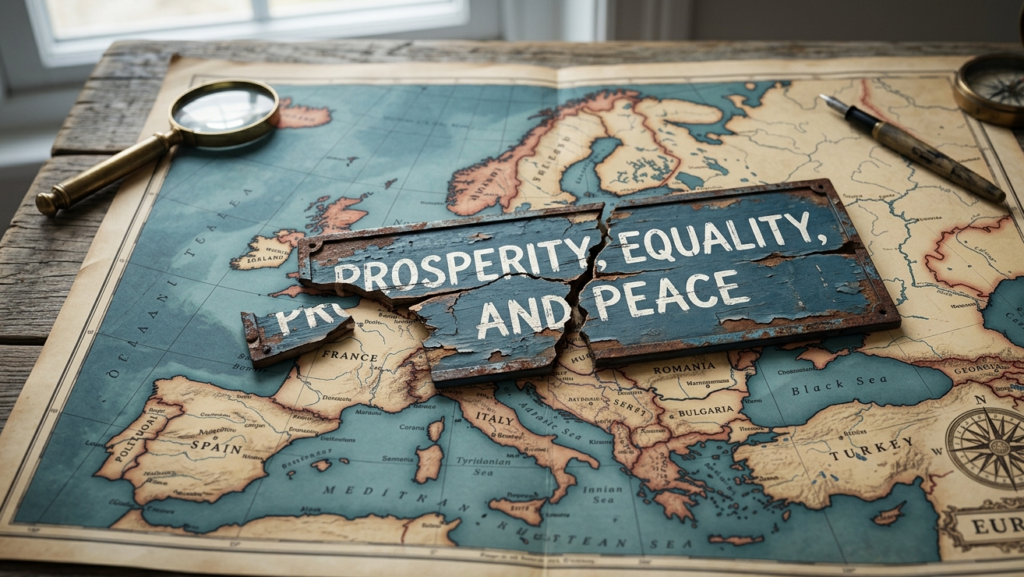
More and more Europeans are waking up to the deterioration of these two first pillars, but the crumbling of the third pillar is likely going to be the strongest catalyst for popular response to the loss of freedom, prosperity, and peace. That third pillar is the welfare state: the promise to all citizens that, no matter their present or future economic circumstances, the state will always provide a comprehensive safety net and—even more importantly—lift up low-income earners to a higher standard than they could pay for themselves.
A high degree of economic equality would guarantee social and political moderation. Entitlements funded by taxes would bring everyone into a middle-class lifestyle where the vast majority had more to lose than to gain from radical political upheaval.
This very fusion of economic stability and political tranquility was supposed to be the winning formula of liberal democracy.
There were just two problems with it. The first was its tendency to breed arrogance among the political elite. Starting in the 1960s, approximately one generation into the liberal-democratic project, Western and Northern European governments began a series of arrogant societal experiments; civilization-critical institutions like church and faith, family and child-rearing, and demographic homogeneity came under attack.
Throughout the last third of the 20th century, experimental hubris eroded the nuclear family and opened Europe to the immigration of untold numbers of people from a culturally, religiously, and economically different background. As part of this exercise in arrogance, the elite began refurbishing the first two pillars of liberal democracy to reinforce the experimental agenda. Racial bias penetrated the judiciary; speech critical of these experiments became stigmatized or even outlawed as ‘hate speech.’
The second problem with the liberal-democratic stability formula has emerged more recently. From the turn of the millennium and forward, Western and Northern Europe’s economies have slowly sunken into economic stagnation. First, they reached the point where they could no longer sustain an annual 3% real GDP growth rate per year, thus losing the ability to improve their standard of living on an ongoing basis. Then they fell below 2% per year, a level below which a nation’s living standards slowly decline.
Seemingly technical and of little general interest, this downshift in economic activity has explosive consequences if it is ignored. Sweden was an early example 35 years ago; the country never really recovered from that crisis. Greece, likewise, permanently lost a sizable part of the prosperity that it built while the liberal-democratic model was still working.
Europe in general is now stuck in a state of structural economic stagnation, and the consequences are increasingly pervasive. Immigrants, whose workforce competence is generally far below the requirements of the European labor market, constitute an unceasingly expanding burden on the welfare state. Meanwhile, the indigenous youth is faced with low-paying, dead-end jobs instead of careers. While they notice that they are not making the same financial progress through life as their parents did, they are also faced with a legal and political system that brands them as racist for being white.
In response, they reject the political mainstream and refrain from reproduction, sending a chilling signal that they refuse to inherit their own nation.
Without productive heirs, the welfare state’s decline accelerates. Under the pressure of structurally inadequate tax revenue and unending demands for social benefits, governments increasingly default on the promises of economic equality—a central tenet of liberal democracy. With the loss of that promise comes the loss of financial predictability: more and more people fall victim to the welfare state’s evaporating entitlement promises.
Those who have done a lifetime of financial planning based on those tax-paid promises now feel the liberal-democratic ground shaking under their feet. Last week, German magazine Bild reported on an almost prosaic example that illustrates exactly how the cracking of the welfare state eats its way into the everyday life of ordinary Europeans. Proposing a reform to elderly-care funding in Germany,
Union parliamentary group vice-president Albert Stegemann (50, CDU) suggests … Your own assets should be used first before the general public pays for them. And he also explicitly thinks about self-inhabited real estate property.
The earth-shattering nature of this proposal is well concealed. If passed into law, this idea would end the model where mandatory insurance and tax-funded social benefits cover the cost of elder care. As a consequence, parents and grandparents can no longer pass on the modest wealth that is embedded in a paid-off house. They have to sell their homes to fund their own elder care.
Inheritance of a home has been a centerpiece of steady, intergenerational financial progress. Knowing they can look forward to that inheritance and themselves rely on the welfare state, younger generations tolerate high taxes and plan their personal finances accordingly.
Gradual social and economic progress is embedded in the promise of liberal democracy.
So long as the economy is growing as part of broader social, cultural, and economic progress, the welfare state can keep its promises. When it does, we embrace it by voting, acting, and speaking in moderation. We contribute to the stability that is promised us by the institutions of liberal democracy.
Now, the European social model is walking away from its promises on a broad front. In the judiciary, in the parliamentary system, and in the welfare state. While people react, the political elites remain in blissful, self-imposed ignorance. Their detachment from reality inspires biblical analogies, but it also raises fears for what may come.
Europe needs to leave the liberal-democracy project behind, but it needs to do so in a peaceful, orderly fashion. That, sadly, looks increasingly unattainable. The slowly accelerating societal decline we are now witnessing inspires only one response from the political elite: the doubling down on the very societal experiments that have set Europe’s decline in motion.
euconedit / Google Gemini