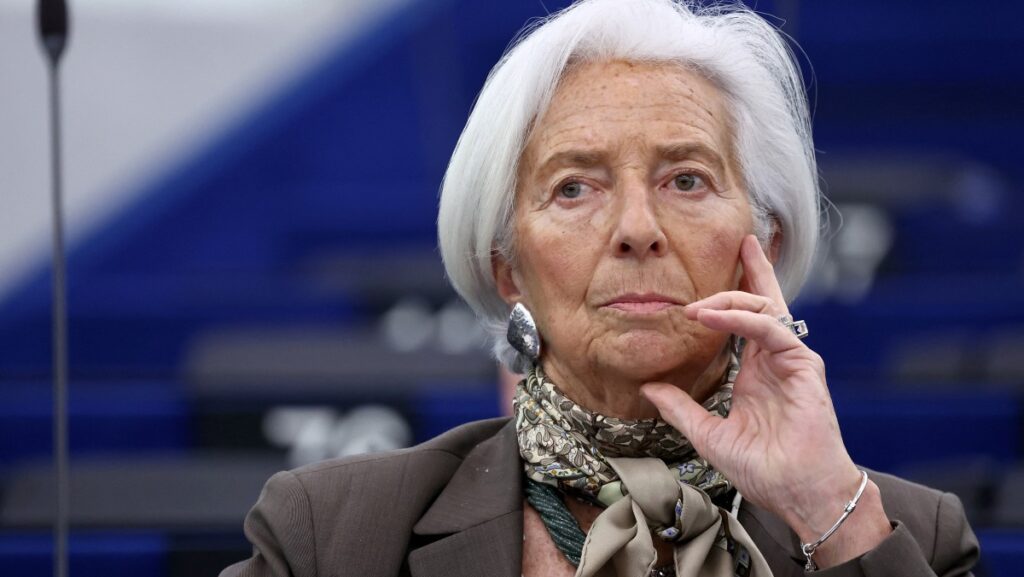
European Central Bank (ECB) President Christine Lagarde arrives to present the bank’s 2025 Annual Report to the European Parliament, in Strasbourg, eastern France, on February 9, 2026.
FREDERICK FLORIN / AFP
I have repeatedly pointed to the troubling state of stagnation that characterizes the European economy. I have also repeatedly expressed my frustration over how little attention European policymakers and thought leaders pay to this problem.
When they do make an effort, like Mario Draghi did a few years ago, they fail both in analyzing and in providing remedies for the stagnation problem.
On February 23rd, ECB President Christine Lagarde addressed Europe’s economic ailment in a speech in Washington. She was there to receive the Paul Volcker Lifetime Achievement Award at an annual conference with the U.S. National Association of Business Executives.
In her speech, Lagarde made a few remarkably blunt statements about the systemic problems facing Europe’s economy today. Starting with the most apparent problem, namely Europe’s exceptional reliance on exports, Lagarde explained:
For much of the past 15 years, the euro area relied heavily on the rest of the world to generate growth.
In terms of substance, this is a correct observation. However, Lagarde is way off in terms of the longevity of this unsound exports dependency. Most EU members have relied on exports to drive their economic growth since at least the 1970s. The expansion of global trade in the 1980s, 1990s, and 2000s only reinforced Europe as an export-dependent continent.
Lagarde continued:
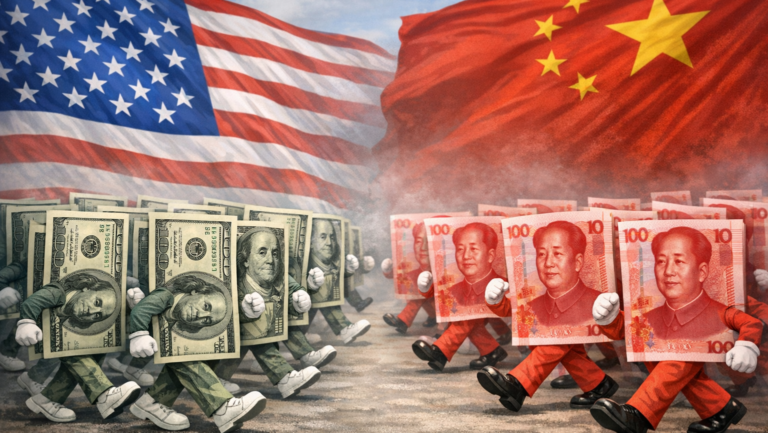
Today, Europeans widely recognise that this model has run its course. It presents two fundamental problems. First, we now operate in a world in which our largest single export market is subject to tariffs, and where our third-largest export market, China, is running a trade surplus of around USD 1.2 trillion.
As a result, Lagarde noted, Europe can expect its exports to grow by about half the rate of its “historical average pace.”
In other words, the euro zone is losing its main growth engine. This is one reason why the euro zone GDP will grow at less than 1.5% per year in real terms for the rest of this decade. However, it is not the only reason—and not even the main one.
Let us get back to that point in a moment. First, here is Lagarde’s second fundamental problem, emanating from Europe’s long-standing exports dependency:
Second, this model has meant exporting our savings at a time when we face substantial investment needs at home. US capital markets now account for roughly one-third of euro area residents’ holdings of listed equities, a share comparable to that invested domestically.
On this point, Lagarde is very much correct, and the numbers she shares speak a powerful language:
These investments have generated significant income gains. In 2025 alone, euro area investors earned almost €200 billion from their US equity holdings, or around 1.3% of GDP. But the broader returns, in productivity gains and innovation, accrue where the capital is deployed. That has overwhelmingly been in the United States.
This is entirely Europe’s own fault. The American economy is less taxed and less regulated than the European economy. We also have a more productive workforce and higher purchasing power. Even though competition is stiffer in the American market, there is still more profit to be made here than in Europe.
Lagarde then points to what Europe’s U.S.-bound capital flight could do if it were kept at home:
As an illustration, if the euro area were to deploy some of that capital productively at home—enough to close just one-quarter of the productivity gap with the United States—the gains for the economy could be in the order of €500 billion per year. That is more than twice the income earned on those foreign investments.
So far, the ECB president has been open, honest, and even humble about Europe’s economic ailment. Unfortunately, she comes up short on the solutions side of the equation. When addressing the remedies question, she begins by suggesting that “a shift is now underway” in the European economy—and she points to rising defense spending as the catalyst for more economic growth:
Europe’s geopolitical needs and macroeconomic interests now point in the same direction: the investment required for security and resilience will also strengthen our domestic growth. Government spending on defence and infrastructure is rising markedly…
I was hoping she would not go there, but she did. Government spending is not the solution to Europe’s economic problem—government is part of that problem. It is too big, too heavy to carry for the taxpaying, value-creating private sector.
Government spending can function as a demand-pull force on the economy, but only when it is stuck in a deep, unrelenting recession. If government then intervenes, its focus should be on so-called ‘public goods ‘ where government has an inherent economic advantage over the private sector. However, the bulk of such spending consists of infrastructure and energy production; while technically being a ‘public good,’ national defense—unlike infrastructure—has no apparent economic feedback into the value-creating part of the economy.
In short, if you want to generate more economic growth, there is no more wasteful way to do that than to increase defense spending. You may have other, very legitimate reasons to do so, but you will never set the economic wheels in motion that way.
Lagarde refuses to see this. She claims that Europe’s rising defense budgets support private sector investments, partly spilling over into much-hyped artificial intelligence:
AI is providing an additional tailwind: private digital investment has risen by almost 20% since 2020, and our survey of large European corporates points to ongoing strong growth in AI-related spending.
She also speculates about how this growth in capital formation will contribute to GDP growth:
Overall, between 2026 and 2028 investment is projected to account for almost 40% of euro area growth—well above its historical average of around one-quarter—representing more than €150 billion in additional cumulative investment.
I wish the Europeans well in generating this kind of capital formation boom. I seriously doubt it will happen, though, for two reasons.
First, in countries where the AI boom has already happened—America, Japan, China—it is not delivering as promised. There is quarreling deep in corporate layers that they cannot see the supposed benefits of AI investments reflected in their bottom lines. Since Europe is one technological cycle behind on this front, they have not yet encountered this problem, but when they do, they are likely going to sober up regarding AI in the way that Americans are already beginning to do.
This means, bluntly, that while AI is a productivity-enhancing form of technology, those enhancements are limited. This becomes even more obvious when we take into account that total corporate investments—also known as capital formation—in the EU is roughly €3 trillion per year. That is two thousand times more than the AI investments that Lagarde envisions—and ‘hers’ are spread out over three years.
The second problem that Lagarde carefully evades is that even with these modest improvements in spending on artificial intelligence and national defense, there will be little to no demand for the new products that more corporate investments are supposed to generate. As Lagarde recognizes, the European economy has a problem with insufficient domestic demand, but unlike what she believes, that problem is centered around inadequate consumer spending.
With low domestic demand, there is not much need for increases in corporate investments. A small blip under the item ‘artificial intelligence’ is going to be inconsequential if Europe’s domestic economy continues to virtually stand still.
Christine Lagarde made some candid remarks during her speech in Washington. She is quite possibly the first major European policymaker to concede that Europe has a structural economic problem. Perhaps it was too much to expect that she would also provide a complete picture of Europe’s true economic ailments. Maybe next time?