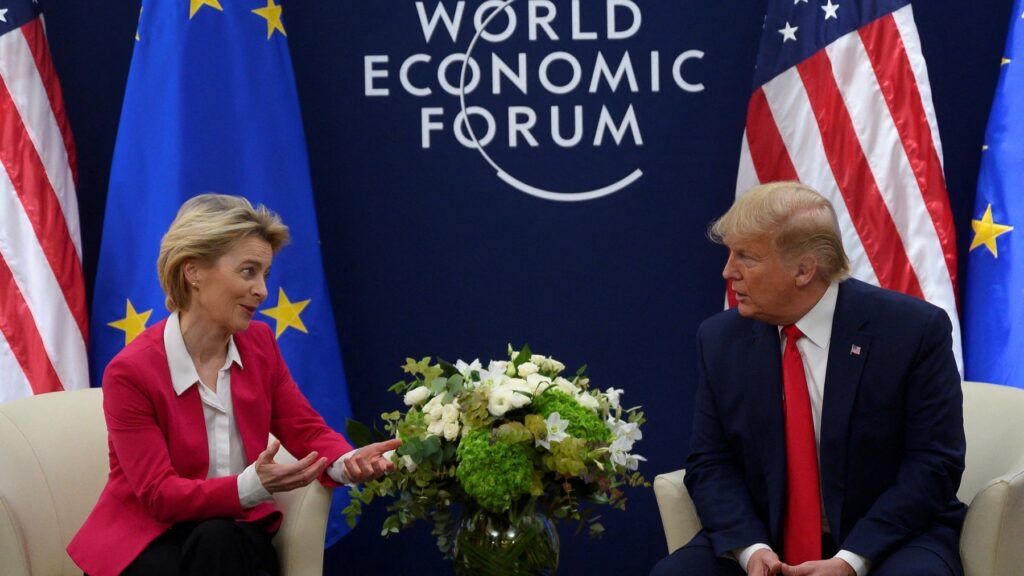
European Commission President Ursula von der Leyen with U.S. President Donald Trump at the World Economic Forum in 2020
Jim Watson / AFP
The outlines of a trade agreement between the European Union and the United States are slowly taking shape. According to diplomats, the EU would agree to a basic tariff of 10%, with exemptions for specific sectors such as pharmaceuticals, semiconductors, alcohol and commercial aircraft. The EU also wants the U.S. to commit in advance to lowering tariffs, as it did with the United Kingdom, which has already secured a reduction in tariffs on car and steel exports while negotiations on other sectors continue. Everything would be set out in a framework agreement, with the details to be clarified later. The European Commission, which is leading the negotiations, wants to aim for a tariff of less than 10%, a level it is only willing to accept under certain conditions.
Initially, it aimed for a 0% tariff that both sides would accept. On top of that, it also wants to negotiate the American import duties of 25% on cars and 50% on steel and aluminium. The latter date back to the first term of U.S. President Donald Trump.
The stakes are high in any case. A complete failure of the negotiations would result in the U.S. imposing additional, so-called reciprocal customs duties of up to 50% on products such as pharmaceuticals and semiconductors, on top of their basic tariff of 10%. However, diplomats believe that a deal is looking likely and think that the 9 July deadline set by Trump could be extended if necessary.
Italy and Germany in particular are pushing for a quick agreement. France, on the other hand, remains more reluctant. “If the U.S. maintains the 10% tariffs, there will have to be compensation for goods and products imported from the U.S.,” French President Emmanuel Macron said on June 26th after an EU summit, adding: “The tariff must be the same: 10% for 10%, or the equivalent of 10%.” For Macron, however, accepting the 10% tariff means a softening of France’s previous position.
For this reason, too, it is possible that an agreement in principle still contains many loopholes. According to a diplomat involved, such an agreement could well be deliberately brief so that both parties can conclude more detailed agreements in various sectors.
Meanwhile, the European Commission is preparing further countermeasures. An initial list of possible retaliatory measures has already been drawn up. It covers 21 billion euros worth of American products and has been suspended until 14 July in exchange for the 90-day postponement announced by Trump in April. A second list has already been submitted to industry and is still to be formally approved by the Member States. It covers no less than €95 billion worth of U.S. products.
Somewhat under the radar, the EU has already made a major concession to Trump. At the end of May, the European Commission classified imports from the United States as ‘low risk’ under the new anti-deforestation directive. It made this decision after heavy pressure from the U.S. Trade Representative (USTR), which considers this European regulation to be a ‘non-tariff barrier,’ or disguised protectionism.
The directive in question, which imposes all kinds of bureaucratic obligations on trading partners to export products such as cocoa, coffee, soy, palm oil and beef to the EU in order to combat deforestation, not only led to a row with the U.S. Southeast Asian palm oil producers, such as Malaysia and Indonesia, also protested strongly. They now consider it unfair that their imports are classified as ‘standard risk,’ as opposed to ‘low risk’ in the U.S., especially given that the problem of deforestation in countries such as Malaysia has recently improved significantly. This is partly due to the imposition of its own MSPO standard, but despite this, the EU continues to refuse to recognise the Malaysian standard as equivalent, unlike the United Kingdom, for example. The fact that the latest version of that standard is even stricter than the European one does not change the situation.
The European Union will probably also have to make concessions in the context of other non-tariff barriers. At least, that is what Trump is demanding. The EU’s digital rules in particular are a thorn in his side.
He recently stated that Canada was “obviously copying the European Union” by imposing a tax on digital services on American Big Tech companies, which the country will ultimately not introduce after American pressure. While the EU does not have such a tax, through its competition policy the European Commission does impose record fines on American big tech companies, often on rather questionable grounds, something Trump has already criticised.
Apart from these fines, there is great concern in the U.S. about the threats to freedom of expression posed by new European rules, in particular the Digital Services Act. In March, Brendan Carr, head of the U.S. Federal Communications Commission (FCC), said: “There’s a risk that [EU] regulatory regime imposes excessive rules with respect to free speech,” adding that “the censorship that is potentially coming down the pipe from the [Digital Services Act] is something that is incompatible with … our free speech tradition.” For U.S. Vice President JD Vance, curbing the DSA in this area is also an absolute priority. The EU would therefore be well advised to prepare for additional pressure from the US on this issue.
Then there is the European Digital Markets Act, which imposes all kinds of restrictions on the major digital players. On June 20th, the Wall Street Journal reported, based on a leaked draft agreement, that “the United States and the European Union appear to be nearing a deal on multiple non-tariff trade issues from deforestation rules to the treatment of U.S. tech companies in Europe.” The newspaper specifically mentioned “the EU’s Digital Markets Act, its carbon-based border tariffs, shipbuilding and more, according to people with knowledge of the text, who said the agreement appeared to be close to final but emphasized it could change in the coming days and weeks.”
However, the European Commission strongly denied all of this. Trade negotiator Matthias Jorgensen stated that it is “not an option for us” to put “the EU’s regulatory autonomy on the table.” European Commissioner Henna Virkkunen defended European digital regulations as “based on our European values…This is not part of trade negotiations from our side.” We shall see.
On the sidelines of the European summit at the end of June, European Commission President Ursula von der Leyen proposed that the EU should forge closer ties with the 12-member Indo-Pacific trade alliance, the CPTPP, perhaps even as an alternative to the World Trade Organisation, which is currently paralysed by the dispute settlement mechanism blocked by the U.S. This is a good idea in itself, regardless of the trade tensions with Trump.
In a noteworthy analysis, Peter Draper and Andreas Freytag of the ECIPE think tank argue that “to counter U.S. protectionism and the gathering U.S.-China (and beyond) trade war, the EU, Australia, and like-minded Asia Pacific trading partners that are members of the Comprehensive and Progressive Transpacific Partnership (CPTPP) should immediately call for a Summit …. The partners should not negotiate endlessly; details do not matter. Rather they should agree on free trade quickly and allow every country a fixed number of exceptions, e.g. in agriculture or security, but also agree on giving up these restrictions later.”
Who knows, such an alternative trade initiative within the free world might prompt Trump to make more concessions than all kinds of countermeasures and protectionism.