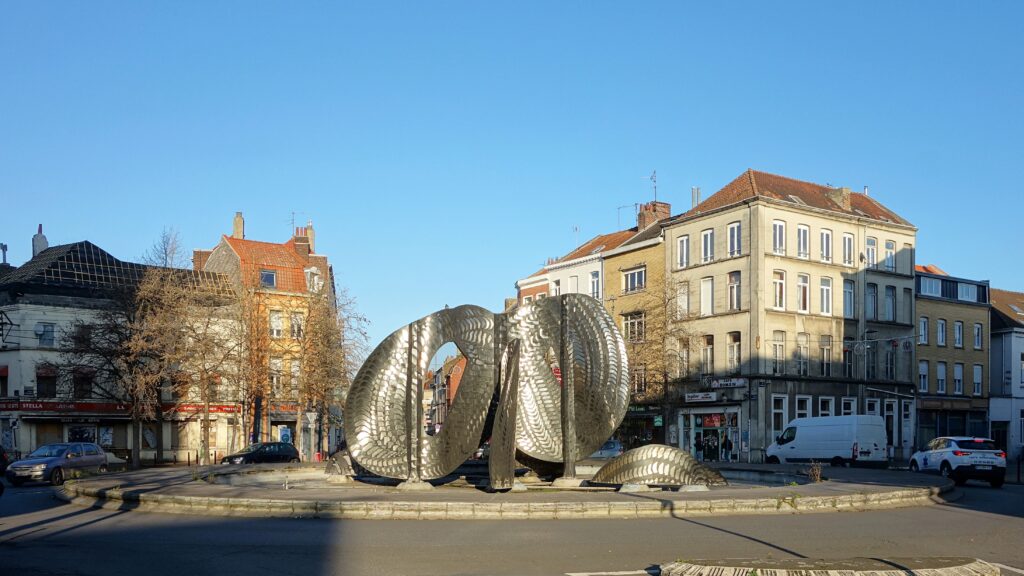
A statue representing the Möbius Strip on the Place de la Solidarité in Lille, France
Photo by Velvet on Wikimedia Commons, Creative Commons Attribution-Share Alike 4.0 International license
The defining characteristic of Western Europe today is not the unity and strength promised by its founders; rather, it is the resolute absence of a vision for the future.
The U.S., China, Russia, and India are actively engaged in constructing a tomorrow for the long term. Western Europe remains ensconced in a nostalgic gaze backwards. Its politicians cling to yesterday’s solutions. The continent’s political agenda seems directed towards a single aim: maintaining the status quo of a world that no longer exists.
The retrograde mentality of EU leadership has transformed this ‘union’ into an enclave of elitist, like-minded people; each strives for political influence while privately seeking to undermine each other. The EU was originally designed to create a unified geopolitical force for its member states. In practice, that unity has been reduced to cynical self-interest and maintaining the status quo of an elitist few.
Germany seeks to preserve its economic dominance in the “union.” It continually signals to Washington that it alone is a stable transatlantic partner. France, despite its military being kicked out of its former colonies in Africa, flexes its nuclear capability over western and southern Europe.
Britain, once an outsider, is suddenly open to again being part of ‘Europe.’
Smaller European states scramble for relevance, while recognizing that they are pawns on a larger power’s chessboard.
Brussels, meanwhile, engages constantly in bureaucratic theater. Figures like Ursula von der Leyen and Kaja Kallas proffer loud proclamations, each in the absence of any real power. They are political actors without a stage, speaking from irrelevant scriptst. The spectacle of European unity has become hollow—not only in appearance, but in substance.
Western Europe’s decline, however, didn’t begin yesterday. The last 15 years have exposed just how insubstantial the EU’s foundations truly are. After the Cold War, the dream of a robust, united Europe gained a degree of traction: a common currency, a common foreign policy, even an undercurrent of strategic autonomy from NATO.
The euro, once hailed as the instrument of European power, has instead become Germany’s weapon of economic control. Southern and eastern member states became locked into a financial order they could not escape. Germany imposed its will during the ‘euro zone crisis,’ and smaller nations, with little recourse, resented being subjugated as appendages to the German economy.
So when the Ukraine conflict escalated in 2022, the rupture of Russian-German ties was quietly welcomed across the continent. France, which gave little to Kyiv, now enjoys more diplomatic prestige than Germany, which continues to give billions. Poland’s foreign minister virtually celebrated the sabotage of Nord Stream II—not because it harmed Russia, but because it weakened Berlin.
EU enlargement, once seen as the triumph of European power, has become a liability. For two decades, eastward expansion was treated as a geopolitical project aimed at absorbing former Soviet spaces. But this failed to give Western Europe more clout with Washington. The new members did not submit to Berlin or Paris; they looked to the U.S. instead. In the end, the EU overreached, alienated Moscow, and gained nothing substantial in return.
Having failed at building a real foreign policy of its own, the EU is now desperately trying to preserve what it has. But without a vision of the future, politics loses its relevance. West European policies have become a “Möbius strip,” where the beginning and end are one and the same—there is no progress, and tensions within the bloc grow sharper.
Britain may have departed the EU, but geopolitical pressure has halted that impetus. Unable to solve its own domestic crises—with four prime ministers in three years—London doubles down on anti-Russian rhetoric to stay relevant.
Most Germans, especially the business community, would like to restore ties with Russia; there is cheap energy and easy profits to be had. And this may eventuate as Moscow and the U.S. seek closer ties politically and economically.
But southern Europe, impoverished and increasingly resentful, can no longer sustain German prosperity. France hopes to exploit this, repackaging itself as Europe’s new ‘nuclear umbrella.’ Macron talks big (and a lot), but if history is our guide, he rarely delivers.
As tensions with Russia and China escalate, EU leaders have been queuing up to visit the new man in the White House. The exception is the Germans, who have formed a coalition government after chaotic elections in which the leading ‘far right’ party is excluded from governing by the infamous ‘firewall.’
From Poland to France, each leader went to ask Trump for preferential treatment; instead, they received tariffs. Divide and rule remains the U.S. approach, and the Western Europeans keep falling for it.
In the East, Hungary and Slovakia seem to have had enough. Years of lectures from Brussels on LGBT rights and strong-arm tactics to toe the accepted political line have created deep resentment. They now speak openly of a relationship with Russia and China. Spain is refusing to see Moscow as a threat. Italy’s prime minister Giorgia Meloni deals with Washington bilaterally and makes little pretense regarding broader European interests.
The European Commission, tasked with representing the EU, has become a parody of itself. Kaja Kallas, recently named High Representative for Foreign Affairs, immediately overstepped her role by demanding tens of billions in new aid for Ukraine. The backlash was swift.
What remains of Western Europe today is a mere shell of its former self: a group of aging power elites, clinging to the past, unwilling to act for the future and refusing to relinquish control. Their one shared goal, or perhaps destiny (when Washington, Moscow, and Beijing make decisions), is to be present—not as equals, but as supplicants.
Ultimately, if stability returns to Europe, it will be because Washington permits it—not because Brussels earned it.