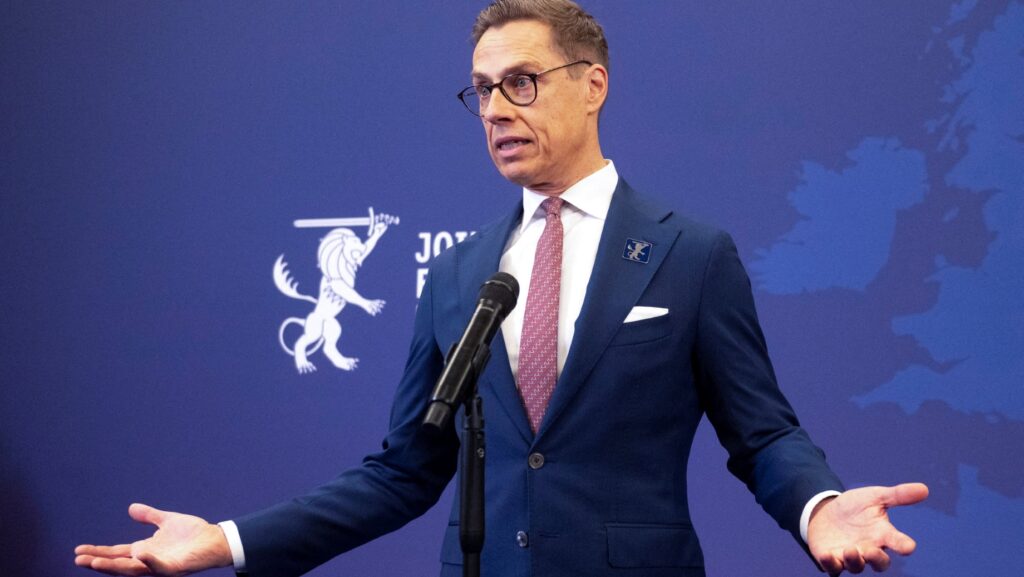
Finland’s President Alexander Stubb
MARKO MUMM / AFP
As I predicted last year, the line of European countries with insoluble budget problems is only getting longer. Finland has become the latest Western European welfare state to fall into fiscal disrepair.
Pushed into budgetary urgency by the EU’s January 20th excessive deficit procedure note, the Finnish government is rapidly running out of economic wiggle room. Finnish news outlet Yle reports:
The need for [fiscal] adjustment of public finances in the coming years is quantitatively large and easy means have been used [already]
Europe’s unending state of economic stagnation will be the fiscal nemesis of all the socialist welfare states in Western Europe. Their operational principle has been digging their governments deeper into the hole for many years now. You can only tax-punish ‘the rich’ and trap the poor in government dependency for so long; eventually, the private sector grinds to a halt while the welfare state explodes with poor people demanding benefits.
The Finnish iteration of this economic model is now faced with an unforgiving economic reality. On January 20th, the Council of the European Union issued an excessive deficit procedure note on Finland. It explains:
The Council today opened an excessive deficit procedure (EDP) concerning Finland. It also adopted a recommendation to Finland outlining the net expenditure path and timeline that should be followed to put an end to its excessive deficit by 2028.
The Council went on to specifically reference Article 126(3) of the “Treaty on the Functioning of the European Union.” This article makes it unconstitutional for an EU member state to run budget deficits in excess of 3% of GDP. Pointing to large deficits in the past two years, the Council then makes a remark that should reverberate through the rest of the EU:
Finland’s use of the national escape clause for defence spending under the stability and growth pact, which allows member states to have an excess deficit of 1.5% without triggering an EDP, does not fully explain Finland’s deficit.
Herein lies even more fiscal urgency for the Finnish government to adapt to. This statement explicitly tells Finland, and every other member state, two things:
This is a bitter pill for Finland to swallow, but the problems that led to this situation are entirely domestic. Nobody forced the Finns to the point where they are now—especially when it comes to the enormous size of their government. According to Eurostat’s national accounts and COFOG databases, the latter on government spending, the Finnish government consumes 56% of GDP.
Think about that: the Finnish government takes away 56 cents of every euro that the nation’s businesses, investors, and workers create. This is less than France (57%) but still more than Italy, Belgium, Austria, and Sweden, all of which also run more than half of their economies through government.
Of the big pile of money that the Finnish government spends every year, it allocates 75% to the welfare state. Only Ireland beats Finland in this category, with a 0.2 percentage-point margin.
It may seem like a technicality how much the Finnish government spends on its welfare state, but it is not. The redistributive Western European welfare state is the very root cause of Europe’s economic stagnation. It operates according to three principles:
The first and second principles reduce economic growth; the third principle gives moral credibility to the policies that slow down the economy. Taken together, these principles have trapped most of Europe in a decades-long state of economic stagnation. That stagnation has led to a structural mismatch between revenue and spending in the redistributive welfare state:
This is a structural budget problem—and Finland has one: its consolidated government has run a budget deficit every year since 2009.
Unfortunately for Finland, its political leaders appear to be just as unwilling to see the welfare state for what it is as their peers are in other countries.
Because of widespread support for the welfare state among the political elite in Finland, attention to the structural budget problem is marginal at best. Therefore, when Helsinki now has to wake up and smell the excessive deficit coffee, there is a considerable risk that they will fall into the same fiscal panic that led the Greek government to crush one quarter of their national economy.
Finland has no margins for austerity experiments. The economy is already in very bad shape: from 2022 through the first three quarters of 2025, GDP grew at an inflation-adjusted 0.0%. Even moderate tax hikes combined with unstructured, panic-driven budget cuts can set in motion a very bad economic process.
If the Finns want to avoid ending up where Greece did, they need to gaze beyond their own national borders. Fortunately for them, Hungary, Europe’s preeminent leader in welfare state reform, can serve as a good example. They only spend 51% of their government resources on the welfare state.
The reason for this is the reform program for the welfare state that the Fidesz government implemented in the 2010s. They rewrote the purpose of entitlement programs and of the Hungarian government’s social role in general. Rather than obsessing over the differences between rich and poor, the Hungarians have concentrated their welfare state on supporting the formation, growth, and perpetuation of the traditional family.
While the Western European welfare state obsesses with economic differences between individual citizens, the Hungarian welfare state is designed for a very different purpose. First and foremost, its purpose is to help Hungarians form families, have children—the more the merrier—and help them grow up in the heart of thriving families and a peaceful society.
The repurposing of the welfare state is not only a bold statement of conservatism in action but also an intelligent way to make the welfare state more affordable. Hungary spends only 51% of its government’s resources on entitlements and social benefits—a far cry from the Finnish 75%. This has allowed the Hungarian government to concentrate its fiscal policy on helping the economy grow.
Their policies have paid off in spades: in the five years leading up to the 2020 pandemic, Hungary averaged 4.2% per year—1.9 times higher than the EU average for the period and almost 2.4 times higher than Finland.
Finland is in dire straits. Its government has no room for fiscal policy errors, especially since the country is trapped in the euro zone’s one-size-fits-all monetary policy regime. The power brokers in Helsinki will only get one real chance at fixing their nation’s ailing economy. They better make very good use of that chance.