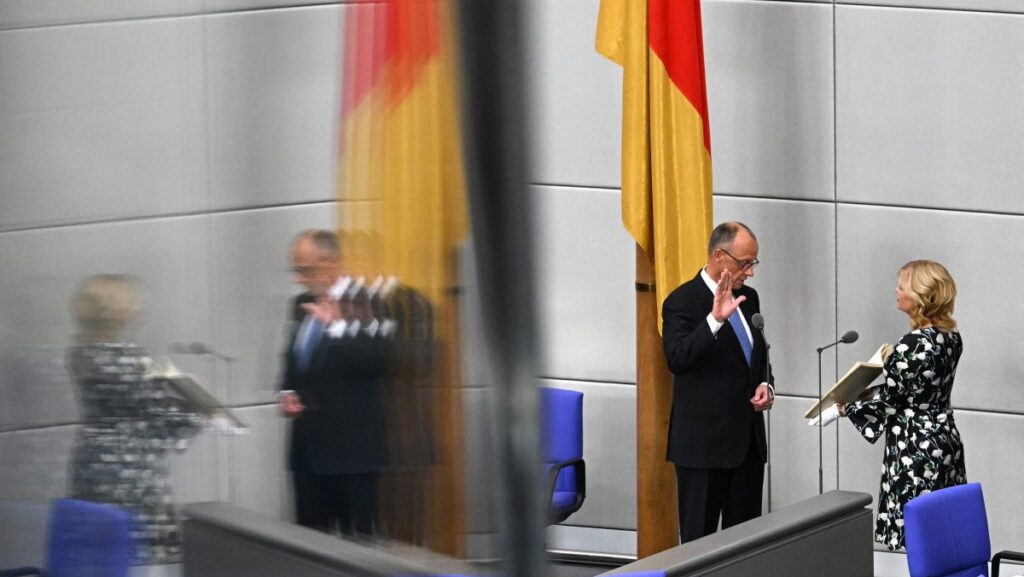
Friedrich Merz takes the oath as the new German chancellor on 6 May, 2025
Ralf Hirschberger / AFP
Friedrich Merz, the newly elected chancellor of Germany and leader of the Christian Democratic Union (CDU), has for years been presented as the great hope to return the party to its conservative roots after Angela Merkel’s long centrist cycle dragged it into a deep identity crisis. That he failed to secure the chancellorship in the first round of voting is more than a procedural footnote—it underscores the lingering divisions within the party and the uncertainty surrounding its ideological future.
#Merz ist der erste Kanzlerkandidat der Bundesrepublik, der im ersten Wahlgang gescheitert ist. Das zeigt, auf welch schwachem Fundament die kleine Koalition aus Union und von den Bürgern abgewählter SPD gebaut ist.
— Alice Weidel (@Alice_Weidel) May 6, 2025
His profile as a successful lawyer and financial manager, his serious demeanor, and his firmer rhetoric at certain moments made him the ideal candidate for those longing for a return to basics. During Merkel’s years, he was the “great outcast,” being one of the few capable of casting a shadow over the Iron Lady. However, the reality of his leadership paints a much more nuanced and, for many, disappointing picture.
In the 2025 campaign, Merz skillfully connected with an electorate increasingly concerned about uncontrolled migration and the decline in public safety. His promises to restrict illegal immigration, reinforce deportations, and limit aid to illegal immigrants tapped into popular sentiment that had not found sufficient echo in official politics.
This shift, although tactically effective in regaining votes lost to Alternative für Deutschland (AfD), soon revealed its circumstantial nature. Barely hours after his electoral victory, Merz toned down his statements. He assured that “no one wants to close the borders,” thereby diluting the firm stance he had upheld during the campaign.
In other words, Merz betrayed a large part of his voter base within less than 24 hours—those who trusted he would do something about immigration or at least make an effort.
This episode, far from being a mere clarification, embodies a constant in his leadership: the willingness to attract conservative votes without fully committing to the demands this entails. The occasional acceptance of AfD votes for a motion on migration control in the Bundestag was more a symbolic gesture than a genuine ideological shift, as Merz immediately reaffirmed the CDU’s traditional refusal of any cooperation with that party. The conclusion is clear: the toughened migration discourse was more a strategy to stem electoral losses than a true political reorientation.
The disappointment has also been palpable in the field of social values. Although as a young MP, Merz showed a relatively conservative profile—opposing abortion liberalization and certain progressive initiatives—his current leadership has carefully avoided any clear commitment in this area.
The defense of life, protection of the traditional family, and other key issues of social conservatism have been notably absent from his recent statements and programs. In fact, Merz has preferred not to upset either the press or his potential partners, especially the SPD, opting for vague talk about “diverse family models” and avoiding firm positions on essential matters for the conservative base. This strategic silence has left the impression that the CDU continues to blur its Christian and social identity in favor of a pragmatism that became a hallmark during the Merkel era.
He is no different from the rest of the partners in the European People’s Party in this. During election campaigns, they wield a series of slogans and supposed values that quickly disappear as soon as the political cards are laid on the table. In this sense, it is surprising that many speak of a “new Germany” under his possible mandate when, in practice, it will be a continuation of that of Olaf Scholz and Angela Merkel.
Where Merz has indeed been consistent is in his defense of liberal economics. His business career, especially his tenure as head of BlackRock in Germany, and his well-known push for tax cuts and deregulation, have cemented his image as a businessman more than a statesman with a comprehensive vision. Proposals such as the reduction of corporate tax and bureaucratic simplification have been well received in economic circles, but his approach has tended to prioritize technical efficiency over social cohesion and the protection of national communities.
Serious conservatism cannot be limited to figures and charts; it also requires a clear will to preserve identity and social structure against the disruptions of globalization. In this respect, Merz offers more continuity than innovation: an economic recipe that any moderate technocrat could apply, lacking the rootedness expected of true conservative leadership.
The Große Koalition (Grand Coalition) with the SPD, which seemed inevitable after the latest election results, has ended up cementing this perception of continuity. Although Merz came to power wrapped in rhetoric about a “new impulse,” the structure of his government and his initial decisions have shown that any real attempt at change is limited by the need to negotiate and compromise. The CDU continues to breathe life into its left partner, and this inevitably blocks any possibility of carrying out ambitious reforms in the areas most sensitive to the German Right.
The Große Koalition is not happening for the first time, but there are increasingly more voices within the CDU calling for a rightward shift, represented by the AfD. Both could have formed a government, or at least tried to, but Merz opted to give half of the ministries to social democrats whose election result was one of the worst in their recent history.
Friedrich Merz is, in short, a figure who generates mixed feelings. He has undoubtedly succeeded in injecting dynamism back into the CDU after years of wear and tear and has managed to tap into some of German society’s most pressing concerns. However, the gap between his promises and his actions remains a source of frustration for many of his voters. His economic stance is clear, but in the areas of immigration, life, and family—the true pillars of coherent conservatism—his leadership has so far been disappointing.
Merz seems comfortable operating within the system’s logic: negotiating, yielding, adapting. This, while politically pragmatic, offers little to those who expected something more than a cosmetic operation. All the more so in a Germany that now makes headlines for the terrorist attacks its population suffers, rather than the successes that once elevated it to the status of a leading world power.