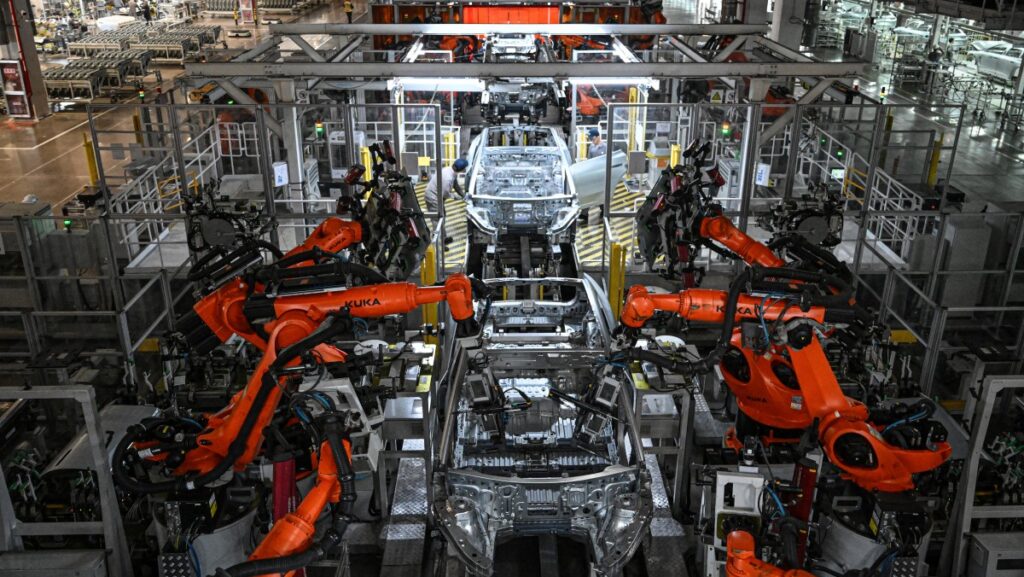
Employees work on an electric vehicle production line at a factory of Chinese automaker NIO in Hefei, in eastern China’s Anhui province on September 24, 2025.
Jade GAO / AFP
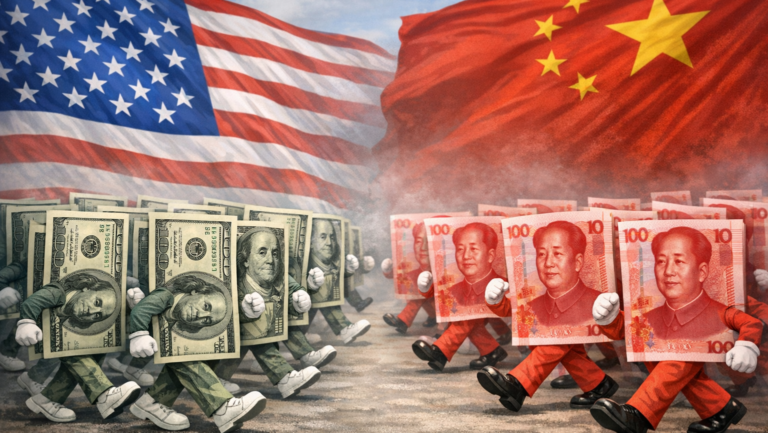
A debate is slowly unfolding in Germany on economic overreliance on China itself, as imports from China continue to increase and German exports to China continue to drop.
When it comes to security-sensitive investment, there should be little debate. Obviously, in those cases, restrictions could make sense. Yet, there seems to be little sense of urgency about this in Germany. For years, the U.S. has been pressuring the German government to exclude Chinese telecoms manufacturer Huawei from its 5G and 6G networks, but Germany keeps dragging its feet here, as it is only intending to impose gradual restrictions.
For years, security agencies have been warning of potential espionage or hidden shutdown devices, alongside warnings there could be sabotage of Germany’s digital infrastructure in case of a conflict. Huawei has consistently denied these allegations, but the concerns stem from a Chinese security law that came into force in 2017, which obliges all organizations and citizens to cooperate with “national intelligence efforts.” At least, however, Germany seems to be planning to get its act together here.
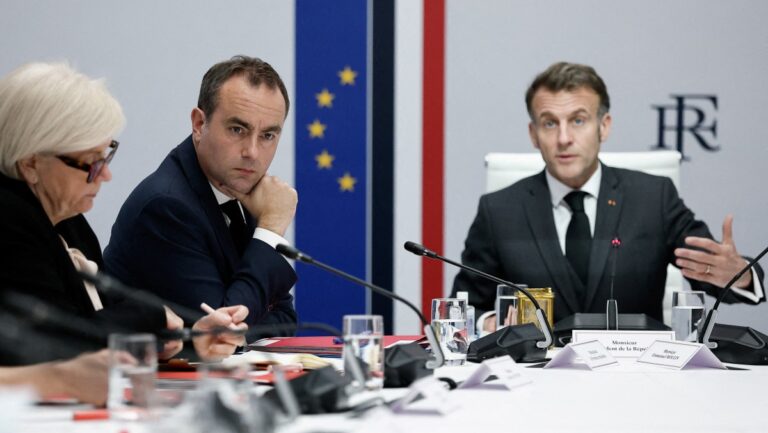
When it comes to economic ties to China, the solution is a lot less obvious. Protectionists like French President Emmanuel Macron are seizing their chance by urging Germany to agree to higher tariffs on China, but of course that would be economically illiterate. Over the last few decades, China’s rise in the world economy, which enabled the cost of manufactured goods in Western countries to drop, also helped to keep service-sector wages high in the West.
In other words, the problem is homegrown. One German businessperson confides to the South China Morning Post: “We could live with the competition from China if we were more competitive here.”
U.S. President Donald Trump’s new national security strategy may offer some inspiration for the German government on how to restore the country’s competitiveness. The strategy in particular singles out the country’s failed energy policies as central to the problem.
The facts speak for themselves. At the moment, industrial electricity prices in Germany are around three times higher than those in the U.S. and China. While the European natural gas price is about four to five times the price in the U.S., companies in Europe need to compete with Asia with a natural gas price that is 50% higher. This competitiveness handicap is largely self-inflicted. European policymakers could improve things today by scrapping or at least reducing the cost of the EU’s climate taxation scheme ETS. At the moment, the cost of this EU climate tax is about twice the total cost of the U.S. natural gas price. Despite the complaints from the chemical industry about this, no political action is taken, however.
As the German chemical industry is sounding the alarm bell, unfortunately, it looks like some in Germany are listening to the siren calls of protectionism. “Some German manufacturers think once-symbiotic partnership has turned into abusive relationship and they want out,” according to the Wall Street Journal. Clearly, going against the Climate Gods is still too much to ask, even in 2025.
Chancellor Merz is literally all over the place when it comes to the matter. When addressing Germany’s sharp drop in exports to China—the reason for the widening trade deficit with China—he even brought up the United States. Last month, he remarked on the issue that “we will discuss with industry how we can become less dependent not only on China, but also, for example, on the U.S. and the major tech companies.”
Equating the leading Western nation and one of the world’s strongest democracies, which has helped liberate Europe twice, with an authoritarian Asian dictatorship is not a good look for a German chancellor. Perhaps Europeans should not fear that Trump will break up the transatlantic alliance, but that its own, ever less popular leadership, will.
China’s population is shrinking—also a result of the morally evil one-child policies. In 75 years, its working-age population will be less than one-third of what it is today, according to projections. Also, China’s recent economic performance has been rather lackluster. Its booming exports are not necessarily a sign of good overall economic health. According to observers, these are the result of excess production, the result of all kinds of subsidies, including heavy subsidy competition between China’s provinces. Excess solar panels and electric vehicles are then dumped on global markets. Sure, this is disruptive, but it is unlikely to be a sustainable development.
It would be one thing to impose extra tariffs if European policies were not at the heart of European companies being unable to compete with the influx of Chinese goods. However, that is not the case. Both when it comes to cars and solar panels, EU policies have been propping up the Chinese influx by banning combustion engine cars and imposing that member states obtain a minimum share of their energy production from “renewable energy.” Thankfully, the EU has now just decided to lift the ban on the production of the kind of vehicles where it is superior—combustion engine vehicles. It should also water down climate policies imposing “unreliables.”
While opening up trade amongst free democracies is a no-brainer, the question of whether to impose extra trade restrictions on China, with its central planning and massive subsidies, is more tricky. Even in that relationship, however, it is a mistake to introduce more protectionism—at least before scrapping domestic policies that badly hurt competitiveness.
To deal with China, Europe should therefore start at home.