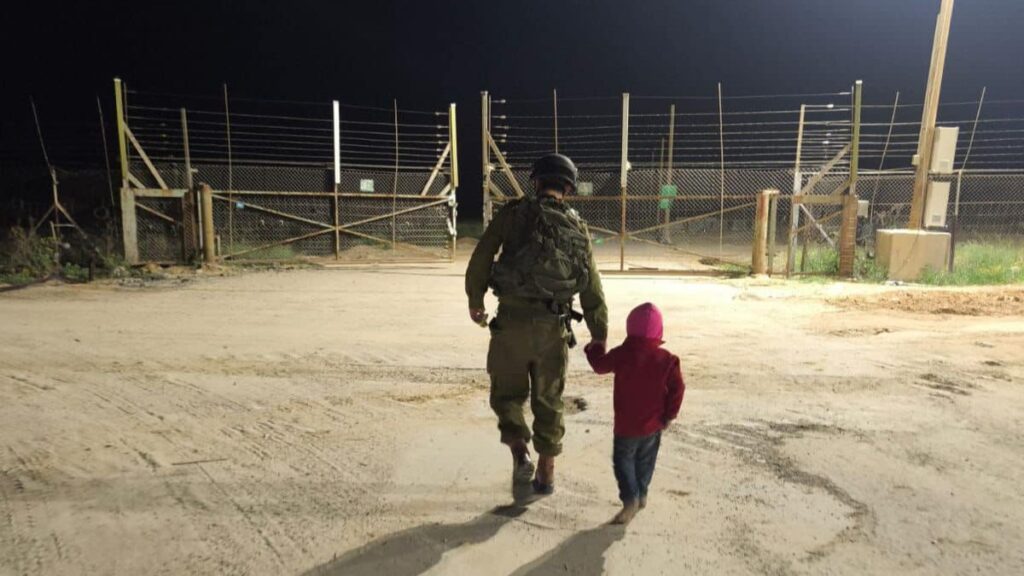
An IDF soldier escorts Palestinian child to safety.
Photo: Israel Defense Forces on Facebook, March 12, 2025
One year ago, while sitting in his back garden a few miles from the border with Gaza, I asked a Colonel in the Israel Defense Forces (IDF) how he thought the conflict with Hamas would end. He sighed and said, “the best we can hope for is forty years of peace.”
One year on in the war there is little sign that peace is about to break out. A new report, called ‘Hamas’s Human Shield Strategy in Gaza,’ by ex-British Army officer Andrew Fox, and Salo Aizenberg for the Henry Jackson Society (HJS), goes a long way to explain the intractability of the conflict. In particular it explains and documents over 60 pages exactly how Hamas uses Gazans as human shields and why this creates such a huge problem for Israel in trying to defeat Hamas and release its hostages.
This excellent report provides all the ammunition and evidence that you need to understand the lengths to which Israelis go to mitigate casualties. However, its conclusive appeal to the international community to learn from and mitigate the human shield strategy of Hamas unfortunately misses the main problem facing Israel: the dearth of international support for an Israeli victory in the war.
Hamas took over control of Gaza following Israel’s 2005 withdrawal. Hamas then built over 500 miles of tunnels to shelter their fighters and began years of rocket attacks on southern Israel. Gaza is one of the most densely populated areas on the planet. Hamas’s deliberate strategy of locating all of their military operations in civilian areas means that the civilian population is always at risk. Hamas’s deliberate strategy of hiding behind civilians creates even further jeopardy. This report goes into great detail about the ten ways Hamas uses Gazans as human shields, including dressing their fighters in civilian clothes, using hospitals and schools for storage of weapons, and locating their rocket launchers close to civilian homes.
The IDF has strict rules of engagement when attacking Hamas, which aim to minimize civilian casualties, and the ratio of civilian to military casualties in Gaza is very low when compared to other conflicts. But as even David Crane, a prosecutor at the International Criminal Court (ICC), has acknowledged
Israel is in an impossible situation. It appears Israel is trying to follow the Geneva Convention and the law of armed conflict but, because the battlefield is one of the most densely populated areas on earth, and because Hamas has a history of hiding behind civilians, protecting the Palestinian people will be complex and civilian lives will be lost.
The consequence, as the HJS report concludes is that,
This tactic is designed to force Israel into the dilemma of either attacking Hamas targets with the knowledge that civilians will often be killed, incurring significant international criticism and calls for Israel to halt its military actions, or allowing Hamas to achieve permanent immunity for fear of harming civilians.
It is not generally controversial outside of pro-Palestinian activist groups to say that Hamas uses Gazan civilians as human shields. Western leaders from Joe Biden downwards, even representatives of the European Union (EU) have condemned Hamas for doing so. But one place where you will not hear much criticism of Hamas is the UN. This is particularly significant as the UN, through the United Nations Works and Relief Agency for Palestine Refugees (UNRWA), whose employees are mainly Palestinians, is the main external agency delivering relief to Gazans. It is embedded in Gazan society, so much so that some of its employees have been dismissed after allegations they took part in the October 7th massacres. UNRWA employees would have firsthand knowledge of how the human shield strategy works on the ground. However, as the HJS report notes
Since 7 October 2023, the UN has issued 367 reports that are filed under the subject of “Gaza Strip …The phenomenon of “human shields” has only been mentioned four times, in each case in only a single sentence, as either an “allegation”, an Israeli “claim” or an unverified “report” that this practice occurred. The UN has never dedicated a single paragraph, let alone an entire report, to analysing how Hamas has fought the war in Gaza.
The HJS report concludes
the international community can take meaningful steps toward mitigating the devastating impact of future conflicts on civilian populations.
The brutal truth is that expecting Hamas not to use civilians as human shields is unrealistic. Likewise, expecting Israel not to fight Hamas because of that is also not realistic. The ample evidence that proves Hamas uses Gazans as human shields and that Israel does all it can to mitigate civilian casualties, and that Gaza is a uniquely difficult battleground, is not enough to stop condemnation and criticism of Israel’s war. The isolation of Israel weakens the IDF’s ability to win the war on the ground. It also acts as a pressure on Israeli society and encourages internal lack of cohesion. Yet a defeat for Israel would mean that Islamist terrorists had defeated a democratic country for the first time—a catastrophe for Western civilization.
The authors’ appeal to the international community is unlikely to succeed so long as there is a strong current of opinion that questions the right of Israel to defend itself when attacked. Over 120 of the 195 countries in the world today have come into existence since 1945, often amongst conflict and with massive casualties and displacement of populations as refugees (20 million alone during the partition of India). The question is, why out of all of these has Israel, born in 1948, been singled out for international condemnation? Of all the displaced people, why is it Palestinians are the only ones granted permanent refugee status by the UN? Why do hundreds of thousands of young Europeans feel the need to protest about Israel only? Answering those questions would bring us to a greater understanding of why the war in Gaza is so intractable, and why 40 years of peace seems a long way away.