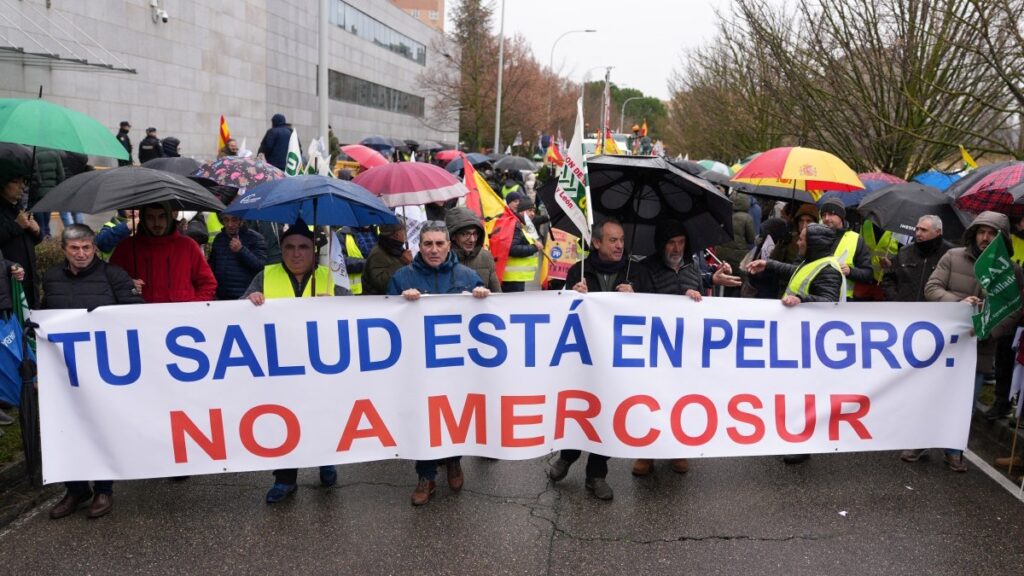
Protesters carry a banner reading: “Your health is in danger: No to Mercosur” during a farmers protest against the EU-Mercosur trade deal and the economic pressures facing the agricultural sector in Valladolid, on January 29, 2026.
ANDER GILLENEA / AFP
The trade agreement between the European Union and the Mercosur bloc—Argentina, Brazil, Paraguay, and Uruguay—is officially presented as a strategic step to strengthen the EU’s international trade and diversify its economic partners. However, a closer examination of its content reveals a set of structural economic risks that directly affect European agriculture, employment, regulatory coherence, and the continent’s overall economic resilience.
Academic studies, think tank analyses, and sectoral reports converge on the same warning: the benefits of the agreement are limited and highly concentrated, while the costs are broad, long-lasting, and unevenly distributed across regions.
One of the most controversial elements of the agreement is the preferential access granted to Mercosur agricultural products. According to the European Commission itself, 92% of the bloc’s exports will be able to enter the European market tariff-free within ten years. For sensitive products, specific quotas have been established, such as an additional annual quota of 99,000 tons of beef subject to reduced tariffs.
For European farmers, the problem is not only the volume of imports but the conditions of competition. Agricultural production in the EU is subject to some of the strictest standards in the world in terms of food safety, animal welfare, pesticide use, and environmental protection. These requirements significantly increase production costs. In Mercosur countries, standards are less stringent, allowing for lower prices. Although Brussels insists that sanitary controls at the border will be maintained, the economic conditions of competition are clearly not equivalent.
A study prepared for the Greens/EFA group in the European Parliament concludes that this asymmetry creates a clear distortion of competition, posing significant risks for European producers, while the benefits in terms of EU agricultural exports would remain limited. The most likely outcome is the loss of farms, jobs, and agricultural income, particularly in regions that are already vulnerable.
The agricultural impact has a direct social dimension. Analysts warn of a weakening of the rural socio-economic fabric. Fewer farms mean not only less direct employment, but also reduced activity in related sectors such as food processing, transport, services, and local commerce.
This effect is not confined to a single country. Sectors including beef, poultry, sugar, rice, honey, and maize in countries such as France, Italy, Ireland, Poland, and Greece have expressed concern about falling prices and farm closures in a context already marked by high energy costs and mounting regulatory pressure.
Beyond agriculture, the agreement raises a broader issue of internal economic coherence. Maintaining strict rules within the EU while facilitating imports of goods produced under more lenient standards creates a strong incentive for relocation of production outside Europe.
The benefits of the agreement are likely to be concentrated in a limited number of large exporting companies, particularly in competitive industrial sectors. By contrast, the costs—business closures, job losses, and reduced regional economic activity—are widely spread and fall disproportionately on SMEs and local economies. This pattern, well-documented in other trade agreements, fuels territorial imbalances and social disaffection with European trade policy.
Another indirect but significant economic effect is the erosion of public support for European regulation. When rules make production more expensive within the EU but are not applied in an equivalent way to imports, those who comply feel penalised. This perception of unfairness undermines the legitimacy of regulatory policies, making them harder to sustain over time.
The debate over so-called mirror clauses—requiring imports to comply with equivalent standards on pesticides, animal welfare, or environmental protection—reflects precisely this fear of competition perceived as structurally unfair.
From an environmental perspective, several reports have warned that the agreement lacks strong, legally binding, and enforceable mechanisms for climate and forest protection. Organisations such as the Veblen Institute estimate that increased trade in beef and soy could be linked to up to 700,000 additional hectares of deforestation, even in an initial phase.
The economic implications are significant. In the future, the EU could face adjustment costs, political conflicts, and legal contradictions with its own climate legislation, such as the European Anti-Deforestation Regulation (EUDR), regulating so-called imported deforestation. Moreover, emissions are not reduced but relocated, further undermining the credibility of the so-called Green Deal.
At the macroeconomic level, even supporters of the agreement acknowledge that its positive impact on EU GDP will be limited—only a few tenths of a percentage point by 2030, and distributed very unevenly among Member States. For consumers, price reductions will be marginal. By contrast, dependence on external suppliers will increase, heightening vulnerability to geopolitical crises, supply chain disruptions, and price volatility.
The EU–Mercosur agreement does not pose a choice between trade and protectionism, but between intelligent design and structural imbalance. The available evidence suggests that economic risks fall disproportionately on agriculture, rural employment, and Europe’s regulatory coherence, while the benefits remain limited and concentrated. In this context, the key question is not whether Europe should trade, but under what conditions—and at the expense of which strategic sectors.