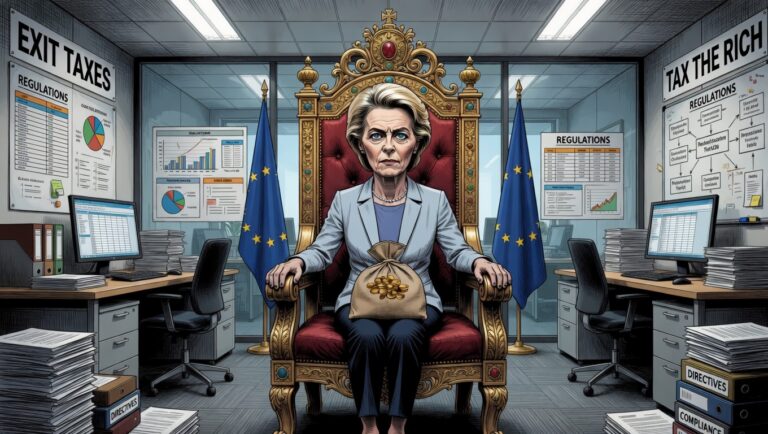
On November 25th, the Hungarian publication Index published a sensational article revealing what they claim is an authentic copy of the opposition party Tisza’s economic plan for Hungary. The plan is radical, to say the least, with a clear ideological profile. If it were put to work as a guideline for changes to taxes and government spending, it would set in motion a painful rollback of what Fidesz has done for Hungary, and especially for the country’s economy.
In a nutshell: if put to work, the Tisza plan would degrade Hungary from its top-of-Europe position in GDP expansion, prosperity growth, and capital formation to a nation in deep economic peril.
Before we proceed, though, a disclaimer is needed. At the end of their article, Index adds a denial from Tisza: according to communications that the publication has received from the opposition party, the economic plan is not a Tisza product; the article is a lie, according to them.
For two reasons, I have decided to write an analysis of the economic plan anyway. First, Index adamantly claims that the document is genuine; if it were not, they would presumably be in deep legal trouble. While I cannot speak for their editorial team, it stands to reason that they would have enough self-preservation to not publish lies, especially if those lies would have such monumental consequences as in this case.
Secondly, the alleged Tisza report has all the characteristics of being a Christmas wish list for a left-wing European political party. There are curious details in it that would be hard to forge, details that originate in left-of-center ideological training and that align well with the tax-and-spending policies you can see in other European countries where the Left has an established influence over fiscal policy.
With this two-pronged disclaimer in place, let us take a closer look at three parts of the alleged Tisza report, parts that—when put together—are bound to send the Hungarian economy into a deep recession.
The three parts are a higher income tax, a higher value-added tax, and a new property tax. These increases in the tax burden—which are only a few of the pieces in the alleged Tisza report—are all motivated by an explicit ideological preference: economic redistribution.
The Index article picks up on this preference and makes a strong point of it, for good reasons: over the past 15 years, Fidesz has transformed Hungary in general and the country’s welfare state in particular. Originally, Hungary shared the same type of welfare state that almost all other European countries have: a traditional Scandinavian model that is designed for economic redistribution.
By contrast, the welfare state Fidesz has built over the past 15 years is centered around a conservative purpose: to promote strong families and the future of the nation itself.
Where the redistributive welfare state is designed to reduce differences between citizens in terms of income, consumption, and wealth, the conservative welfare state is designed to facilitate the formation, growth, and resilience of families—no matter their economic status. With the alleged Tisza report, Hungarian voters are now faced with two very different, highly distinctive choices in the elections in April:
This contrast is by no means limited to theory. It is a matter of what economic reality Hungarian families will find themselves in after the election in April.
This is where the three tax increases in the alleged Tisza report come into the picture. First, there is the idea of a higher income tax, about which Index has the following to say:
[With] the introduction of progressive personal income tax, the state would reach deeper into the pockets of practically every average earner. The draft would introduce two new rates: those earning over HUF416,000 [€1,093] gross would pay a 22 percent tax—in September, the average gross income of full-time employees was HUF687,100 [€1,805], so this measure would affect an average, but even those living on the median gross income (HUF568,700 [€1,494]). For those earning over HUF1.25 million, €3,284, the tax rate jumps to 33 percent.
These are steep increases from the current 15% income-tax rate. If put to work, they would withdraw major amounts of money from Hungarian households, especially those who have been more successful in terms of career building and entrepreneurship. However, those who design this type of income tax system rarely care about the dynamic economic consequences: to them, what matters is that the tax reduces the rewards for hard work and investments in careers, education, and businesses. All that matters is that the economic differences between ‘rich’ and ‘poor’ are reduced.
If this multi-bracket personal income tax was the only tax idea, the consequences of putting the plan to work would be bad, but not catastrophic. Unfortunately, the alleged Tisza report appears to be designed to elevate the situation to a catastrophe. The second tax hike, a drastic increase in the VAT, will make sure that no household, not even those who have a very low income, escapes unscathed.
The standard Hungarian VAT rate is supposed to go up from 27% to 32%. Although Hungary has two lower, selective rates of 5% and 18%, the 27% nevertheless puts the country at the VAT top within the EU. Therefore, any increase in the tax, especially by five percentage points, would be a hard blow to Hungarian households.
The irony with the VAT tax increase is that it is regressive in nature, as opposed to the income tax increase, which is progressive. Unlike a progressive tax hike, which increases the tax burden with a person’s higher income, the regressive tax hike puts the brunt of the burden on lower-income families.
It is a well-established statistical fact that families with the lowest paychecks typically spend a lot more of every forint they make compared to families with high incomes. This means that low-income families have to pay a larger share of their income in VAT increases than high-income families have to do.
One tax hike neutralizes the ideological effect of the other. Under the alleged Tisza report’s tax policy, everyone wakes up to a higher cost of living.
But wait—the Index article mentions a third tax proposal:
The most surprising and controversial element of Tisza’s reform package would be the introduction of a special 6.5 percent annual tax on assets—not only on luxury properties, but also on cars and various larger-value movables. The tax authority would carry out a full asset assessment covering all real estate and larger movables.
The threshold for this tax would be HUF500 million, or €1.3 million. Despite being referred to as a ‘wealth tax,’ it has all the characteristics of a traditional property tax. A wealth tax would explicitly tax net asset values, i.e., the difference between market value and the debt that the taxpayer owes with the property as collateral. A property tax does not account for debt.
The alleged Tisza proposal would impose this new property tax on all kinds of assets, from real estate and jewelry to cars with an engine larger than 1.6 liters (no mention of EVs) and business ownership.
Admittedly, the threshold for the property tax is high enough that it is unlikely to hit middle-class families, but that is of little consolation for any Hungarian. Since the tax includes “business shares,” it will be a major problem for owners of small businesses. This particular group of entrepreneurs often chose to be modest about the income they take out of their businesses, primarily to make sure they have liquidity in their businesses to pay employees, fund investments, and seize upon new opportunities as they surface.
Due to modest income withdrawals from their businesses, their personal income is not hit as hard by the new income-tax brackets as was perhaps intended. But by taxing business shares, the alleged Tisza report will force them to take more money out of their businesses just to pay taxes. This situation is made more precarious by the fact that when business owners leave more money in their businesses, they unintentionally increase the tax value of those businesses.
In short, by being prudent, long-term-oriented entrepreneurs, they make their businesses vulnerable to this new tax. Thereby they have to drain their businesses for money without getting anything back on the drainage. As a result, small businesses all around Hungary will be weakened: they will scale back investments and employment, with both decisions having negative multiplier effects on the Hungarian economy.
Let us also keep in mind that taxes are not set in stone. Once created, they have a tendency to grow their tax base. If Hungarians were to vote in such a way that this tax became a reality, it is a safe bet that its threshold will quickly creep downward to apply to smaller asset values.
Going through all the problems with the tax plan in the alleged Tisza report is a painful experience; if the report limited itself to the three tax hikes mentioned here, it would be bad enough for Hungary. But the report has a lot more to ‘offer,’ which makes it a valuable read for anyone interested in just how consequential the Hungarian April elections will be for the country.