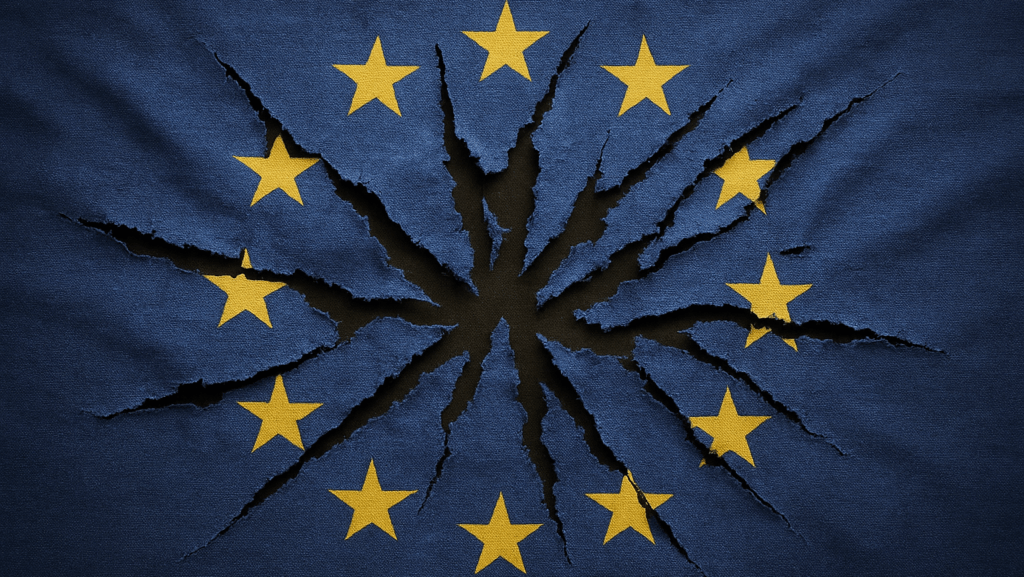
When Elon Musk speaks, the world listens. His latest jab at what he sees as an increasingly totalitarian European Union called for an end to the super-state structure itself.
Dissolve the EU and return power to the people https://t.co/SwT51KvwWB
— Elon Musk (@elonmusk) December 8, 2025
This simple statement sent a tsunami of reactions through the mediaverse. Interestingly, the stories that emerged missed Musk’s main point, namely that he wanted the world’s largest superstate bureaucracy dissolved. Instead, they portrayed his comment on the EU’s dissolution as a childish reaction to the fines that the EU imposed on X. From CNBC:
Elon Musk has called for the European Union to be abolished after the bloc fined his social media company X 120 million euros ($140 million) for a “deceptive” blue checkmark and lack of transparency of its advertising repository.
Here is the EuroWeekly:
Elon Musk is making headlines in Europe again—and not for the reasons Brussels would like. Just days after the European Union slapped his social network X (formerly Twitter) with a €120 million fine under the Digital Services Act (DSA), the billionaire boss of SpaceX and Tesla went on the offensive, calling for nothing less than the abolition of the EU itself.
The New York Post:
Elon Musk is calling for the European Union to be abolished after it fined his social media platform X about $140 million for breaching online safety laws, a step he rejected as “bulls**t.”
Financial news site SeekingAlpha:
The European Commission on Thursday said X had breached its transparency obligations under the Digital Services Act (DSA), including deceiving users with the use of its ‘blue checkmark,’ … “The EU should be abolished and sovereignty returned to individual countries, so that governments can better represent their people,” Musk said on Saturday on his X account.
As Elon Musk’s original posting on X reveals, his comment about the EU was not at all in response to the fine against X. The remark was in reaction to another X user’s criticism of the EU’s fines against Hungary for not accepting enough non-EU migrants.
In other words, what Musk was really targeting was not the fallout from the EU’s application of its Digital Services Act. His comment was related to the well-established and highly problematic practice by the Brussels Eurocracy to quell opposition from member states on assorted policy issues.
This overreach by the EU has gotten a lot more attention recently, but it is not new. Just to take one example: the Greek people know it painfully well, as they are still living with the consequences of the EU’s fiscal assault on their country 15 years ago. To this day, the threat of similarly harsh enforcement of the EU’s stability and growth pact still hangs as a dark cloud over debt-ridden member states.
Enforcement of fiscal rules is just one way that the EU exercises undue economic power over its member states. The increased weaponization of EU funds to states and the sprawling ambitions of Brussels to levy its own taxes are two other examples.
Taken together with Musk’s plain and simple suggestion, these instances of EU power grabs raise the question: what would the European economy look like if the European Union were dissolved?
As revolutionary as this question may be, it is actually relevant when one considers the vision from which the EU was born. When plans were drawn up in the 1980s for the EU to replace the European Communities, the vision was one of four freedoms that would open the entirety of Europe as one big free-market economy. There would be freedom for labor, capital, goods, and services to move freely across national borders.
Today, the EU is nothing like this. Already with the Maastricht Treaty in 1992, the EU began taking a shape that was leaps and bounds more intrusive—especially economically—than its original four-freedoms idea would have permitted. Perhaps the most egregious breach of the original four-freedoms idea was the Stability and Growth Pact (SGP). It gained constitutional status in the Treaty and gave the EU fiscal powers that had no rationale in either the idea of making Europe a better economy or the economic research inspired by the plans for the EU.
If the EU ceased to exist tomorrow, many good things would happen to the European economy. To begin with, there would no longer be the threat of an overlord-style intervention by a superstate structure into the fiscal affairs of individual countries. While budget deficits are not good, especially when they turn structural, an individual member state’s path to fiscal balance cannot be dictated by a rigid fiscal bureaucracy in Brussels. Its only recipe for such interventions is to demand simplistic austerity policies that fix the budget deficit today but cause even bigger ones tomorrow.
The fiscal liberation of member states from the EU means that each one of them can adjust its taxes and government spending to its own macroeconomic and political reality. This brings a whole new, positive dynamic to each member state, especially those that have problems keeping a governing coalition together in the face of fiscal challenges (Belgium, France, Germany, Netherlands, Sweden).
Although the EU has more recently tried to accommodate individual member state circumstances in its enforcement of the SGP, the only practical meaning of this is that Brussels delays its otherwise strict enforcement of the pact’s budget rules. As the political turbulence around the continent shows, this has made no material difference; the threat of an EU intervention remains very much real. Only a formal abolition of the EU would remove the threat of austerity interventions.
The cessation of the EU would also end the slowly growing burden of EU-specific taxation. Member states would get to keep all of their tax revenue for themselves; no more membership fees means a big improvement to some countries and a small improvement to others, but it is an improvement all the same.
But what about the EU funds coming into member states? Those would obviously also go away, but the impact on member states would not be as significant as one might expect, given how the EU portrays itself as a member state benefactor. Table 1 reports the net balance between the contributions to the EU and the funds received from the EU for each of the 27 member states:
The second column reports the net gain or net loss as a percent of total government revenue in the respective member state.
Table 1
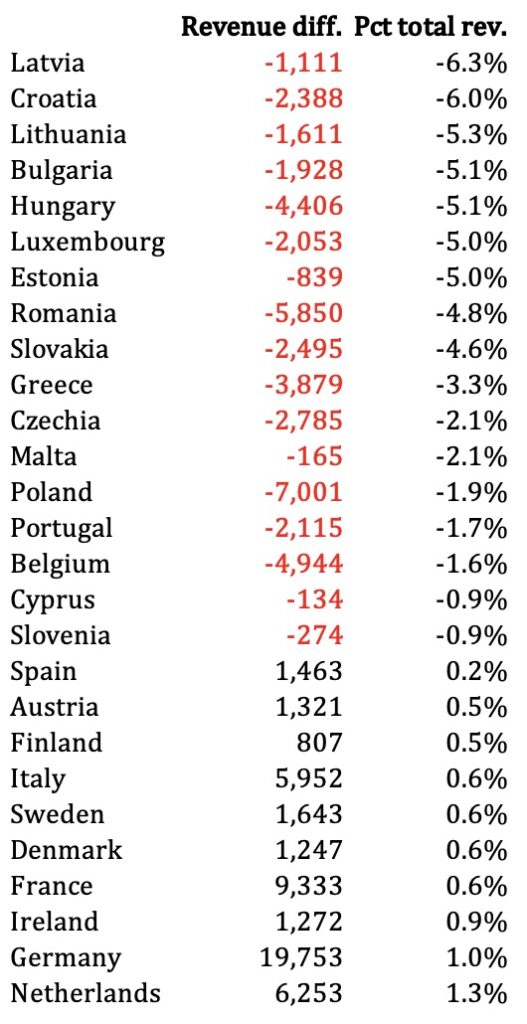
The countries that stand to lose the most from an EU dissolution would face a not-insignificant fiscal adjustment. However, when split in half between spending and revenue, the worst cases, Latvia and Croatia, come down to 3-3.2% compensated on each side of the budget. Given that neither country would have to put up with the EU’s fiscal requirements, and given their general liberation from EU rules and regulations that stifle free enterprise, free trade, and free markets, the termination of EU funds and mandatory contributions would only represent a marginal fiscal problem, even for the top ten states on the list in Table 1.
All in all, if the EU were to dissolve itself tomorrow, from the viewpoint of public finances the member states would be notably better off. Their regained ability to make policies without having to look over their shoulder at Brussels would greatly contribute to renewed economic dynamism. That, in turn, would generate more growth, reduce fiscal imbalances, and strengthen the individual economies—especially for those who currently depend the most on the EU.
There is, however, one big elephant in the room that we have not yet mentioned: the euro. Would it, or would it not, survive an EU dissolution? The answer to that question is by no means given, but the issue is too complicated to be summarily treated. It requires a dive into the academic literature on such matters as ‘optimal currency area’ and central bank theory.
With that said, the analysis presented here is valid regardless of whether or not the euro would survive the end of the EU. The question is what additional economic consequences—good and bad—member states could expect if the euro were also dissolved and they all returned to their erstwhile national currencies.