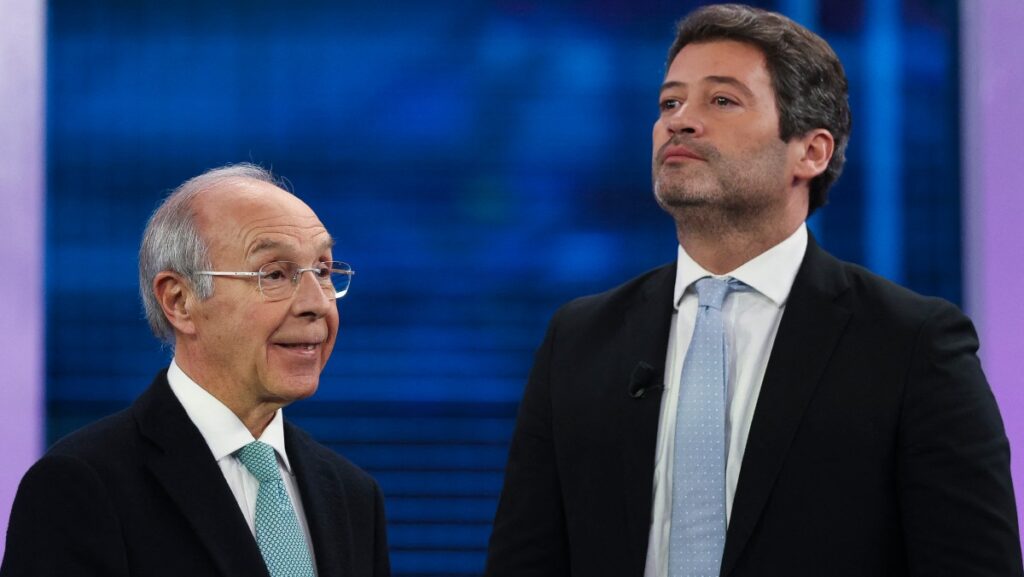
PP candidate Luís Marques Mendes (L) and Chega candidate Andre Ventura are pictured before a TV debate with the rest of presidential candidates ahead of the January 18 election, in Lisbon on January 6, 2026.
PATRICIA DE MELO MOREIRA / AFP
Something extraordinary is happening in Portuguese politics. Not just remarkable, indeed—historically unprecedented. This coming January 18th, Portugal will hold the first round of a unique presidential election. For the first time since the foundation of the country’s current, left-wing-dominated regime, the idea of both candidates qualifying for the second round being right-wingers seems, at the very least, to be highly likely. It isn’t just that this has never happened before. It hasn’t. It’s what this reveals about the national conversation and just how completely the Left has now come to lose control of the narrative.
Like most of the West today, Portugal is undergoing a veritable political revolution. For five decades, the Iberian nation’s culture and institutions have been under the undisputed control of the Left. Unlike neighbouring Spain, where democracy came not through revolution but as a voluntary concession of the Francoist government, Portugal’s own experience was traumatic. Whereas in Spain the Right, having taken control of the state by force of arms, then magnanimously allowed the Left to return from the cold and back into the institutions, in Portugal, ‘democracy’ came as a result of the annihilation of the Right—narratively and sociologically. Having purged anything and anyone remotely ‘right-wing,’ the Left then imposed its worldview and political grammar on a despondent country.
Indeed, Portugal’s post-1974 Third Republic was defined by an artificial, boring, and solidly left-leaning equilibrium. The hegemonic Left, culturally progressive and economically clientelist, alternated power with a timid, technocratic centre-right whose primary ambition was to administer the same consensus with marginally better accounting. Presidential elections reflected this depressing stasis: grey, uninspiring, reassuring figures, designed to offend no one and to change nothing. In theory, the presidency acted as a moderating power. In reality, instead, it remained a ceremonial extension of the regime’s intellectual inertia and utter absence of ambition.
That era is now in the past, over and done with. Thank God for that. The rise of André Ventura—and of Chega—got the wheel moving again. One of the leading candidates ahead of Sunday, Ventura doesn’t just represent a party or a programme but a rupture in discourse, a rejection of taboos, and, above all, the return of politics as a conflict of ideas rather than consensus management. His presence alone has shifted the axis of debate to the point that even his fiercest opponents now speak in a language he helped impose. On immigration, Ventura now speaks for the people—other political actors have no choice but to offer their own imitation of Ventura, however crude or untrustworthy.
With André Ventura’s nationalist, anti-immigration platform poised to make it to the second round, the greatest proof of his success is how hegemonic the Right now appears to be. Other than the Socialist António José Seguro, no other left-of-centre candidate is polling over 2%. Instead, the field is dominated entirely by more or less coherent—and serious—right-wingers. These include former Navy Admiral and chief of Portugal’s COVID-19 vaccination programme Henrique Gouveia e Melo, market-liberal João Cotrim de Figueiredo, and Prime Minister Luís Montenegro’s own candidate, Luís Marques Mendes.
While only Ventura openly presents himself as a candidate of the Right, all these other contenders for the presidency are disputing the same political camp. Gouveia e Melo, who appears to be by instinct a man of the centre-right and who earned the respect of significant numbers of conservatives by appealing to his military credentials, foolishly tried to distance himself from this image during the campaign in the hope of seducing left-wing voters. This was a profoundly unintelligent move and will stand as a testament to his political inexperience. Had the admiral stuck to his guns and presented himself as a conservative, he would have captured the imagination of a Portuguese Right that has always admired the charisma of the uniform. Portugal has a strong tradition of right-wing caudilhismo; the almost monarchical image of a political soldier has been part of its imagination since the days of Sidónio Pais, the Army officer who, in 1918, attempted to overthrow the revolutionary republic and replace it with a conservative authoritarian state. Gouveia e Melo’s political illiteracy has almost assuredly cost him his lofty ambitions.
The liberal Cotrim de Figueiredo was one of the campaign’s surprises. Articulate, clever, with a solid private sector career, Cotrim galvanised the young upper-middle classes by promising them lower taxes and a smaller state. But, the youthful dynamism of his campaign notwithstanding, everything about Cotrim is hopelessly passé. His worldview is substantively obsolete. The liberal candidate speaks of globalisation and free markets at a time of geopolitical competition and protectionism; he promises low taxes when demographic crises and the imperatives of military defence make large government spending inevitable; he proposes individual liberties at a time the pendulum has shifted to individual—and collective—responsibilities. Like a distant star, the image he projects today is not the present, but the past. Neither he personally nor his platform has anything relevant to give Portugal.
Ultimately, in a competition between branches of the Right, the only offer that seems aligned with the spirit and the needs of the moment is Ventura’s. Gouveia e Melo, the conservative-looking, left-sounding Navy officer, seems like a candidate of the 1980s. Marques Mendes, whose electoral implosion will leave a decidedly bitter taste in Prime Minister Montenegro’s mouth, is a man of the 1990s. Cotrim’s Macronist mix of social and economic liberalism would have worked well in the 2010s. But that isn’t where Portugal, Europe, or the West is today. This is no time for anodyne, shape-shifting politicos; it certainly isn’t the right time for rooftop, cryptobro liberalism. In 2026, identity and sovereignty are what actually matter. There’s only one candidate saying those words in Portugal—and that’s Ventura.