Former U.S. President Joe Biden (R) and Britain’s then-Prime Minister Boris Johnson shake hands ahead of a meeting of The North Atlantic Council during the NATO summit at the Ifema congress centre in Madrid, on June 30, 2022.
JONATHAN ERNST / POOL / AFP
Previous articles:
In the first months of 2022, as Russian troops entered the Donbas and diplomatic channels still lingered, a group of Boris Johnson’s advisers in Downing Street drafted what they called “lobby lines”: the official talking points that would define the British position on the war. The documents, dated between March and September 2022, show a clear pattern: any possibility of negotiation with Moscow had to disappear from public discourse.
One of those internal texts analyzed by europeanconservative.com, dated September 21, 2022, instructs spokespeople to declare that “Ukrainian gains against the Russian invasion continue to be inspiring,” and that “reports of mass graves in liberated areas such as Izium are appalling—proof of Russian barbarism.” No mention of negotiations or mediation. Only victory.
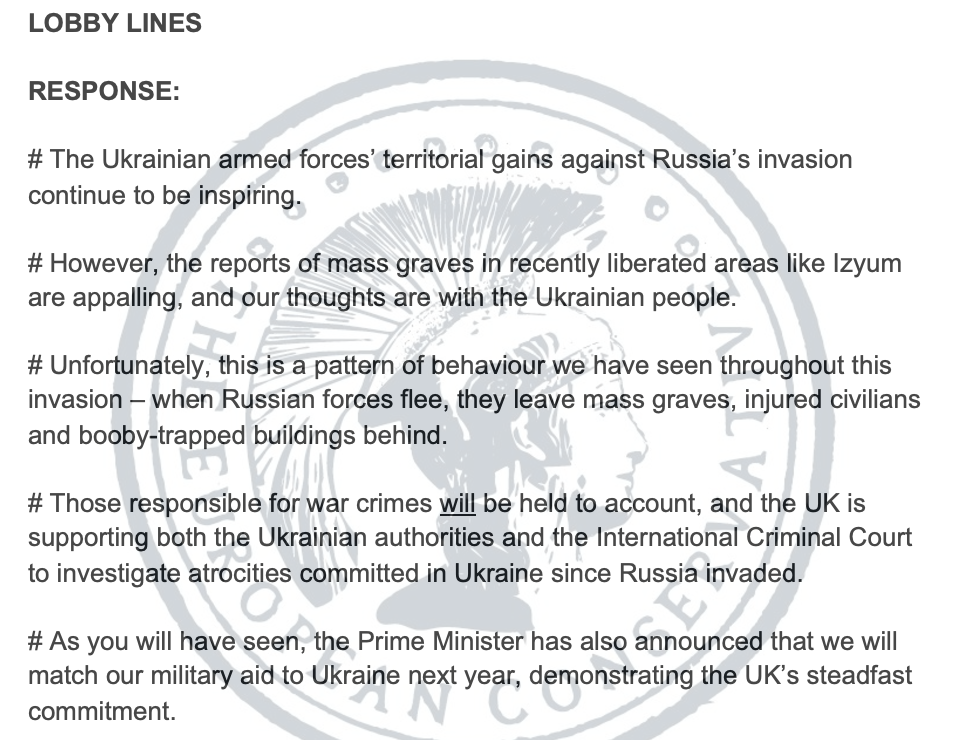
The tone was deliberate. In a parallel briefing for British embassies and international media that same day, acknowledged by europeanconservative.com, precise figures were set out:
This year we have delivered £2.3 billion in military support to Ukraine … We are training 10,000 Ukrainian soldiers every 120 days, and eight countries have already joined our program. … We have sanctioned more than 1,000 individuals and 100 entities, freezing assets worth £275 billion.
Rhetoric became doctrine. Every Russian withdrawal had to be interpreted as a crime; every sanction as an act of justice. The moral war had begun, and its script was written in London.
With the same discipline with which he imposed the wartime narrative, Johnson later turned his prominence into an economic asset. On 14 March 2023, a private contract with Associated Newspapers Limited, signed by editor Alex Bannister, set the terms of his collaboration with the Daily Mail:
During the twelve months you will provide 46 columns for publication … Your remuneration will be £500,000 per year plus VAT
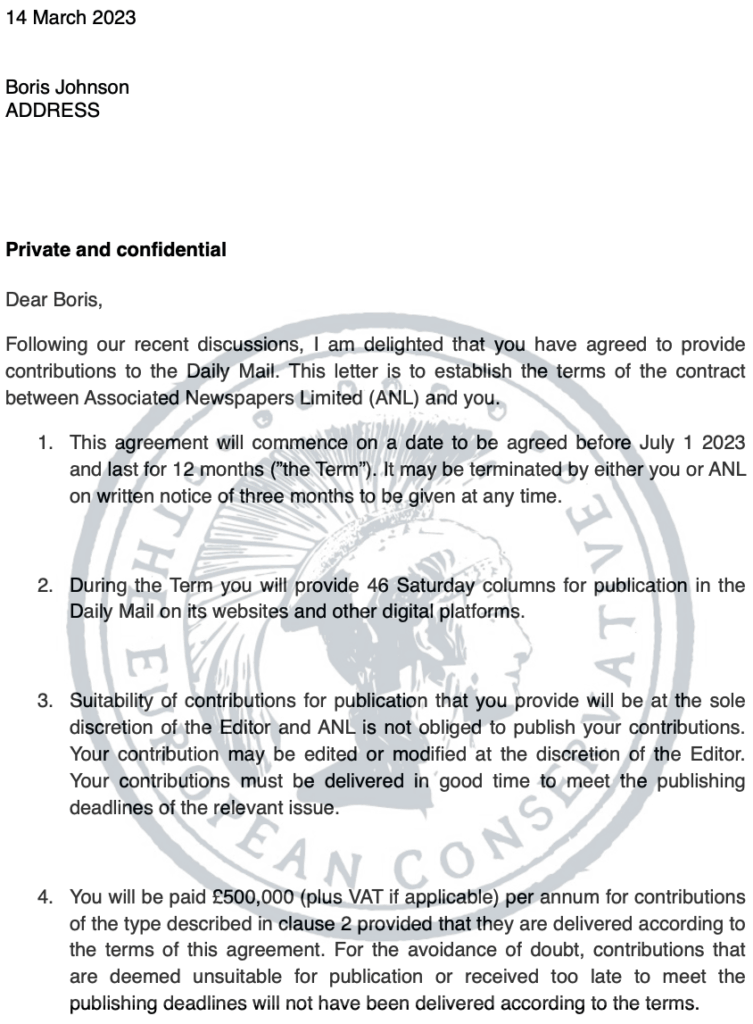
The exclusive document, marked “Private and confidential,” stipulated that Johnson must “refrain from any conduct that damages the reputation of the newspaper” and use his social media to promote his columns. In return, he was free to write on international politics. Since then, every Saturday, he repeated the same ideas he had promoted from Downing Street: “Putin must fail,” “The West cannot yield,” “Ukraine fights for all of us.”
Between 2023 and 2024, his annual income as a columnist and speaker exceeded £1 million, according to his parliamentary declaration before leaving the House of Commons. The discourse that had cemented Western unity in wartime was now a lucrative personal brand.
While Johnson defended the idea of “total victory” from London and Washington, Brussels began to institutionalize it. In June 2022, the European Union granted Ukraine candidate status—a decision taken in the midst of war. Two years later, the Bruegel Institute, a leading European economic think tank, published a report titled ‘Ukraine’s Path to European Union Membership and Its Long-Term Implications’ (March 2024).
The study estimated that Ukraine’s accession would cost 0.13% of the EU’s annual GDP, about €19 billion per year, a figure deemed “manageable” in exchange for “strengthening the eastern border and increasing the continent’s energy security.” The report also stressed that Ukraine’s integration “will coincide with its postwar reconstruction,” giving Brussels a central role in the country’s “institutional rebuilding.”
Thus, London’s message—“there will be no peace without victory”—ended up permeating the European strategy: more sanctions, more weapons, and an institutional expansion that is reshaping the continent.
The documents reviewed for this investigation show how the British government treated language with the same precision as military operations. In more than a dozen internal papers, words like “negotiation” or “diplomacy” do not appear even once. Instead, the terms “victory,” “failure,” “accountability,” and “justice” recur obsessively.
Downing Street itself instructed in September 2022 that spokespeople must “maintain an inspiring and firm tone” and avoid “comparisons with opposition positions or more cautious European partners.” Everything had to serve one goal: to shield the narrative of victory as synonymous with peace.
Three years later, the consequences of that narrative engineering are evident. Ukraine is moving toward European integration under Brussels’ supervision (not without major internal friction and against some of its own rules); NATO is expanding eastward, heightening tension with Russia; and European diplomacy has adopted a moral-war vocabulary that echoes, word for word, the talking points of Downing Street.
The Bruegel report warns that enlargement could alter the EU’s internal balance while at the same time consolidating a bloc “more dependent on Anglo-Saxon defense and energy.” Is this really the end goal—to subject nearly thirty nations to the strategic will of a post-Brexit United Kingdom?
Johnson, now the emblem of that current, presents himself as a “visionary statesman.” Yet the documents reviewed suggest another reading: that of a politician who managed to turn an international crisis into a profitable, enduring narrative—one in which morality and strategy merged until they became indistinguishable.
From his London office, the former prime minister continues to repeat the slogan he wrote three years ago: “The only way to end this war is for Ukraine to win—and to win fast.” What began as a communication line is now continental doctrine—against Europe’s own interests.