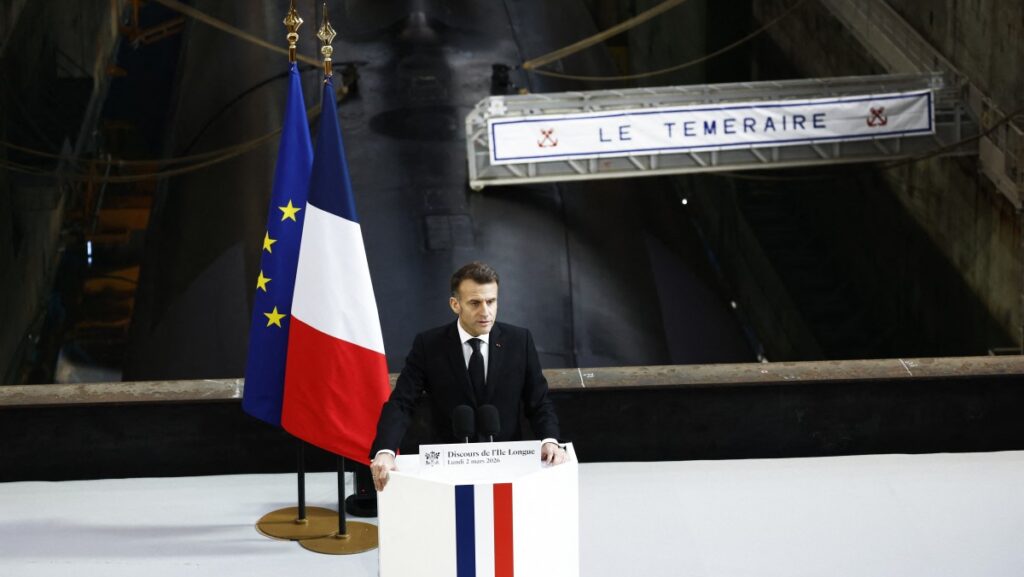
France’s President Emmanuel Macron delivers a speech next to nuclear-powered ballistic missile submarine (SSBN) submarine Le Temeraire-S617 during his visit to the Nuclear Submarine Navy Base of L’Île-Longue in Crozon, north-western France on March 2, 2026.
YOAN VALAT / POOL / AFP
During a visit to the naval base where France’s submarine fleet responsible for nuclear deterrence is stationed on Monday, March 2nd, President Macron announced his intention to engage other European states in military exercises involving the deployment of this weapon, which is the foundation of French military sovereignty.
This intervention was planned and known even before the start of hostilities in Iran. In recent months, Macron has made several announcements about the possibility of sharing French nuclear deterrence with European partners, according to terms that remained to be defined.
At L’Île-Longue, near Brest, Macron announced his intention to increase the number of French nuclear warheads—the current French nuclear force being estimated at around 300. He described this development as the establishment of an “advanced deterrence.” He then explained that he wanted to involve other European states in France’s nuclear deterrent. According to the head of state, eight states are interested: Germany, of course, but also Belgium, Denmark, Greece, the Netherlands, Poland, Sweden, and the United Kingdom.
The military collaboration envisaged by France goes beyond the framework of the European Union, as a long-range missile project led by Paris, London, and Berlin has also been announced as part of the ELSA (European Long Range Strike Approach) initiative launched in 2024, which also includes Italy, Poland, and Sweden.
At the forefront of the partners is Germany, with the establishment of a “high-level nuclear steering group” at the bilateral level announced in a joint communiqué signed by Macron and Chancellor Merz. Polish Prime Minister Donald Tusk also publicly confirmed that he is working alongside France on the “advanced deterrence” project proposed by France. “We are arming ourselves with our friends so that our enemies do not dare to attack us,” Donald Tusk said on X shortly after Macron’s speech.
Such sharing raises major strategic questions.
France is the only country in Europe to have invested considerable sums in nuclear deterrence for decades—an effort that other European states have been unable or unwilling to make. How will the countries associated with this “advanced nuclear deterrence” bear their share of the research and development, manufacturing and maintenance costs that France has been bearing alone for so many years and from which they would now reap the benefits without having contributed?
In addition, there is a significant operational problem. In practical terms, sharing nuclear strike capabilities only makes sense for airborne weapons, not for submarine forces. However, French nuclear bombs can only be mounted on Rafales, French aircraft. “Sharing” would therefore be limited to a flight by French aircraft carrying out the strike in formation with foreign aircraft—a ‘collective’ display that would be loudly touted politically but which would in fact be essentially symbolic cooperation.
Finally, sharing nuclear strike capabilities amounts to devising a shared doctrine of military sovereignty on bases that are obscure, to say the least. According to the French head of state, the only restriction would be “the absence of sharing the final decision.” But in practice, how would the sharing of responsibilities work in the event of a retaliatory strike? If France, for example, were to use nuclear force alongside Germany in the defence of Poland, would it be the only one to bear the brunt of enemy strikes in response, given that the bomb would be French and the aircraft would also be French? These are all questions that Macron has been careful not to answer.
Rassemblement National (RN), the leading opposition party, has expressed serious concern about these new developments, which have not been discussed in parliament. The RN has said it is prepared to initiate impeachment proceedings against the head of state if Macron were to recklessly sell off the country’s sovereignty in this way.
The latest events in the Middle East give a different meaning to Emmanuel Macron’s statement. As part of operations against Iran, a French naval base in Abu Dhabi was the target of an Iranian retaliatory drone strike. The attack caused a fire but no injuries, and the French army has so far refrained from commenting. Rumours circulated about the Charles de Gaulle aircraft carrier, currently on a mission in the Baltic Sea, being sent to the Mediterranean, but these were denied by the French Ministry of Defence.
The French president was not informed ahead of time of the American-Israeli strikes and gives the impression, on this issue as on so many others, of playing second fiddle in the international order. His announcements on the nuclear issue are intended to restore his international stature and make him appear as an indispensable partner. In his speech, Macron sought to present himself as an arbiter on the use of nuclear power by the major powers. The global architecture of nuclear arms control resembles a “field of ruins,” Macron said on Monday, pointing out that several international treaties are now ineffective or under threat. He explained that he wanted to “rebuild the norms of collective security.”
Macron took the opportunity to remind his audience that Europeans must “take back control of their own destiny” and that strategic issues related to nuclear arsenals must never overshadow “ethical considerations.” “Nuclear weapons are terrifying, and the moral questions they raise cannot be reduced to the iron laws of strategy, with their disembodied logic,” he insisted.
Linking the issues of military and civil nuclear power, the French president called for a summit on the use of nuclear power to be held in Paris on March 10th “to encourage the development of this energy, its uses and its financing.”