The American saying, “If you are in a deep hole, quit digging” means that when you have gotten yourself into trouble, the best way to get out of trouble is to reverse course and fix what went wrong in the first place.
France is in a deep hole, especially from an economic viewpoint. Government finances are in lousy shape.
You would think that French economists would come rushing to the forefront of the public discourse with serious proposals for how to save the country from committing fiscal suicide. That is not happening, though; if anything, the nation’s economists appear to be eager to accelerate on the downslope.
The latest example is the so-called Zucman tax, “which plans to impose a 2% tax on assets worth over €100 million, including professional assets.” Invented by French economist Gabriel Zucman, this tax has won broad appeal among the French Left—and beyond. According to Le Figaro and the opinion institute Ifop, the tax is supported by 86% of the French electorate.
With such broad appeal, this tax could easily become law and therefore poses a serious threat to the French economy.
But how can an innocent little two-cents-per-euro wealth tax be so dangerous? After all, it is only two percent.
No, it is not a two-percent wealth tax. If it were to become reality, it would become an income-tax surcharge, capable of confiscating more than 100% of a wealthy person’s income.
To see why this is the case, we first need to follow the wealth-tax logic to its absurd end station. Doing so, we first have to understand how it is even possible to imagine that a wealth tax can function as just that: a tax on a person’s assets.
A surprising number of people who propose all sorts of wealth taxes live under a comical but all-too-common illusion of how rich people keep their money. Often using the term ‘dead wealth,’ economists and other pundits with a penchant for hating the rich believe that high-net-worth individuals idle in a room all day long with golden coins up to the ceiling.
Let us get away from that myth as quickly as we can. Wealth is never dead. Wealth is not idle. Wealth works. It is loaned out to indebted governments that use borrowed money as an extension of their tax revenue to fund costly welfare-state programs.
Wealth is invested in businesses where it creates jobs.
Since wealth is not idle, it cannot be used to pay a wealth tax. If a wealthy person were to use his wealth to pay the Zucman tax, he would have to sell shares in his company. This is impractical and, of course, grossly counterproductive. If you sell a portion of your wealth each year for tax payment purposes, then your wealth will eventually vanish.
Or, as in the case of the Zucman tax, shrink to just a hair under the €100 million threshold.
In addition to being bad portfolio management, the liquidation of assets to pay taxes is bad for the economy as a whole. To see why, let us go back to BFM TV, including quotes from METI, an organization representing midsize French corporations:
According to the organization, the 100 million euro threshold of the Zucman tax “specifically targets mid-sized companies,” “the heart of the industrial fabric, made up of 70% family businesses. … There are 7,200 of these in France, generating €1.38 trillion in turnover.
These mid-size businesses account for 25-30% of total employment, which makes them critical to the private, taxpaying sector in the French economy. With 70% of them being family-owned, a Zucman tax would put the owners in a precarious situation. The option of selling stock is unthinkable from a rational viewpoint, but since there is nothing rational with a tax like this, the option of gradual liquidation of ownership does come into play.
Suppose a family owns a mid-size business worth €1 billion. Under the Zucman tax, they are supposed to pay 2% on €900 million of that wealth, i.e., €18 million. If they sell stock in order to pay the tax, they gradually lose control over the business. Although tax payments fall as they sell off, they are still liable to pay the tax each year until their ownership of the business is down to €100 million.
All other things being equal, this means they lose control over the business. Who is going to buy it? Some big corporation in America or China? That is a likely scenario, and with it comes the significant risk that the buyer prefers to move the business home, away from France’s high taxes, intrusive unions, rigid bureaucrats, unimpressive productivity, and the omnipresent threat of a strike.
In other words, if families choose to gradually liquidate their assets to cover the cost of the Zucman tax, there could be serious de-industrialization consequences for the French economy.
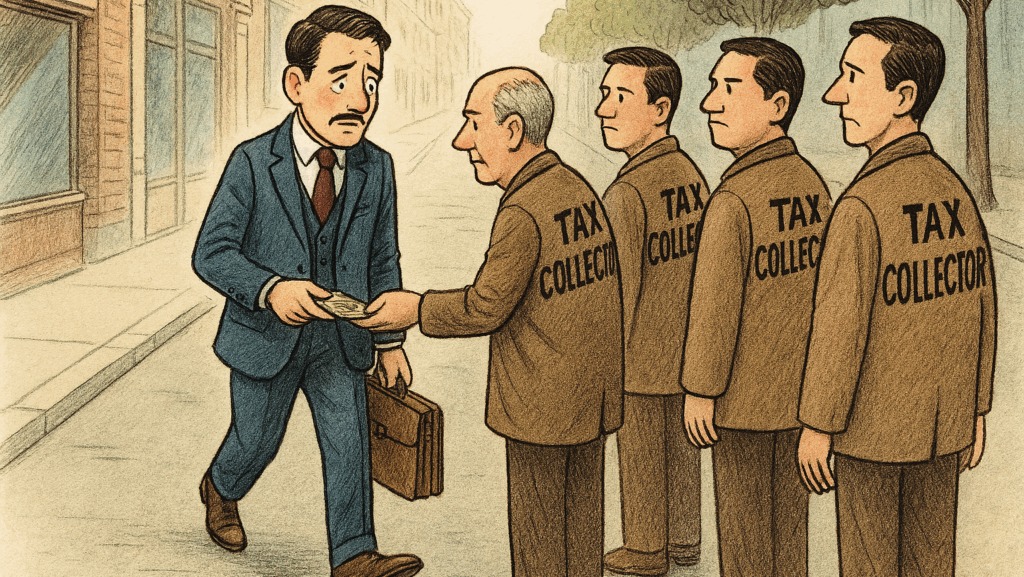
Again, tax-bill-driven asset liquidation is unrecommendable for a host of reasons, and wealthy people know this. They will try to avoid it as far as possible. Under normal financial conditions, they will pay the tax out of current income—which means that the Zucman tax isn’t really a wealth tax but an income tax.
All taxes on equity work the same way. Americans, who are all too familiar with paying property taxes on their homes, can often be placed in a situation where the value of their home increases faster than their income. This leads to the absurd situation where a property tax, fixed as a percentage of a home’s value, claims an increasing share of the homeowner’s income over time.
An annual tax hike, for short.
The Zucman tax will have similar effects on France’s business owners. Let us go back to the €1 billion midsize company. Suppose the company pays a return of 5% to its shareholders (a figure well in line with the highest-dividend CAC 40 corporations). This means €50 million per year, out of which the €18 million Zucman tax is supposed to be paid.
Suddenly, the 2% wealth tax becomes a 36% income tax.
But that is not all. The French tax code already charges 30% on dividends. Adding the Zucman tax on top of that creates a de facto 66% tax income rate on wealthy French taxpayers. And that is under the assumption that they get all their income from dividends. If instead they took the €50 million out as personal income from work, they would pay roughly 49% in personal income taxes and some 20% as social contributions.
Add the Zucman tax, and things go haywire. Again, the €18 million for the tax becomes a 36% tax on this size of income. Add that to the 69% combined personal-income and social-contribution taxes—and the final tax rate ends up at 105% of pre-tax income.
Tax systems are complex. This little experiment is obviously simplified specifically to capture the practical meaning of a wealth tax. With that said, the substantial impact of a wealth tax on a person’s income, even one who is a billionaire, is indisputable—and will in all likelihood drive some of France’s wealthiest, biggest taxpayers out of the country.
For the moment, French Prime Minister Sébastien Lecornu seems unwilling to give in to the pressure from the Left and remains reluctant to implement the Zucman tax. Let’s hope he sticks to that plan—for France’s sake.