Politics is full of make-believe acting before cameras and the public. A rather conspicuous example took place in the Netherlands on June 23-25.
When the leaders of the 32 NATO member states emerged from the meeting and called it a big success, they performed a sublime act of political posturing. They wanted us all to believe that they had achieved something historic, of substance and significant consequence.
Here is the official NATO statement:
Allies commit to invest 5% of GDP annually on core defence requirements as well as defence- and security-related spending by 2035 to ensure our individual and collective obligations
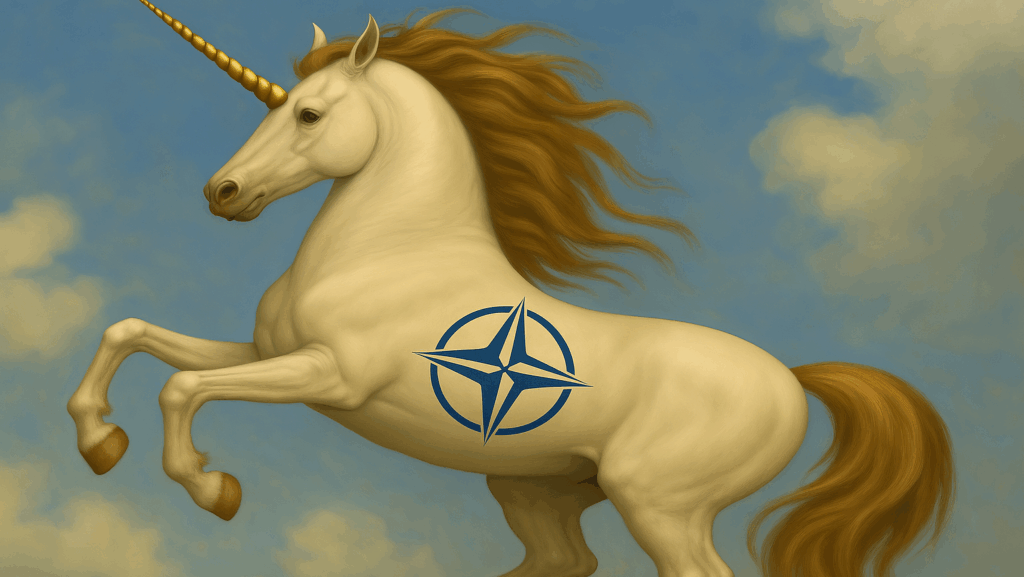
I hate to crash the party, but this is nothing to celebrate. It is a much better use of our time to prepare for widespread disappointment. The reason is simple: the member-state pledge to spend 5% of GDP on national defense is about as believable as a three-horned unicorn. I would be shocked if even half of the member states reached this goal by the 2035 deadline; I would be amazed if half of those countries, in turn, were able to sustain their military spending at that level for more than two or three years.
There is a simple reason why this goal will not be met: Europe cannot afford it. We are already seeing political battles emerge where opponents to more military spending pit education and social benefits against the defense budget. The Spanish government threw in the towel even before NATO formalized the 5% requirement. Fearing political backlash from the hard Left, Prime Minister Pedro Sánchez claims that his country can meet the operational defense goals attached to the 5% rule while spending significantly less.
Although estimates vary across news sources, the general idea seems to be that Spain can meet NATO’s operational requirements on a defense budget close to their current GDP ratio, which in 2o23 was less than 2%.
The prime minister’s attempt to escape the political trap set by the hard left is of course only a political smoke-and-mirrors show. If Spain really could meet NATO’s new operational requirements on a budget far below 5% of GDP, then every other NATO member could do the same and there would be no need for the new, higher spending goal.
With that said, the Spanish example illustrates with clarity the main reason why I confidently predict that there will at best be modest compliance with the 5% rule. In some countries, political resistance will overwhelm the pro-defense advocates; in other cases, the astronomical scale of the defense expansion will be enough to discourage any attempt at compliance.
A few may try the Swedish fiscal escape route. The government in Stockholm evaded a fierce political battle over government priorities by developing a plan to borrow money for the defense expansion. This idea falls into the ‘different, not better’ category: sooner or later, they are going to have to find a fiscal solution to a problem that can only be solved when permanent revenue pays for the new permanent defense spending.
But if every member state’s political leadership really knows that few—if any—NATO members will ever reach the 5% goal, then why did they make this spending level their new formal, official requirement?
The reason is simple. The NATO bureaucracy itself is not posturing here: their military experts have very likely made calculations down to the boots on the ground about what expansion of military capabilities the 5% rule can give them.
President Donald Trump probably believes that NATO really will build a much stronger military this way. This is why he has strong-armed Europe’s NATO members into agreeing to the 5% rule. They have no other choice than to speak of the higher defense outlays as a major accomplishment.
Again, reality will look much different. To get an idea of just what a daunting fiscal challenge NATO has produced, Table 1 reports the increases needed in defense spending by 27 EU member states (they are all NATO members as well). The baseline is their defense outlays in 2023.
Table 1

The only countries that may realistically have a chance to reach 5% of GDP are the three Baltic states. Greece ‘only’ has to expand its military appropriations from €5 billion (2023) to €11.5 billion; given a GDP of €225 billion, it should not be a problem to add €650 million per year to the military budget—or should it?
Yes, it should. The €650 million annual increase is equal to 7% of total government spending on education in Greece. Would Greek families accept an annual reduction of that size of the money that goes toward their children’s education—for ten years?
A realistic scenario would of course be a spreading-out of the spending cuts across all government functions, maybe even in combination with higher taxes. However, Greece suffered enormously for most of the 2010s from a long line of severe austerity programs in 2009-2014. Those programs decimated all public services, some of them to mere crumbs of what they used to be and taxes increased by 11 percentage points of GDP. The standard of living froze for a whole decade.
Will Greek voters, who are known to lean Left at the ballot box, put up with a return to the bad old austerity days, even if at a smaller scale, in order to grow defense spending?
But what about GDP growth? If Europe’s economies expand fast enough over the next decade, could not that growth generate enough tax revenue to at least lower the burden of defense expansion?
I would not rule out a couple of rare exceptions where strong growth can at least lend a helping hand. Overall, though, there is no hope for even moderate relief from general economic expansion. Despite strong-performing outliers like Hungary and Poland, over the past 30 years, the current 27 EU member states have averaged 1.6% real economic growth per year. This is not even enough to keep their welfare states afloat fiscally, let alone enough to maintain their national standards of living.
Rather than pretend to be working toward a goal that is as unattainable as the far side of our galaxy, Europe’s governments should acknowledge that they are stuck in a nasty structural deadlock, trapped between overly expensive welfare states, crippling taxes, the green transition chokehold, and standstill economies. Instead of baking pies in the sky to look strong, they should concentrate their political and intellectual efforts on bringing strong, sustainable economic growth back to the continent.
Once that is done, they can start talking about how to use their common resources.