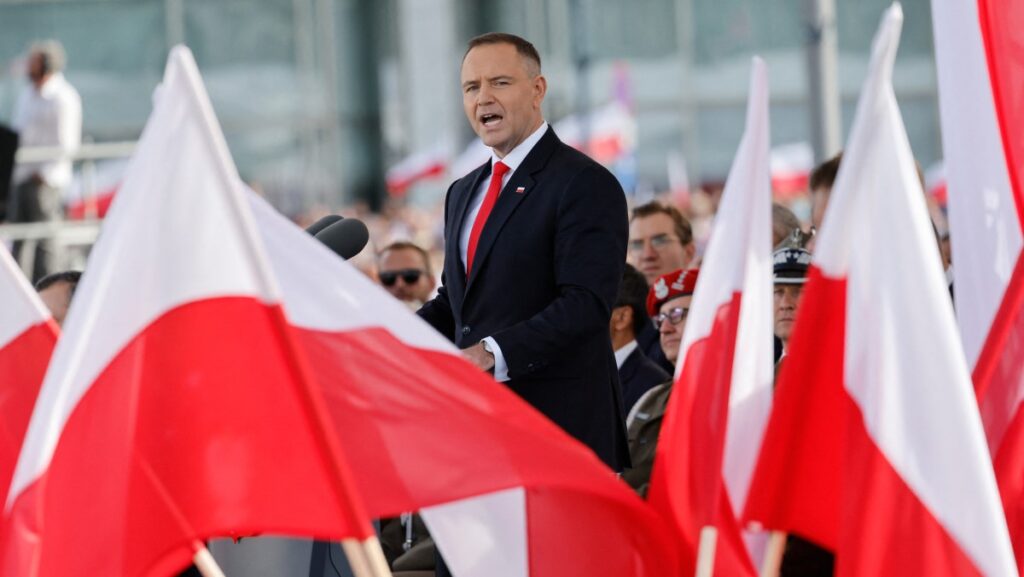
Polish President Karol Nawrocki
Wojtek Radwański / AFP
Families with flags, young people holding homemade banners, elderly men and women wrapped in red-and-white scarves flooded the streets of Warsaw to witness President Karol Nawrocki’s inauguration. On foot, by car, in buses rented by parishes and local associations, they came from all corners of the country to witness what many here are calling, without hesitation, “the beginning of the reconstruction.”
At ten o’clock this morning, Karol Nawrocki took the oath of office as President of the Republic of Poland before the National Assembly. He did so without modern theatrics or empty rhetoric. Around the Sejm—the Polish Parliament—the tension among security forces contrasted with the people’s joy. “Poland is no longer ashamed of being itself,” said a tearful woman as she raised the national flag. A Lord’s Prayer was recited at Piłsudski Square, where the new president would later formally assume command of the Armed Forces. Then came the singing: “Jeszcze Polska nie zginęła” (Poland is not yet lost), a roar of identity echoing through the heart of the capital.
📍We are on the ground for President @NawrockiKn's inauguration and we can tell you this much👇
— The European Conservative (@EuroConOfficial) August 6, 2025
🇵🇱Polish society has spoken: it wants its voice back, it wants its history back and it wants to regain control over its future once and for all. pic.twitter.com/MYJhtOgLVU
A middle-aged man called it a “miracle,” admitting he had little hope of seeing such a rapid change in one of the nation’s key posts after the progressive years under Tusk. “Karol Nawrocki, Polish president,” they chanted—a rhyme that resonates in Polish.
President Nawrocki’s speech was sober, firm, and uncompromising. He addressed his supporters and those who did not vote for him: “The nation exercises supreme power in the Republic,” he reminded them from the podium, setting the tone for a presidency focused on reclaiming sovereignty, values, and clearly defined borders—both physical and legal.
Each mention of the Constitution, the złoty, the rejection of the euro, or opposition to illegal immigration drew spontaneous applause from the crowd watching on large screens in the Three Crosses Square. Nawrocki pledged loyalty to Plan 21, his government program, and announced his goal of turning the Polish Army into the most potent force on NATO’s eastern flank. The American delegation—led by Kelly Loeffler, Donald Trump’s envoy didn’t miss a word. Given the current tensions in Europe and with Russia, Poland now stands as one of the continent’s most geopolitically vital countries.
Delegacja Prezydenta Trumpa @POTUS @WhiteHouse, której przewodniczy Pani Kelly Loeffler @SBA_Kelly, Administrator Amerykańskiej Agencji ds. Małych Przedsiębiorstw @SBAgov, wzięła udział w zaprzysiężeniu Prezydenta Karola Nawrockiego @prezydentpl @NawrockiKn przez Zgromadzenie… pic.twitter.com/VWODLkAzYD
— US Embassy Warsaw (@USEmbassyWarsaw) August 6, 2025
After the parliamentary ceremony, the new president chose to walk on foot from Piłsudski Square to the Presidential Palace, accompanied by chants of “Karol! Karol!” and “Polska jest nasza!” (Poland is ours). The city had a palpable energy—and a sense of cautious hope.
Throughout the day, Warsaw became a mosaic of emotions long held back. The White and Red March brought together more than a hundred thousand people in an outpouring of civility and hope unimaginable just a few months ago.
As evening fell, the last groups of citizens remained singing outside the Presidential Palace. A mother, holding her child, appeared to explain to him that this building now also belonged to them again—a display of pride in national symbols. In a nearby corner, a priest led an impromptu prayer for Poland, joined by many.
The city, closed off at key points by police, throbbed with a mix of official sirens and popular songs. The bells of St. John’s rang out after the morning Mass. No one spoke of revenge; everyone spoke of a fresh start. Whether this is possible under the control exerted by Tusk and von der Leyen remains to be seen.
Donald Tusk’s coalition attended the inauguration in silence. Their expressions reflected not just a political defeat, but the recognition of a changing era. For nearly two years, their government strained relations with the Church, the military, the judiciary, and with Polish families. Nawrocki is well aware. And while he promised dialogue, he also drew a firm red line: “Poland must return to the rule of law. And judges must serve the Republic, not their own agendas.”
What’s at stake now is not just the presidency—but a vision of the nation fighting to stand firm in a crumbling Europe.