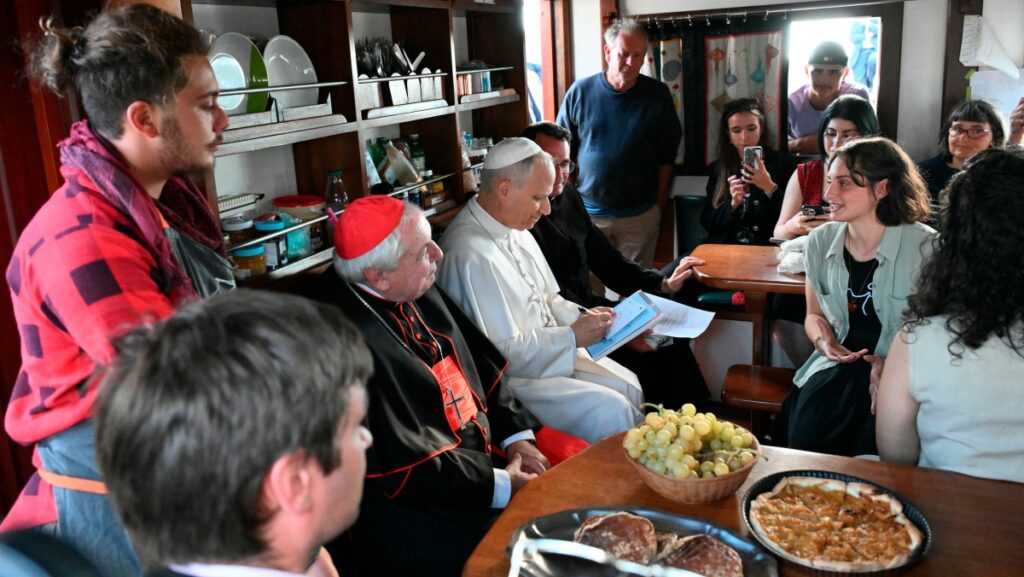
Pope Leo XIV seats next to French cardinal Jean-Marc Aveline during a visit to the Peace training ship MED 25 – Bel Espoir in the port of Ostia near Rome on October 17, 2025.
Alberto Pizzoli / POOL / AFP
On October 9, Pope Leo XIV released Dilexi te, his first magisterial document. The Pontiff, who holds American and Peruvian citizenship, chose the format of an Apostolic Exhortation rather than the more binding form of an Encyclical. This decision reflects a pastoral and dialogical style: while an encyclical lays out doctrinal teachings, an exhortation invites paths of reflection and action, allowing greater room for personal discernment and reception.
A choice that was, in a certain sense, “mandatory” for Pope Leo—if not formally, then at least morally—given his sense of indebtedness to Pope Francis on several fronts. As noted in our previous analyses, Leo shares Francis’s overall vision of the Church, though not his method.
Indeed, as Pope Leo himself explains in paragraph 3 of Dilexi te, “I am happy to make this document my own—adding some reflections—and to issue it at the beginning of my own pontificate, since I share the desire of my beloved predecessor that all Christians come to appreciate the close connection between Christ’s love and his summons to care for the poor.”
The draft was kept in the Secretariat of State and had been conceived by Francis drawing on various contributions, including the book Storia della Povertà (History of Poverty) by Vincenzo Paglia, a controversial Italian bishop who, in the past, caused scandal for his openness toward legislation not fully aligned with Catholic moral doctrine.
During the press conference presenting the Exhortation, Cardinal Czerny was asked, “What percentage comes from Francis, and what from Leo?” The Prefect of the Dicastery for Integral Human Development—an unmistakably Bergoglian institute—replied: “I’d say 100% Francis and 100% Leo.”
An emblematic answer, capturing Prevost’s intent to absorb Bergoglio’s legacy and refine it through a more Christological and Christocentric lens.
We will not dwell here on the theological and doctrinal significance of the document, but rather on its sociological and political dimensions. Indeed, as is inevitable, Pope Leo—by addressing the issue of poverty and care for the poor—cannot avoid sociological analysis, identifying, especially in the second half of the text, specific causes of poverty and proposing equally radical solutions.
Both dimensions—the causes and proposed solutions to poverty—raise significant concerns, not only for Catholic politicians (to whom the pope primarily addresses himself, for obvious reasons), but also for the broader political class that may look to the head of the Catholic Church as a credible moral authority.
In particular, paragraph 92 reads: “We must continue, then, to denounce the dictatorship of an economy that kills, and to recognize that, while the earnings of a minority are growing exponentially, so too is the gap separating the majority from the prosperity enjoyed by those happy few.”
After diagnosing the social illness, Leo echoes Francis and proceeds to analyze its causes: “This imbalance is the result of ideologies that defend the absolute autonomy of the marketplace and financial speculation. Consequently, they reject the right of states, charged with vigilance for the common good, to exercise any form of control. A new tyranny is being born, invisible and often virtual, which unilaterally and relentlessly imposes its own laws and rules.”
And again: “As it is, the prevailing privatistic model [Editor’s note: the Italian and the English translations differ here] does not appear to favor an investment in efforts to help the slow, the weak or the less talented to find opportunities in life”. This claim overlooks historical and concrete reality: in statist and socialist systems, where the State controls the entire economic life, poverty tends to grow rather than diminish. Moreover, in a free labor market, the unemployed are a resource—they can offer talent and creativity, and thrive through private initiative.
It now happens not only in the Global South, but increasingly in the West as well, that the State—through taxes and regulatory constraints—discourages investment and keeps the poorest segments of society dependent on bureaucracy. The problem, then, is not the market itself, but rather state interference that stifles responsibility and economic initiative.
If poverty truly stems from an underregulated—or even unregulated—market, how is it that the countries with the highest numbers of poor are precisely those governed by socialist or communist regimes, where the State exercises pervasive control over the economy?
And yet, Dilexi te pays no attention whatsoever to these realities, despite the fact that they concern nations of the Global South—the very South that was central to Francis’s pastoral concern, and which ought to matter to Leo as well. In short, the analysis presented is not without its limitations, some of them quite serious.
The risk is that of fostering an ideologized reading, in which the misery of the Global South ends up being attributed exclusively to a historical guilt of the “rich and capitalist” West, thereby leaving Asian and African populations trapped in the rhetoric of “unfinished decolonization”—a rhetoric that fuels support for authoritarian and military regimes in those very regions, and even at the international level.
Pope Leo (or perhaps one should say Pope Francis), like a good physician, after offering the diagnosis and identifying the cause of the illness, proceeds to deliver a prognosis: “Unless we stop and take this matter seriously, we will continue, openly or surreptitiously, to legitimize the present model of distribution, where a minority believes that it has the right to consume in a way which can never be universalized, since the planet could not even contain the waste products of such consumption.” (p. 95)
Naturally, one could not escape the eco-socialist rhetoric, according to which the wealthy pollute to indulge their desires and must therefore be taxed—when, in fact, the richest countries are also those most environmentally conscious.
Finally, we have therapy: “Unjust structures need to be recognized and eradicated by the force of good,” that is, not only “changing mindset but also, with the help of science and technology, by developing effective policies for societal change.” (p. 97)
Not virtue—as the popes have repeated for centuries — but science and technology at the service of the State are what supposedly improve society. It is hard not to think of China, with its system of social credit and hyper-surveillance: is this the model to follow? Indeed, for many European politicians, it would seem so.
In short, if it is true that “we need to be increasingly committed to resolving the structural causes of poverty,” the socio-political analysis proposed does not appear to be correct, effective, or internally coherent. Rather, it seems to be a convenient adaptation of ecclesiastical magisterium to the currently dominant political agenda.
On this point, it is disheartening to read in the document: “There are those who say: ‘our task is to pray and teach sound doctrine.’ Separating this religious aspect from integral development, they even say that … it would be better to teach [the poor] to work. At times, pseudo-scientific data are invoked to support the claim that a free market economy will automatically solve the problem of poverty … It is easy to perceive the worldliness behind these positions.” (p. 114)
It is striking—and unsettling—that those who advocate a social vision steeped in ideological engineering and statist dependency presume to accuse of “worldliness” those who call the Church back to its mission, not only spiritual and doctrinal, but also pastorally coherent.
The inversion is clear: what truly defends transcendence is stigmatized as superficial, while an immanentist vision that conflates salvation with resource redistribution is cloaked in spiritual language.
It must be acknowledged that today’s Church hierarchy actively contributes to the current socio-economic disaster, which is not primarily a political issue, but one of consensus or “mindset,” as Leo himself puts it. As long as the people continue to believe that protectionism is beneficial, politics will continue to offer them protectionism.
As long as they believe that subsidies—which generate inflation—make them richer, politics will continue to give them inflation. In documents like this, the Catholic Church becomes complicit in such misguided thinking.
The more immediate problem highlighted by this Apostolic Exhortation is that Pope Leo XIV is poorly advised on these social matters. Once again, we must lay blame on the Curia, which remains Bergoglian in orientation—progressive in theology and socialist in politics.