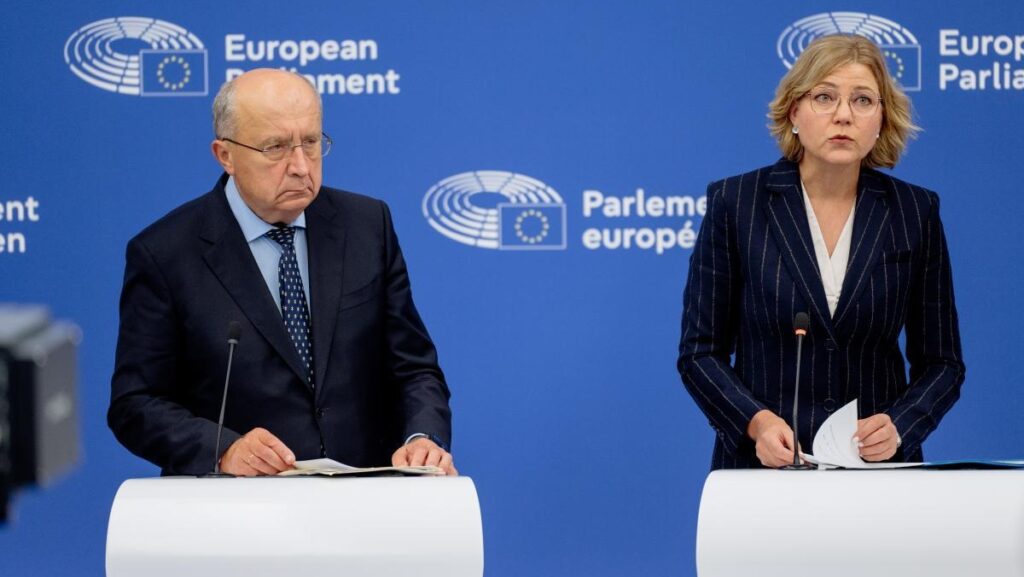
Press conference by Henna Virkkunen, Executive Vice-President of the European Commission (R), and Andrius Kubilius, European Commissioner, on the allocation of loan amounts to member states under SAFE, on 9 September 2025.
Valentine Zeler, © European Union 2025, EC – Audiovisual Service
Presented as a strategic breakthrough in European defence policy, the EU’s SAFE instrument may turn out to be far more consequential—and far more controversial—than first advertised. Beneath the language of “strategic autonomy” and “industrial strengthening” sits a financing model that links defence money to political conditionality. The real question is whether Brussels is reinforcing Europe’s military capacity—or expanding its leverage over member states.
Regulation 2025/1106 of 27 May 2025 established the Security Action for Europe (SAFE) instrument—a financial mechanism designed to help member states increase defence spending and strengthen the European defence industrial base. Officially, SAFE aims to boost Europe’s defence readiness by financing joint procurement, expanding industrial production and closing capability gaps.
The mechanism is straightforward on paper. SAFE provides loans to member states for public investment in defence capabilities and military procurement. The money is raised on capital markets or from financial institutions, then lent onwards. To access the funds, each country must submit a detailed investment plan: what equipment it intends to buy, what actions it will take, how much it will spend, how the financing will be structured, and how it will comply with the regulation.
But the money does not flow automatically. Funds are released in tranches, and only after the European Commission assesses progress. If Brussels judges implementation unsatisfactory, it can suspend payments in part or in full. In practice, SAFE operates as a milestone-based system in which disbursement is tightly tied to Commission approval.
According to legal analysis prepared by the Polish think tank Ordo Iuris, the controversy lies in the built-in ‘rule of law’ conditionality mechanism.
SAFE explicitly refers to Regulation (EU, Euratom) 2020/2092, which introduced a general conditionality system to protect the EU budget. Under this framework, funds can be suspended if the Commission concludes that breaches of the rule of law affect—or pose a serious risk of affecting—the Union’s financial interests.
Critically, no actual financial damage must be proven. The mere existence of a “serious risk” is enough. The criteria are broad and largely discretionary. The EU’s definition of the rule of law includes judicial independence, effective judicial protection, and proper judicial appointment procedures, as interpreted by the Court of Justice of the European Union.
The Commission decides whether to open proceedings, what evidence to use, how to assess corrective measures and what sanctions to propose. The Council votes by qualified majority, and experience shows it rarely blocks Commission proposals—as demonstrated in proceedings against Hungary.
Ordo Iuris argues that this means SAFE payments could be suspended not only for technical or financial failures but also on the basis of political assessments regarding a member state’s rule of law. In effect, SAFE becomes another extra-treaty instrument of influence, using debt and budgetary leverage to shape national policy.
Jacek Saryusz-Wolski—one of Poland’s most experienced EU politicians and currently a social adviser to President Karol Nawrocki—described SAFE as placing a “double Nelson” on Poland, a wrestling hold that immobilises an opponent from behind. In his assessment, the programme has two major flaws.
First, it risks imposing a model of defence procurement that conflicts with Poland’s existing strategy, which is built around integrated systems from the United States and South Korea. Second, it creates what he calls “a dangerous risk of discretionary and politically motivated suspension of payments.”
In an interview with the weekly Do Rzeczy, Saryusz-Wolski warned that Brussels could effectively steer defence policy, even though defence is not an EU competence. Funds must largely be spent within European and Ukrainian production. In practice, he argues, this favours major Western European defence industries. “These are earmarked funds,” he said. “We cannot spend them freely as we wish.”
Piotr Nowak, former Minister of Development and Technology in the government of Mateusz Morawiecki, was equally blunt. He called SAFE “a mistake” and “a cat in a bag.” Poland is expected to receive between 45 and 47 billion euros, yet the real cost of financing remains unclear. “We were told—between 3 and 4%. Between 3 and 4% is a huge difference,” he noted.
Nowak stressed that Poland can borrow independently on financial markets. He pointed to a January bond issuance at 3.74% and argued that similar funds could be raised without conditionality or spending restrictions. “Why add SAFE, if it may turn out to be a political muzzle?” he asked.
Both critics draw parallels with the Recovery and Resilience Facility, where Poland’s access to funds was linked to judicial reforms and broader governance conditions.
The wider institutional context reinforces these concerns. EU documents outlining priorities for 2026 clarify what the Commission understands by ‘rule of law’ and confirm that linking access to EU funds with adherence to European values—democracy, rule of law and fundamental rights—will remain a central policy tool. The Commission also signals continued implementation of the Migration and Asylum Pact, climate policy targets, gender equality strategies and media oversight frameworks.,
In short, for the Commission, “the rule of law” means compliance with—and participation in—all of these (ideological) initiatives.
Formally, SAFE is a defence financing instrument. Structurally, however, it fits into a broader trend: joint borrowing, conditional disbursement, expanding Commission discretion and the linking of funds to wide-ranging governance standards.
For critics such as Saryusz-Wolski and Nowak, SAFE is not merely a loan facility. It is part of a deeper shift—one in which financial instruments double as mechanisms of political alignment.