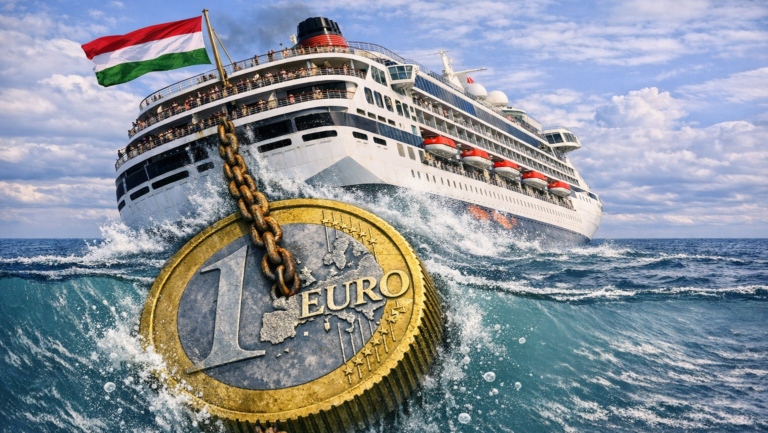
There has been a lot of focus across Europe’s media outlets on the major expansion of the EU budget. In its proposal for the seven-year period 2028-2034, the Commission asks for a 67% increase in appropriations.
Currently, the budget is facing a high level of resistance in the EU Parliament. However, if it were to be approved at the proposed spending levels, it would grow EU spending by two-thirds over current levels. In total, for the entire seven-year period, the EU Commission wants to spend almost €2,000 billion, or €2 trillion.
This is an impressive amount of money. However, when split up annually, it breaks down to approximately €286 billion, less than 1.6% of the EU’s total €18 trillion gross domestic product (in 2024).
Compared to the member state governments that spend half or more of their nations’ entire GDP, the EU Commission is showing restraint that could almost be mistaken for fiscal humility. However, the Commission makes absolutely no secret of its ambition to rapidly grow more fiscal muscles.
Before I get to any details on the actual policy ambitions in the EU’s new proposed budget, it is worth making a trip back in time to the early 1990s, where ‘it all started.’ At the time when the 12 member states of the European Communities laid the foundation of the European Union, it was clear that the authors of not only the Maastricht Treaty, but research and white papers pertaining to its formation, wanted to restrain EU powers.
At the time, in fact, one could sense real worries about the EU becoming a pan-European superstate.
As part of their efforts to rein in the powers of the EU, the authors of the Maastricht Treaty created a policy-making architecture that is almost American in its efforts to enumerate government powers and clarify jurisdictional responsibilities in policy making. Since economic policy is a formidable power-grabbing tool in the hands of the wrong policy makers, it is perhaps no surprise that the Maastricht Treaty originated a policy triad connecting policy goals, policy methods, and policy jurisdictions.
To start with the economic policy goals, they were: growth in GDP, price stability, and full employment. They were supposed to be achieved by means of three different policy methods:
The jurisdictional part of the policy triad was also relatively clear. It was the responsibility of the EU Commission to oversee member-state compliance with the Stability and Growth Pact. The European Central Bank naturally became responsible for low inflation or price stability, given that the Treaty defined inflation as a monetary phenomenon.
These jurisdictions made a lot of sense. One part of the EU, including its member states, was barred from meddling in another part’s policy making. Each jurisdiction presided over its own goal and its own methods, and would thereby be busy enough not to try to intrude on someone else’s policy-making responsibilities.
The last policy goal, full employment, was supposed to be achieved by the member states through deregulated, supply-side-oriented labor markets. We never really hear about this policy goal in the daily debate over EU policies, and one reason might be that, technically speaking, it was never formalized in the Maastricht Treaty. However, it does occur in the research and white papers that guided the formation of the Maastricht Treaty. References to full employment are implicit in the Treaty, but still to a degree that any analysis of the structure for economic policymaking merits the inclusion of full employment.
Looking at the economic policy triad some three decades later, I am struck by how far the EU has ventured from the original ambitions to limit EU government powers. The EU has significantly strengthened its control over the policy goal of GDP growth. Its active application of the Stability and Growth Pact, from Greece in 2009-2014 to France just last year, has reduced member state independence in terms of fiscal policy.
With rare exceptions, the governments of the 27 member states show remarkable eagerness in complying with the EU’s debt and deficit rules. Ironically, this has led to a frightful synchronization of fiscal policy across Europe, promoting austerity over economic growth. Simply put, it takes a government of Hungarian integrity to downgrade fiscal austerity in favor of policies that actually create a growing economy.
In addition to strengthening its control over fiscal policy, the EU Commission has also reached into the policy-making hallways of the European Central Bank. It only took one decade after the ECB’s creation before it complied with apparent requests from the EU Commission to buy member state government debt. This happened openly in Greece, where the ECB’s debt monetization was supposed to help bring the Greek government’s budget into balance.
For the better part of the 2010s, the ECB ran a program where it frivolously bought member-state debt. This led to a breakdown of the central bank’s efforts to keep inflation low, a breakdown that was exacerbated by the EU Commission’s insistence on centrally planning the EU economy during the 2020 pandemic.
In short, today’s ECB follows in lockstep wherever the EU Commission wants to go.
As for the last goal, full employment, its jurisdictional assignment to the member states has remained in place. The EU has shown little interest in this issue, which, in fairness, could be because in the past ten years, euro zone unemployment (to focus on the most homogenous part of the EU economy) has fallen by about one-third to its current level around 6.5%. During the same period, workforce participation has increased by about three percentage points.
This implies that the member states have done a reasonably good job with their labor market policies. However, given that the EU has drastically expanded its control over both fiscal and monetary policy across the union, the positive impact of better-functioning labor markets is limited.
With its budget for 2028-2034, the EU Commission continues to expand its jurisdictional ambitions over policymaking. As Tamas Orbán reported on July 16th, EU Commission President Ursula von der Leyen talks about the budget in terms of size, ambition, and scope. She lauds the EU’s expansion of policy making, both in areas where it is already active and in areas where it has not yet set foot.
In the Commission’s own words:
Europe faces an increasing number of challenges in numerous areas such as security, defence, competitiveness, migration, energy and climate resilience. These are not temporary but reflect systemic geopolitical and economic shifts that require a strong and forward-looking response. The Commission therefore proposes a fundamental redesign of the EU budget
The list of policy areas where the Commission wants to be involved with its budget spans across policy areas where it was unthinkable for the EU to be involved 30 years ago. Gone is the careful demarcation between policy jurisdictions in the Maastricht policy triad; gone is the confinement of the Commission to a fiscal policy oversight role under the Stability and Growth Pact; gone is the presumption of an independent central bank.
There is one area where the EU still has not been able to expand nearly as aggressively as it has in terms of where to spend money. The Commission still has to rely on member states to provide any meaningful amounts of tax revenue for the EU. The Commission makes no secret of what it wants: a lump-sum corporate income tax and a tobacco tax are the most protruding examples.
It is high time for the member states to put an end to the EU’s steadily expanding policy ambitions. The time to do it is now, when the Commission still depends almost entirely on member states for its revenue. Once the EU has its own tax system in place and can pull in revenue independently of the member states, the battle is lost against an unhinged, unending, and unnervingly totalitarian pan-European super government.