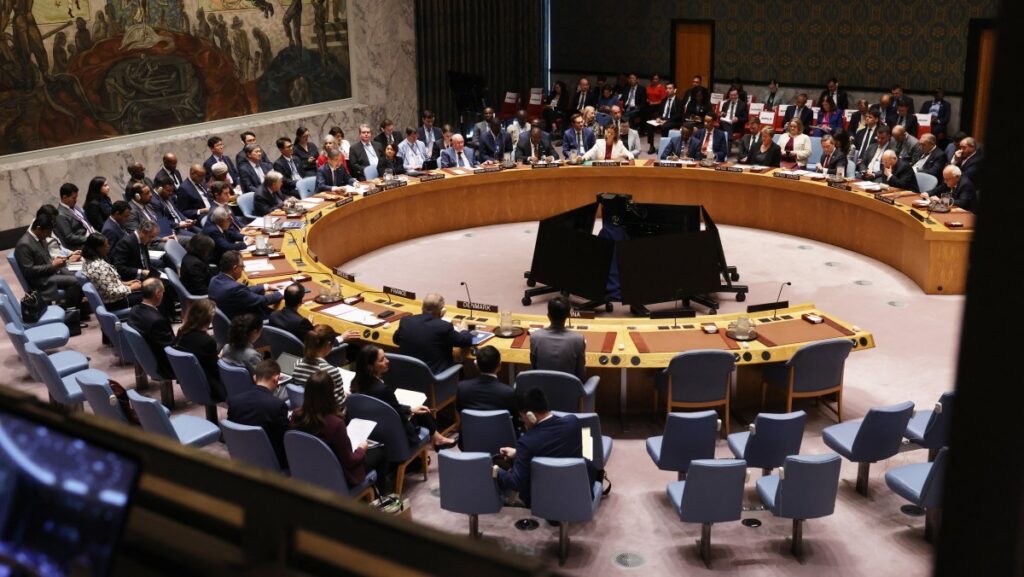
Dignitaries attend a Security Council meeting on the situation in the Middle East, including the question of Palestinian statehood, during the United Nations (UN) General Assembly on September 23, 2025, in New York City.
Spencer Platt / Getty Images / AFP
“With Trump’s inauguration, the old world order will soon disappear”—so said many commentators in the wake of Trump’s pre-inauguration speech at Mar-a-Lago. He sounded themes that hadn’t been heard in the recent decades of the liberal international order. Suddenly, after the then-president-elect’s references to retaking the Panama Canal and Greenland, talk of the Monroe Doctrine, spheres of influence, and national interest was back—and many concluded that the usual, vague newspeak dominating the post–Cold War public discourse was gone for good.
This realization that the liberal world order is vanishing and something new is emerging has left its mark on the actions of both tech billionaires and political leaders. Mark Zuckerberg wasted no time in killing fact-checking on Facebook right after Trump’s election, and we’ve seen Keir Starmer cozying up to Trump (even though Labour campaigned against him), along with Mark Rutte, who has since been encouraging NATO countries to increase their military spending. Von der Leyen has even said, “The West as we knew it no longer exists.”
Even though Brussels has largely continued its old ways, EU leaders have at least acknowledged that the world is entering a new era where many of the old institutions, declarations, and even the language used on the global stage will eventually prove dysfunctional and will need reform—to say the least.
But in a few special places, the relics of the past are not only still alive—those running them seem completely unaware of the new imperatives of national interest that the major global actors are following. Such is the case with the UN, whose General Assembly last week offered a telling snapshot of the state of Western thinking.
Opening UNGA was former German foreign minister Annalena Baerbock (back home considered a failed politician), who has chosen the motto ‘Better together’ for her presidency. Given the UN’s widely known shortcomings in preventing or ending conflicts, and, in general, its rather limited impact on global politics, the choice of motto is somewhat ironic. At the same time, it all but confirms that this session will bring no paradigm shift either.
The speech of António Guterres was mostly an enumeration of the organization’s failures. He started on the commitments made at the moment of the UN’s founding: the choice of peace over conflict and of cooperation over chaos. He then went on to elaborate on how—despite the UN’s 80-year history—the world has descended into chaos, into an “age of disruption,” with wars raging across the globe.
Indeed, today the UN is not only largely incapable of preventing wars, but in recent years, it has also faced challenges in its mediation and peace efforts, often yielding to individual states (e.g., the U.S. or the UAE) and other regional groups (such as BRICS). In short, Guterres summarized what everybody else has known for long: the UN has lost traction, and if there is no change of direction, it may gradually sink into irrelevance.
Still, one could take a more optimistic view of the Secretary-General’s remarks: he openly admitted the UN’s failings in recent decades and even concluded with suggestions on how to remedy them. Yet the question overshadowing this year’s General Assembly is whether institutions like the UN are capable of maintaining peace at all—or are we instead moving toward a multipolar order in which peace is maintained by a balance of power, much like in 19th-century Europe? Finnish President Alexander Stubb devoted his speech to this very issue. Speaking with Wilsonian idealism, he appealed to common values in contrast to both multipolarity and transactional politics. What he seemed not to consider is that international cooperation can also be built on shared interests rather than on supposed or actual values. The BRICS group, whose foreign ministers happened to meet on the margins of the General Assembly, already provides such an example. And while Western leaders champion common values, the countries of the Global South are steadily deepening their community of interests.
While not necessarily intended as a direct answer to that question, Donald Trump’s speech—and indeed his entire posture—sent a clear message. Speaking for nearly an hour, well beyond the allotted time, he argued that the UN had become incapable of fulfilling its declared goals. He not only set aside the solemn language and familiar themes of the UN but also rejected some topics outright—climate change, for instance—choosing instead to speak about American national interests, Europe’s decline, migration, and his own efforts to secure peace. While the president acknowledged that the UN retains significant potential, the overall message of his speech was clear: with the UN largely ineffective, the United States is forced to take the lead on issues that truly matter.
If the UN is still operating on the rules and forms of the decaying liberal order, one incident must have been a wake-up call to even the staunchest defenders of multilateralism. Despite the Ukrainian president’s warnings (“Ukraine is only the first”) and President Trump’s apparent about-face on the war, the issue of supporting Ukraine seems to have fallen off the agenda outside Europe. A joint statement condemning Russia, proposed by Ukraine and the European Union, was backed by only 36 countries. The rest appear uninterested in isolating Russia—no matter how eloquent the statements or how inspiring the speeches delivered along the East River may be. These states clearly have no intention of conforming to the West, having likely recognized that pursuing their national interests ultimately serves them better than adhering to the globalist consensus.
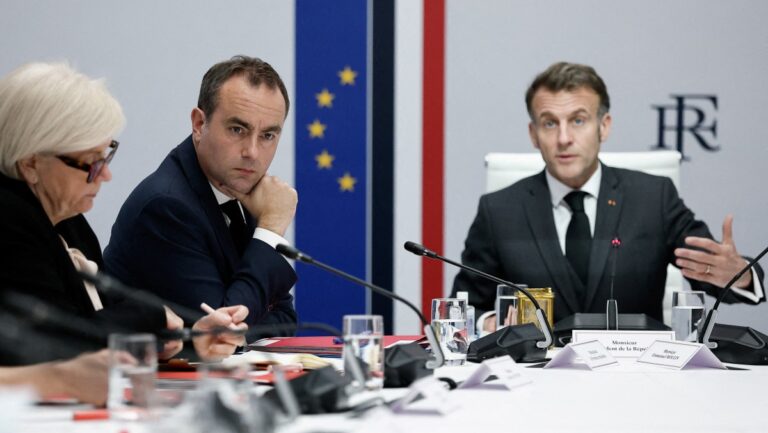
Among the many side events, none drew more attention than the summit convened by France and Saudi Arabia, where President Macron—joined by the leaders of the United Kingdom, Canada, Australia, and others—formally recognized the Palestinian state. Yet little was said about what practical impact this recognition might have on the conflict, or even what, in concrete terms, was being recognized. The significance of the gesture was further undermined by the absence of the United States, which chose to boycott the meeting. Instead, President Trump took the occasion to discuss his Gaza peace plan with Arab leaders—a plan that has since received the endorsement of Israel. In light of this, the event resembled more of a media stunt. Yet Macron—whose domestic support is at a record low—is no stranger to such theatrical foreign policy tricks, and the occasion in fact served as a striking illustration of the spirit of the UN itself. As did the panel discussion between retired U.S. General David Petraeus and Syrian leader Ahmad Al-Sharaa. “A milestone in Al-Sharaa’s unusual career,” wrote Time Magazine, while one analyst aptly remarked, “Reality is the best sci-fi”—referring to the surreal scene of a former terrorist conversing in New York’s luxurious conference halls with the very American general who once captured him in Iraq. And even if we choose to set aside the issue of Al-Sharaa’s past, it is hard not to think of the current situation in Syria: attacks on religious minorities and the country’s deepening sectarian divisions.
Anyone who followed the news about this year’s General Assembly could not help but draw a parallel between the dysfunctional microphones, transponders, and escalators and the anachronistic nature of the UN itself. Multilateralism—as we have known it since World War II, with its peculiar language, familiar topics, and established processes—is in crisis. Just as the UN faces challenges in global politics, so does the WTO, among others, drawing widespread criticism for its inability to serve as a meaningful platform amid the transformation of global trade. While the UN continues to host elegant speeches in Manhattan, elsewhere in the world new alliances are forming—built on different values and principles yet informed by the experiences of globalization. If traditional multilateral institutions are not reformed to reflect both the current and emerging dynamics of world politics, they risk being irreversibly sidelined on the global stage. And in a few years, UNGA will resemble less a gathering of world leaders and more a room at Madame Tussauds.