Writing about the European economy is often a depressing experience, for the simple fact that for the most part the European economy is—yes—a depressing experience.
Fortunately, there are some bright spots on the European map. One of them is gaining strength in Germany, where a promising debate is emerging about the country’s most pressing fiscal and economic problem: the welfare state.
On February 10th, Welt reported on a new opinion poll where a whopping two-thirds of all respondents believe that Germany can no longer afford its welfare state:
According to a Forsa opinion poll, almost two-thirds of the German people are of the opinion that the welfare state can no longer be funded. In the representative survey … 64 percent took this position; 34 percent disagreed.
The Welt article sees this result as an echo of what Germany’s Chancellor Friedrich Merz said last summer. This is an interesting shift in public opinion; potentially, it represents a tectonic shift from solid public support for widespread economic redistribution to a more conservative take on the government’s role in the economy.
In my own analysis of Merz’s statement and of the German welfare state in August last year, I expressed concern that Merz would not follow his words with decisive action. I was worried that the chancellor would stop short of a systemic analysis of the welfare state’s unaffordability. I noted that he might “take the convenient approach” and blame the problem on ad hoc explanations.
That is exactly what Merz did, but, contrary to my fears, his words have continued to resonate through the arena of public opinion. As the aforementioned opinion poll demonstrates, Merz has clearly set a ball in motion in the German public arena. That ball will continue to gain momentum, in no small part because the Left seems to be determined to defend the current welfare state. Back in August, the SPD’s Secretary General Tim Klüssendorf explained:
Our welfare state is a central achievement of our democracy and the foundation of the social market economy that has made Germany strong. … The welfare state is therefore not a burden one has to choose to bear, but rather a safety net of fundamental value.
The message from Klüssendorf is unmistakable: defending the welfare state is a matter of political ideology. This appears to be the common attitude on the Left: on February 10th, the left-leaning public policy organization Arbeiterwohlfahrt (AWO) responded sternly to the Forsa opinion poll about the welfare state. Their president, Michael Groß, did not mince words:
The welfare state isn’t too expensive, it’s underfunded because we’ve let the wealthy off the hook for decades. Instead of debating ever more social cuts, we should finally be talking about tax fairness.
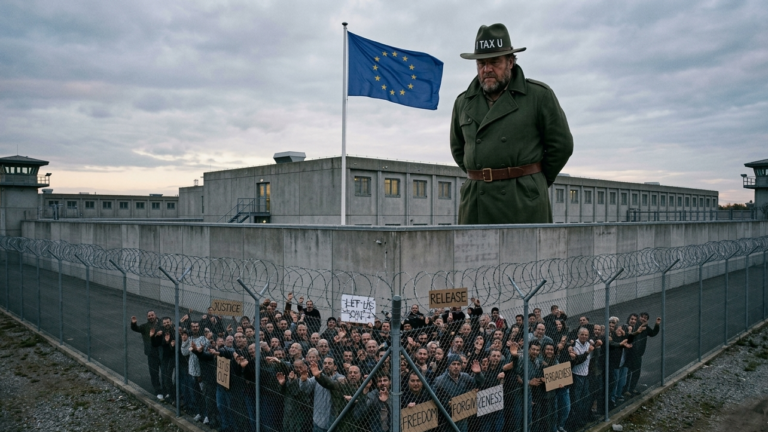
It is not clear if AWO’s opinion on this issue is an outlier or if its call for “tax fairness” signals a broader consensus on the Left regarding the welfare state. It will be essential for the SPD to come clean here: do they understand the fiscal and economic reality that Chancellor Merz pointed to, or do they prefer to align themselves with the Europe-wide hate-the-rich campaign for confiscatory taxes?
They should not take too long to make up their mind. The real world speaks alarmingly of the tragic state of the German economy. Adjusted for inflation, the average annual growth rate for the German economy over the past two years—fourth quarter 2023 through third quarter 2025—is a negative number: -0.3%. Since the end of 2021, the German economy has shrunk by 1.8%.
This may not sound like much, but it is big news in the context of the welfare state debate. From 2010 through 2019, the German GDP expanded by almost 2% per year, adjusted for inflation—1.98% to be exact. During the same period, the cost of the welfare state increased by 1.8% per year, again adjusted for inflation. If we make the realistic assumption that tax revenue grows on par with GDP, this means that the German government was able to just barely keep up with the costs of the welfare state.
It is important to remember that ultimately, the cost trajectory of a welfare state is not determined by whatever budget priorities a legislature may have. They can make minor adjustments in appropriations from one fiscal year to the next, but they cannot change the long-term cost trajectory—unless they reform the benefits programs themselves. People will demand the benefits they have been given the right to. They will also vote to protect those benefits.
One consequence of this is that a long period of very weak GDP growth results in a structural deficit in the welfare state. Its underfunding becomes a permanent problem that cannot be solved by higher taxes (higher taxes depress economic activity and, by consequence, tax revenue), which leaves only one option: to reform the welfare state’s benefits programs.
This is where Germany is now. While the nation’s economy is shrinking in real terms, the cost of the welfare state continues to rise. Chancellor Merz has seen this problem, and now two-thirds of the German people have come to the same conclusion: the welfare state, Sozialstaat, is unaffordable.
I am positively surprised by the fact that Merz’s opinion regarding the welfare state has resonated as well as it has with German voters. This means, at least in theory, that the electorate has a high degree of immunity to the ideological trumpet signals heard from the Left. However, in order to formulate a cohesive, productive, and long-term sustainable alternative, German conservatives will have to become ideologically engaged in the debate over the welfare state.
In a nutshell, they need to explain that a conservative welfare state is fiscally sustainable. This should not be too hard to do; they can get major inspiration from Hungary, which is home to Europe’s most successful experiment to date in building such a state.