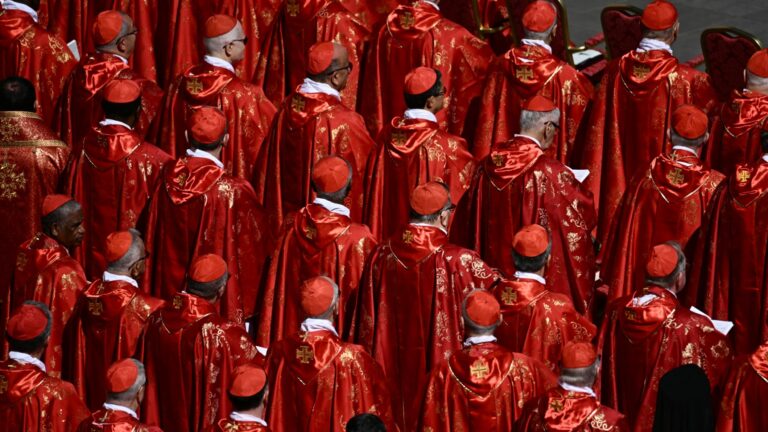
Pope Leo XIV leads a mass in the Tor Vergata district of Rome, as part of Jubilee of Youth, on August 3, 2025.
Filippo Monteforte / AFP
On July 26th, Pope Leo XIV received in audience Antonij Sevryuk of Volokolamsk, the Orthodox metropolitan bishop and president of the Department for External Church Relations of the Moscow Patriarchate—effectively the ‘foreign minister’ of the Russian Orthodox Church. Many issues were discussed, but three core topics dominated the table: the war in Ukraine, the resumption of ecumenical dialogue with the Russian Orthodox world, and, above all, Kyiv’s legislative effort to suppress the Russian Orthodox presence, as it is perceived as an instrument of Kremlin influence.
In August 2024, the Ukrainian Parliament passed a law banning the activities of the Orthodox Church in Ukraine affiliated with the Moscow Patriarchate.
The meeting is of significance because the conflict on Europe’s doorstep and the election of an American pope had, seemingly, done little to facilitate relations between the Kremlin and the Vatican. Initially, the intentions of the new pontiff—holder of both U.S. and Peruvian citizenships, a detail of no small significance—appeared markedly more polarised than those of his predecessor.
Pope Francis had authoritatively embodied the segment of Latin American culture that is traditionally inclined to harbour a certain mistrust toward the ‘Yankees.’ Throughout his pontificate, repeated expressions of hostility were directed at the American world, both in its Catholic and secular dimensions.
At the same time, Francis showed from the very beginning a strong openness to the Russian world. He welcomed Putin to the Vatican on three separate occasions, always with great cordiality. However, following the outbreak of war in Ukraine in February 2022, the situation appeared to have changed.
Dialogue came to a halt. Francis was deeply disappointed by the unconditional support that Patriarch Kirill gave to Putin’s policies, to the point that, during a virtual meeting held a month after the war began, Francis admonished the Orthodox Patriarch, saying, “You cannot become Putin’s altar boy,” a phrase that inevitably caused a great stir.
Despite the challenges, Bergoglio chose to adopt a policy described as one of ‘equidistance’ between Moscow and Kyiv. And this, all things considered, appealed to the Russians. It thus explains the gradual curtailment of diplomatic freedom experienced by the Secretariat of State under Pietro Parolin, the ideal heir to Agostino Casaroli’s Ostpolitik, which had long been appreciated in Washington.
Francis, through a deliberate yet legitimate bypassing of official Vatican diplomacy, turned to Cardinal Matteo Zuppi—head of the Italian bishops and an influential member of the Community of Sant’Egidio—to negotiate with the Russians and Ukrainians in favour of peace. Since then, this community has played a leading role in Vatican affairs—at least until May 8th, 2025.
The Argentine Pope’s diplomatic approach was rooted not only in a markedly critical theological-ideological view of the American lifestyle but also in a network of complex dynamics with China—characterised by political turnover, tensions, and ambiguous relations. Beijing emerges as Moscow’s principal ally (despite not being directly involved in military conflicts), as well as the signatory of a controversial secret agreement with the Vatican concerning the appointment of Chinese bishops.
With the election of Leo XIV and the restoration of the pre-Ratzinger diplomatic status quo, everything seemed to herald a decisive shift and a definitive break with Putin’s Russia, and, consequently, with the Orthodox world orbiting him. This impression was reinforced by the pontiff himself, who on several occasions expressed solidarity with the Ukrainian people. On July 9th, the Pope even appeared at the window of Castel Gandolfo alongside Volodymyr Zelensky.
In an effort to present at least a formal continuity with Francis, Leo immediately proposed the Vatican as a neutral ground for negotiations and even confirmed Zuppi’s mission to negotiate the repatriation of Ukrainian hostage children. On May 23rd, 2025, during an address at the OSCE summit in Malta, Russian Foreign Minister Sergei Lavrov described the idea of hosting talks at the Vatican as “unrealistic and inconvenient,” arguing that “it would not be elegant” for two Orthodox countries to negotiate at a Catholic venue.
Although Francis’s geopolitics had been largely appreciated, it was inevitable that the Russians would now show distrust toward a newly elected pope of American origin.
By contrast, the meeting between Leo and Antonij Sevryuk confirmed that the Russian-Vatican dialogue may resume. In reality, this represents the culmination of a series of small yet significant signals of détente that have emerged in recent weeks, demonstrating that the apparent rupture was more a matter of external media perception than a genuine intention on the part of Pope Prevost.
Even Kirill had already expressed satisfaction with the choice of the new pontiff’s name, in honour of Saint Leo the Great—a figure of great symbolic significance for the Orthodox world, as one of the foremost Church Fathers, venerated by Eastern Christians as well as Catholics.
Moreover, on June 4th, 2025, Leo XIV and Putin spoke by phone, succeeding precisely where Francis had failed. After the outbreak of the Ukrainian conflict, the Kremlin had denied any official conversation with the Argentine pontiff. During his phone call, however, Leo made a direct appeal to Russia to carry out “a concrete gesture to promote peace” and even discussed the role of Cardinal Zuppi in the recovery missions.
In short, it was a major diplomatic success. Undoubtedly, these negotiations were also bolstered by the experience the new pope gained as a member of the Dicastery for the Eastern Churches, a position he held since March 2023.
To fully grasp the positive diplomatic development brought about by Pope Leo XIV, three key factors must be considered.
First, Prevost’s American origins do not necessarily imply subordination to Washington’s strategic orientations. Although certain circles within the U.S. establishment have long entertained the notion that the microstate at the heart of Rome might serve as a conduit of influence for Western interests in Europe’s cultural and political dynamics, the historical evolution of relations between the Holy See and the United States reveals a far more nuanced and independent reality. The Church’s transversal vocation naturally entails a predisposition toward multipolarity. In this context, Leo XIV’s dual American and Peruvian citizenship symbolises a genuinely universal sensitivity—one capable of embracing both the Western world and the Global South.
Second, Pope Leo XIV shapes his agenda around the values of unity, mission, justice, and peace—all of which reflect a broader ideal of cohesion. He is committed to maintaining dialogue with global powers, and even Moscow, despite critical public rhetoric, acknowledges the strategic value of the Vatican channel as the last remaining bridge to the West—particularly to Europe. Both sides understand that renewing Russian-European dialogue is essential to ensuring the continent’s stability.
Third, the Catholic Church retains a significant international influence, especially during crises and conflicts, thanks to its global humanitarian efforts. Despite its decline as a geopolitical power following the Italian Risorgimento, it continues to shape diplomacy—as demonstrated during the Cuban Missile Crisis and the collapse of the USSR. It is the only religious institution with such reach, and its humanitarian work is vital both during and after wars, in reconstruction and in assisting the most vulnerable.
The meeting between Leo XIV and Metropolitan Antonij marks the return of the Holy See as a credible actor in international diplomacy. In an era of extreme polarisation, the Vatican proves it can still offer a space for mediation where others fail. It’s not merely a matter of faith but of a tradition that has managed to transform the language of the sacred into a grammar that serves diplomacy as well. Moscow once again considers Rome a viable interlocutor, showing that, despite deep fractures, a glimmer of dialogue remains open. And in times of war, that can make all the difference.