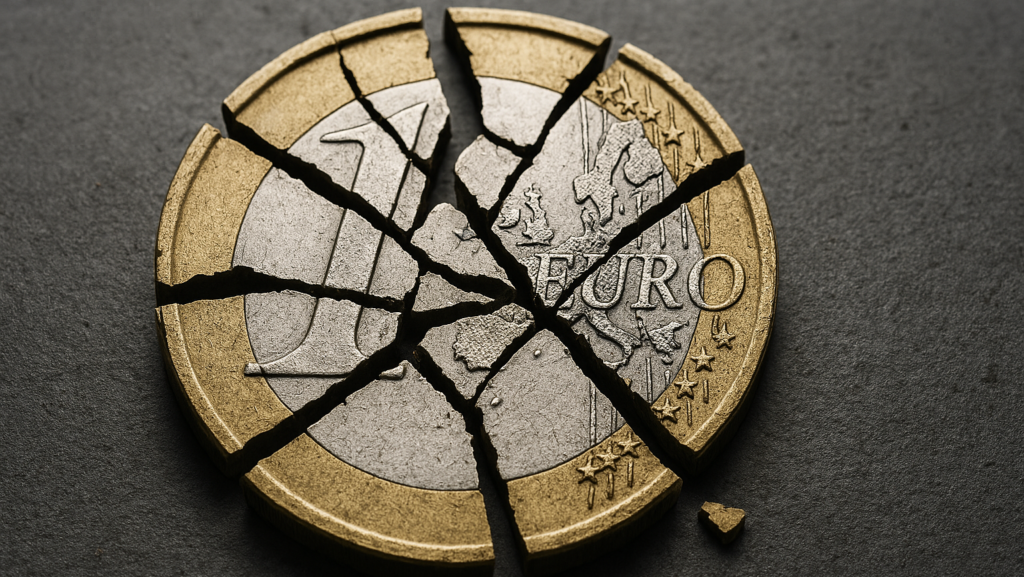
The idea of a Europe-wide currency has been around for a long time, but it began taking concrete shape in the 1980s. As the EU formally replaced the European Communities in the 1990s, the currency union also became a reality. Minted at the turn of the millennium, the euro has now been a monetary reality for a quarter of a century.
With the currency union growing and adding new members—Croatia joined in 2023 and Bulgaria will join in January—it might seem peripheral, maybe even a waste of time, to ask if Europe could handle the dissolution of the currency union. After all, if new countries want to join, what is the point in considering a dissolution in the first place?
The question of the future of the euro is in part motivated by the perennially poor performance of the European economy; the common currency was sold to Europeans back in the ’90s as a catalyst for growth and prosperity.
In part, the question of the future of the euro springs from Elon Musk’s audaciously truth-to-power comment on X recently, where he called for the dissolution of the European Union.
As a thought experiment, I decided to take Musk’s words literally and explore the consequences of the termination of the EU. My focus was entirely economic, with the conclusion that should the EU vanish tomorrow, Europe might be facing a brighter economic future than under the heavy hand of the Brussels bureaucracy.
However, I left one question unanswered: would the European economy benefit from a dissolution of the euro zone?
To answer this question, we need to take a dive into the academic literature, specifically that which deals with so-called optimal currency areas. This concept has a long line of research attached to it, with the starting point being Robert Mundell’s classic “A Theory of Optimum Currency Areas” (The American Economic Review, Sept. 1961). Mundell was awarded the Nobel Memorial Prize in Economics for founding this vibrant strain of research.
When the euro zone was first conceptualized, the assessment by its backers was that the currency area would indeed be optimal. The original principle behind the EU itself was a punchline-style summary of that optimal currency area: the union would promote four freedoms, i.e., the free mobility of labor, capital, goods, and services.
If these four freedoms had been fully implemented, the EU would have created the world’s first synthetic optimal currency area. It would be synthetic in the sense that it did not grow organically from the gradual formation of a nation-state with a need for a common currency, nor from the gradual, time-tested economic integration of separate countries. The euro zone would be—and in fact is—the result of legislative fiat, a process that greatly sped up the transition from national currencies to the euro.
Despite its synthetic nature, an optimal euro zone would still contribute greatly to the European economy. It would have elevated the continent to economic and financial global leadership.
Yet none of this happened. Why?
The reason is as tragic as it is symptomatic of what the European Union became. Instead of building a foundation for a free, integrated, continent-wide economy, the EU has become a superstructure that imposes its own ideas on its member states. As a consequence, the euro zone has been a catalyst for economic stagnation—not economic success.
In the early 1990s, when the concept of the euro reached ‘reality’ status, the academic research on its potential was quite clear. The euro zone was not going to be an optimal currency area. If the EU wanted one, its political apparatus would have had to focus on achieving optimality right from the start.
The academic research was unequivocal on this point: Europe needed to make sure its production factor markets, i.e., the markets for labor and capital, were fully integrated. Here are some examples.
Roland Vaubel, in “Currency Competition and European Monetary Integration,” The Economic Journal, Sept. 1990, explains that without proper integration of labor and capital markets, the euro zone would never be an optimal currency area. As a suboptimal area (a term Vaubel does not use), the euro zone will have to allow for significant price volatility. Since prices are not flexible enough to allow such volatility, the only remaining alternative is a suppression of economic activity in some countries while others thrive—again: macroeconomic instabilities.
This is exactly what has happened. The crisis in Greece, Italy, Spain, and other countries 15 years ago was a parade-worthy example of macroeconomic instability in a sub-optimal currency area.
In an article called “Is Europe an optimum currency area? Symmetric versus asymmetric shocks in the EC,” in the May 1993 issue of the National Institute Economic Review, Gugliermo Caporale confirms much of what Roland Vaubel said. When countries have their own currencies, they adjust differences in the business cycle with fluctuations in their exchange rates. If Poland is experiencing a recession but Germany is going through a growth period, the Polish zloty will weaken vs. the German mark (assuming no euro) until the exchange rate has given the Polish economy a good enough boost to ‘catch up’ with the German economy.
Economists, who love using fancy terms for plain-as-vanilla things, refer to these business-cycle differences as ‘asymmetric macroeconomic shocks.’ Caporale explains that under a common currency, asymmetric, i.e., country-specific, recessions will obviously not be contained by shifts in exchange rates. Instead, they will spread to other euro-zone countries.
This could be prevented, according to Caporale, if the euro zone’s labor markets were sufficiently integrated. If they are not, he explains (p. 95),
asymmetric shocks result in high costs of adjustment, in terms of higher unemployment and lower output
Caporale wrote this in 1993. He predicted with chilling precision what the euro zone has in fact been plagued by since it was formed. His prediction is shared by Giorgios Karras (“Is Europe an Optimum Currency Area?” Journal of Economic Integration, Sept., 1996) and Christian Schmidt (Real Convergence in the European Union: An Empirical Analysis, Peter Lang AG 1997).
In other words, there was no shortage of warnings to the European Union not to go ahead with the euro zone unless it had a major plan for implementing the free mobility of labor, capital, goods, and services.
Leaping ahead to 2004, Stephen Silvia (“Is the Euro Working? The Euro and European Labour Markets,” Journal of Public Policy, May-Aug. 2004) finds that despite more than a decade of time to make adjustments toward an optimal currency area, the EU had made no such progress by the time the euro was formally minted. His findings were confirmed by Paul Krugman in his 2013 article “Revenge of the Optimum Currency Area” for the NBER Macroeconomics Annual.
Instead of integrating the European economy, the EU was preoccupied with integrating fiscal policy, i.e., making sure all countries, especially those in the euro zone, aligned with the Stability and Growth Pact (SGP). This feature of the EU constitution dictates that member states cannot exceed 3% of GDP in budget deficits and 60% of GDP in public debt.
The implementation and enforcement of the SGP became the EU’s instrument for ‘harmonizing’ euro zone economies with one another. In an evaluation of the euro zone, “Optimal Payment Areas or Optimal Currency Areas?” (AEA Papers and Proceedings, May 2018) Columbia University economists Patrick Bolton and Haizhou Huang demonstrate that in lieu of optimizing economic integration, the only recourse for governments that want to save a currency area is to eliminate so-called fiscal asymmetries.
In short, punish excessive debt and deficits until every euro-zone government is laser-focused on balancing their budgets.
Initially, this focus led to exacerbated so-called asymmetric shocks, gaping differences in unemployment, and glaring discrepancies in capital formation. The only reason why such structural differences have not torn the euro zone apart is that over time, the rigorous enforcement of the SGP dampened economic activity in the strongest euro zone countries. This effect was strong enough to pull down the entire currency area into a state of economic stagnation.
In short: the only reason why the euro zone has survived for 25 years is that its governments have competed in a race-to-the-bottom pursuit of economic stagnation. With no growth, there are no differences that demand the full functioning of the EU’s original four freedoms; with high unemployment all over the continent, there is no need for labor-market flexibility.
Now: what does this whole review of economic research tell us about the prospect for the European economy if the euro ceased to exist tomorrow? The answer is short and simple: a return to national currencies with flexible exchange rates would allow the 20 euro zone economies to grow and evolve, each at its own volition. There would be price stability; if another inflation shock happened, like the one we had a couple of years ago, it would be contained by the flexible exchange rates.
Since the end of the euro zone is predicated on the dissolution of the EU, there would no longer be anyone there to enforce the SGP. This, in turn, would allow Europe’s governments to conduct fiscal policy based on their own national goals and needs. Some would run bigger deficits; others would achieve surpluses in their budgets. The differences would be worked out by the exchange rate mechanisms.
Over time, though, the macroeconomic differences between the individual countries would shrink to relative insignificance. This happens when countries trade and when they have free flows of capital. Ironically, this type of organic economic integration would do more to bring Europe into compliance with the criteria of an optimal currency area than the euro zone has ever done.
In short: if it ever came to this, Europe should not fear the end of either the EU or the euro.