

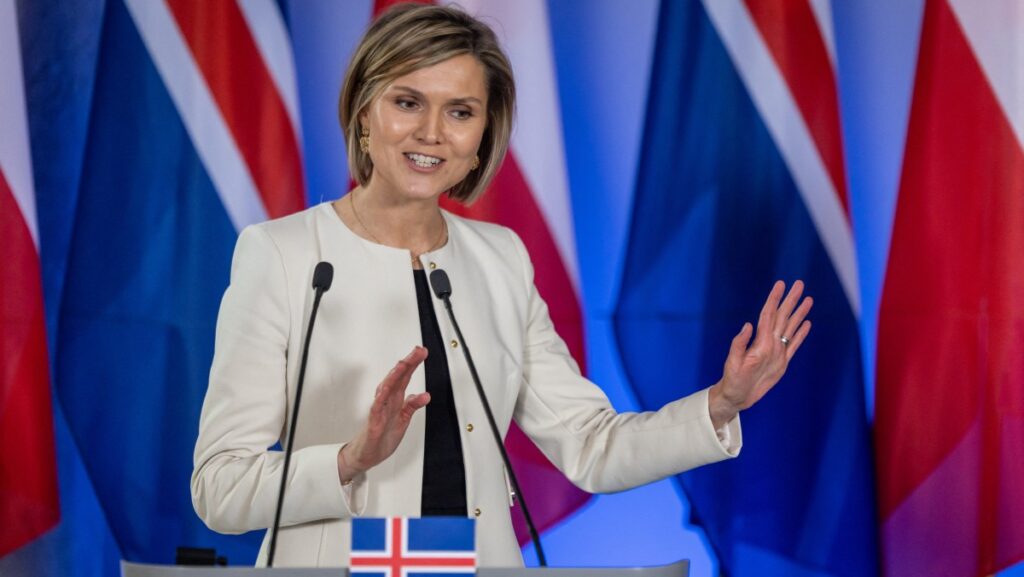
Iceland’s Prime Minister Kristrún Frostadóttir attends a joint press conference with Poland’s Prime Minister (not in picture) following talks in Warsaw on February 25, 2026.
Wojtek RADWANSKI / AFP
Iceland is again flashing red. Being hailed as the world’s “most equal” society, Iceland tops the World Economic Forum’s Global Gender Gap Index with a score of 92.6%—the only country above 90% and leading for an unprecedented 16 consecutive years.
However, just as Iceland’s 2008 financial meltdown—fueled by extreme deregulation, sky-high leverage, and collective denial—served as the canary in the coal mine for the global financial crisis, alarm signs are again flaring from the island. Nowhere in the world has feminization advanced further and faster than in Iceland. Women dominate in all areas of life, especially education—massive majorities in humanities, teacher training, and overall university enrollment skew heavily female—and hold most top leadership roles.
It’s the same dynamic: an early adopter of extreme policies. In 2008, it was laissez-faire finance; now law nr. 10/2008’s aggressive gender equalization has mandated tipping the scales artificially, causing rapid institutional shifts and visible downstream fallout.
For the first time ever, women occupy virtually every pinnacle of power in Iceland: This is no mere increase in female participation—it’s the Great Feminization, as Helen Andrews termed it last October in her controversial article for American Compact magazine: key institutions tipping from male-majority to female-majority at unprecedented speed. Never before have women commanded such comprehensive institutional dominance and political power.
The Great Feminization isn’t an abstract theory; it’s a historic revolution unfolding in real time in small, hyper-progressive Iceland.
For decades, we’ve been told the West suffers under patriarchy. The reality, however, is that we’re entering matriarchy territory, with no historical precedent for long-lasting success. Iceland exemplifies the endgame: women now hold nearly all top leadership roles, from president and gay rights activist Halla Tómasdóttir, Prime Minister Kristrún Frostadóttir, and Foreign Minister Þorgerður Katrín Gunnarsdóttir, to the heads of coalition parties (all three female-led), the Director of Public Prosecutions, the Director of Health, the Speaker of Parliament, the bishop of the Icelandic State Lutheran Church (a ‘trans’ mother and activist), the Reykjavík mayor, and the rectors of all major universities.
Yet beneath Iceland’s progressive sheen, deep societal fractures are emerging: mental health crises, chronic depression rates, sky-high antidepressant use, economic pressures, soaring living costs, and a culture increasingly prioritizing emotional safety and cohesion over hard-edged realism, objective rigor, and debate—at the expense of merit and realism. If feminization’s downstream effects hit hardest here first, the rest of the West should pay attention.
Andrews writes: “Wokeness is not a new ideology, an outgrowth of Marxism, or a result of post-Obama disillusionment.” It is, in fact, feminine behavioral patterns institutionalized. As she points out, the timeline matches the shift. Psychology, publishing, and media have feminized similarly worldwide. U.S. examples abound—New York Times staff majority-female by 2018 (now 55%); medical schools in 2019, professoriate in 2023—but Iceland’s imbalances are extreme. At the University of Iceland, women now comprise 58% of academic staff and faculty, having become the majority since 2018–2019. Women make up around 65–69% of students overall (per recent Times Higher Education rankings, far above OECD averages), and Iceland leads the charge.
Iceland pours extraordinary resources into education—with spending at 5.6–6.7% of GDP (well above the OECD average of 4.7–5.1%) and per-student expenditure around €15,040 across levels, far exceeding OECD norms. This funds high teacher salaries. Iceland’s education system is overwhelmingly female-dominated: women make up 80 percent of all teachers, one of the highest rates in the OECD.
The results, however, are damning: lavish spending yielding exceptional ‘equity’ but middling-to-below-average PISA results and a long-term slide in core skills. In PISA 2022, Icelandic 15-year-olds scored well below OECD averages across the board—459 in mathematics (OECD: 472), 436 in reading (OECD: 476), and 447 in science (OECD: 485)—ranking Iceland near the bottom among high-spending Nordic and European peers. Scores have declined steadily over two decades (e.g., reading fell 70 points since 2000, math dropped 36 points from 2018 alone), outpacing most peers’ slides and equating to roughly a year’s learning loss in recent cycles.
This is the feminized education sector in microcosm: women comprise 80–85% of primary and lower-secondary teachers (with pre-primary nearing 94%), and over 90% of students in teacher-training programs at the University of Iceland are female. The system prioritizes emotional safety, inclusion, reduced competition, and ‘care’ over rigorous challenge, merit-based rigor, and knowledge application. High costs buy access and equity, but not competence or ‘smarts.’
What Iceland has to show for its investment are gilded classrooms where empathy reigns and students lag in real-world problem-solving, boys disengage more sharply, and the nation pays dearly for outcomes that trail far less generous systems. Iceland’s education experiment—extreme feminization backed by opulent spending—delivers not excellence, but mediocrity masked as progress. The canary isn’t only wheezing; it’s failing the test.
“The threat posed by wokeness can be large or small depending on the industry,” Andrews writes. “It’s sad that English departments are all feminized now, but most people’s daily lives are unaffected by it. Other fields matter more.” The field that Andrews says frightens her most is the law:
All of us depend on a functioning legal system, and, to be blunt, the rule of law will not survive the legal profession becoming majority female. The rule of law is not just about writing rules down. It means following them even when they yield an outcome that tugs at your heartstrings or runs contrary to your gut sense of which party is more sympathetic.
As women fill judiciaries, the justice system shifts toward feelings and relationships over rules.
If these priorities manifest themselves in feminized institutions, then Iceland’s rule of law is at risk. Iceland’s director of public prosecutions, is (of course) a woman. Thirteen prosecutors work under her, nine of whom are women. That leaves four men, two of whom are assistant prosecutors.
The best-known victim of the Icelandic trend toward female-feelings-over-facts, law be damned, is Iceland’s former assistant director of public prosecutions, Helgi Magnús Gunnarsson. His boss, Director of Public Prosecutions Sigríður Friðjónsdóttir, said Gunnarsson’s controversial comments that many immigrants’ claims about being persecuted in their home countries (in order to gain asylum status in Iceland) based on their sexual preferences were suspect, had shown “prejudice against immigrants, gays, and lesbians.” For this, Gunnarsson’s superior Friðjónsdóttir, herself a lesbian, decided to “keep all cases from him” and “refuse his work.” This despite the law, which clearly states that only the minister of justice has the power to interfere with the employment status of the assistant director of prosecutions.
The rule of law demands rigorous loyalty to objectivity and facts, even if the outcomes are uncomfortable or hurtful. Women prioritize empathy, safety, and cohesion over rationality, risk, and merit. Moral psychology confirms the divide: women emphasize care; men prioritize justice. Male-led systems run on rules and objectivity; female-majority ones tilt toward feelings, relationships, and bias. Women dislike freedom of expression as much as we dislike facts: polls asking which is more important, freedom of speech or an ‘equal’ society, two-thirds of us support an ‘equal’ society, while two-thirds of men support freedom of speech.
Why is everything worse in Iceland, the West’s Valkyriemostest Dreamland?
Life sure isn’t safer, more productive, or more affordable than it was a quarter-century ago. Iceland’s “most equal” status clashes hard with reality: the country ranks 7th most expensive overall in Numbeo’s 2026 Cost of Living Index, driven heavily by housing.
Since 2000, real estate prices have surged dramatically, a cumulative increase of approximately 710–712% (adjusted for inflation, the increase is around 300–400%). Overall, Iceland is among the top 10–15% of the world’s most expensive and least affordable housing markets. It’s behind only places like Switzerland, Singapore, and Bermuda, with housing as the dominant factor.
Iceland’s promises of equality meet harsh economic walls, especially for families and the young. High wages and gender parity don’t translate to accessible housing. Mortgages as a percentage of income hover at 82–85%, one of the highest globally, meaning typical buyers spend most of their income on housing debt—far above OECD averages and contributing to burnout and delayed family formation.
No wonder mental health has plummeted: Iceland consistently ranks highest in Europe for antidepressant use (prevalence far above Nordic peers, with long-term increases) with 16% reporting chronic depression. In the Valkyrie Equality Dreamland, most mothers cite work burnout.
Why is everything worse in the world’s most ‘equal’ country? Perhaps it is because we have eradicated “the four cardinal virtues” that our ancestors, according to our Icelandic sagas, believed “should characterize every decent person: wisdom, justice, humility… strength.”
Vilifying masculinity and traditional masculine qualities—like manliness, honor, physical strength, courage, and integrity—leaves a vacuum that women are physically and mentally incapable of filling on a large scale and long term.
Men, denied outlets for progress and productivity, retreat or disengage. Society runs on emotions, dreams, and codependency instead of realism and courage. Feminine governance prioritizes individual protection—the child, the vulnerable—over the group, favoring discussion and anecdotes over debate, logic, and harsh realities. Despite this, however, we don’t hesitate to sacrifice women on the altar of feminism. Sending women into combat or high-risk policing isn’t empowerment—it’s a perversion. Recall the female Secret Service agents shielding President Trump by crouching behind him during an assassination attempt? It was a natural response, but incompatible with duty. It was simply a reality check from reality.
Democracy and the rule of law demand unflinching objectivity and dedication to the truth. Female-majority governance, merit be damned, risks kakistocracy—rule by the least competent—or outright idiocracy. Iceland exemplifies this. Law No. 10/2008 mandated aggressive “purposeful” gender equalization in the workplace, tipping the scales artificially in women’s favor. Positions that weren’t needed were invented for women; political parties placed unqualified women high on lists for optics. Universities censor ‘dangerous’ or ‘harmful’ ideas to protect emotions. Immigration laws and rules are violated or ignored if enforcement might hurt someone’s feelings.
This must stop. As Andrews writes, feminization is social engineering; remove the artificial weights favoring women, and it collapses in a generation. Eliminate unneeded positions created for quotas. Dismantle HR departments engineered for “friendly” environments that often alienate and are hostile to men. Address the two-income trap with policies that enable single-breadwinner families.
Iceland’s near-total female dominance in top roles reveals the endgame: a society heading toward ruin. As women dominate governance and institutions, systems shift toward care over rules. Iceland’s near-total female hold on apex roles reveals the irony: the “most equal” nation edges toward one without truth-seeking institutions, robust borders, rule of law, and merit-based realism. We risk becoming the first idiocracy—unless we restore balance before it’s too late. Iceland’s trajectory isn’t paradise—it’s a cautionary signal.
The canary is singing again. Will we listen before the mine collapses?


One Response
Interesting article. It made me think. In my job I’ve worked with 95% woman. I have respected them, befriended them and married two of them. Iris is right, in that some woman, not all are stepping out of their role in life. I call them the typical mentally ill elite liberal democrat socialist. They are the deraiged leftists indoctinating our kids in schools, they are politically 180 degrees opposed to the conservative male. They don’t raise families or keep a home. They think their role in life is to change society and Civilization. Totally un natural role. They don’t think man like in male is capable of doing anything right so they raise them to be submissive to what they believe. I am not sure but we have a situation where neither man or woman are playing their designated roles in life. Just my observation. Thanks for the article it made me think.