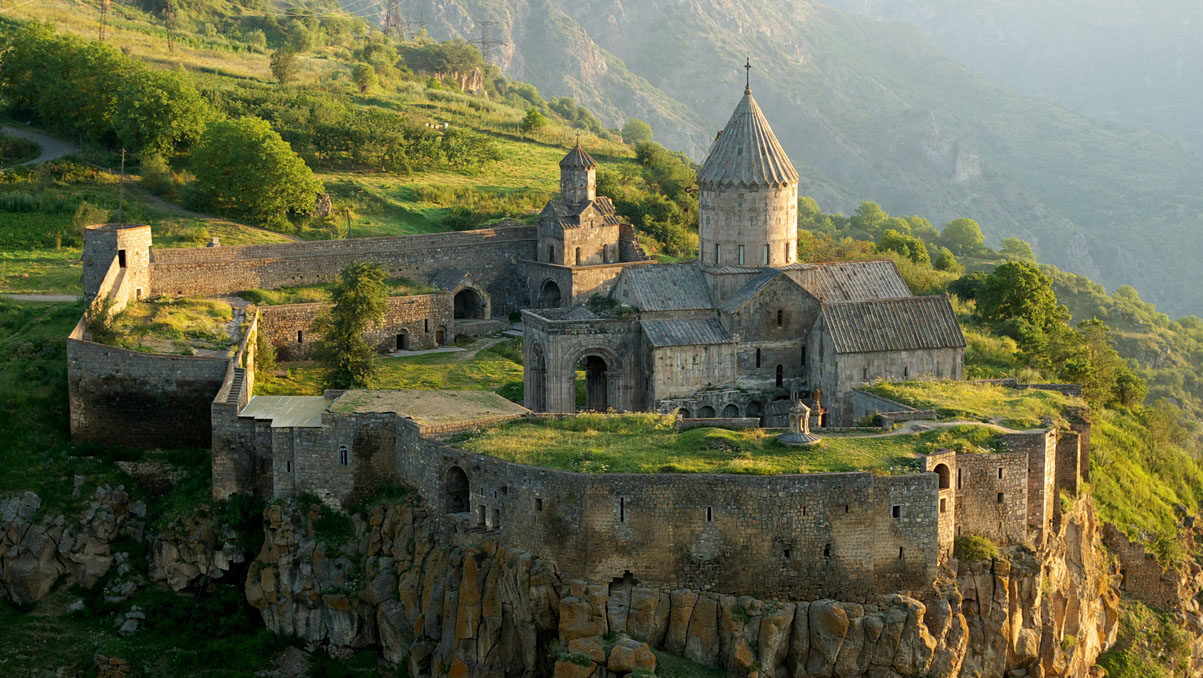
A view of the 9th century Armenian Monastery of Tatev in southern Armenia.
Photo by Alexander Naumov, CC BY 3.0 via Wikimedia Commons.
“The best response to the violence is not hatred, but the daily courage of those who continue to believe that ideas are fought with other ideas. Never with violence.”
Grachia Margarian is an Armenian entrepreneur and social activist who leads institutional projects via the National Center Development Foundation and the White Cross Foundation. His academic and professional qualifications encompass a range of disciplines, such as politics, international relations, theology, construction engineering, and international business, and include degrees from the University of Oxford, Università Cattolica del Sacro Cuore, Moscow State Institute of International Relations, and the Far Eastern Federal University.
To fully grasp the essence of Armenia and its vital role as a bastion of Europe, it is essential to contextualise its history. Armenia played an invaluable role in the formation of a cohesive pan-European space through the adoption of Christianity as the state religion in 301 AD. As the first Christian state, Armenia spearheaded missionary efforts that significantly influenced the Christianisation of many contemporary European nations. A notable example is Saint Servatius, an Armenian missionary who became the first bishop and baptised what are now the Netherlands and Belgium. During the Byzantine imperial age, many emperors and prominent figures in Byzantine society were of Armenian descent, effectively intertwining Latin, Greek, and Armenian cultures within the empire. Furthermore, the establishment of the Armenian Cilician Kingdom marked Armenia’s transformation into a quintessential Western European state, characterised by dynastic alliances with French royal families.
Despite its substantial contributions to pan-European culture, Armenia faced challenges that led to a decline in its state role due to Islamic invasions and its incorporation into the Ottoman Empire following the fall of Byzantium. Yet Armenian influences on cultural and developmental aspects of Western Europe have continued, albeit in more subtle forms. Today, the country remains a vital outpost of European heritage, representing the confluence of ancient and Christian culture.
An awareness of my country’s complex past has shaped my own sense of being Armenian. Living outside my homeland—in the Russian Far East, Moscow, and in several Western countries including Italy, the United Kingdom, and Switzerland—has alerted me to the possibility of a unified community across Greater Europe, extending from Lisbon to Vladivostok, and even more broadly from Vancouver to Vladivostok. Not long ago, this vision seemed like a distant and utopian ideal. However, in today’s polarised world where nations increasingly cling to their identities, this vision has acquired even greater importance in both politics and public discourse. To my mind, Armenia continues to embody that vision, as a uniquely powerful civilisational symbol.
Importantly, this concept transcends issues of ethnicity or nationality; it revolves around a person’s self-awareness and connection to the European tradition, which profoundly influences political dynamics and societal development. After gaining extensive experience across our pan-European landscape, I made the decisive choice to repatriate to Armenia five years ago, following the tragic war in Nagorno-Karabakh (Artsakh). In doing so, I was moved by the desire to support the development of Armenian institutions, which will in turn favour growth and civic improvement at a microsocial level. This longing for and propension to returning is, in my understanding, another core feature of an Armenian identity, especially if one thinks of the systematic, brutal displacement our people have suffered in the last century.
Ultimately, I understand and experience being Armenian as being both bearer of and heir to a rich pan-European Christian culture, which has long unified the European community through shared (and universal) values. The spiritual aspect carries immense significance, in this respect: a Christian ethos shapes the daily life, work, art, culture of Armenians like me, and nourishes a worldview that honours personal dignity. This identity is not just a part of my own heritage; it is a vital force that drives me to contribute meaningfully to the future of Europe.
Our approach is centred on healthy, classical conservatism. Unfortunately, in many countries, conservatism has been distorted and has morphed into extreme populism or outright fascism. The conservative movement in Armenia, instead, is largely a response to the aggressive actions of authoritarian Muslim neighbours and therefore serves as a vital means of self-preservation. Concretely, I am building strong relationships with like-minded people across Europe and fully engaging in a variety of conferences and events. Each year, our Foundation proudly hosts a distinguished public figure, politician, or intellectual to Armenia to deliver impactful lectures and speeches. This year, we have invited a renowned politician, a leading professor of religious studies, and a respected Christian leader to share his insights and perspectives. Additionally, we are planning to hold a Conservative Forum in Armenia focussed on enhancing political literacy, fostering national identity, and addressing the pan-European agenda of our country.
We are also engaged in numerous institutional and intercultural initiatives that will eventually lead to the establishment of a robust movement and a political force. For instance, we are implementing several Monument projects through our National Center Development Foundation. We are creating a monument to one of the first female diplomats, Diana Apcar, as well as a monument to the international lawyer Raphael Lemkin. Additionally, we plan to erect a monument to St. Servatius in Yerevan. Furthermore, we are developing institutional projects aimed at streamlining and enhancing the operations of various state institutions. For example, we have developed the most effective business platform in Armenia, which assists foreign entrepreneurs in integrating more easily into the local business environment.
Concurrently, I organise various events in partnership with European organizations and Churches through the White Cross Christian Foundation. I would like to mention the Divine Service we recently organized in Oxford to further the memory of the holy martyrs of the Armenian Genocide. This event was held in collaboration with the Oxford’s University Church of St. Mary the Virgin and marked the first Armenian service at this Church, symbolising Christian solidarity and serving as a heartfelt remembrance of the genocide’s martyrs.
When it comes to Armenian-Azerbaijani relations, their long-term and sustainable development, and the seemingly positive outcomes of the recent deal, it is essential to recognise a preliminary, indisputable truth: Azerbaijan launched an unprovoked and illegal full-scale war against Armenia in Nagorno-Karabakh in 2020. This fact is even openly acknowledged by their own government. After a first war in the early 1990s, the structure of the Minsk Group was established as a guarantor of peace, involving the co-chairs from the United States, France, and Russia. This framework mandated that the conflict be resolved solely through political and diplomatic means, explicitly prohibiting military aggression. Yet Azerbaijan flatly ignored that.
Given these circumstances, any internationally mandated dealings with those who initiated that conflict, employed disproportionate force, and perpetrated ethnic cleansing against our ancient Christian population can only be inherently unstable. The context of these relations often eludes external observers, who may not grasp the continuous, unbroken threats posed by Azerbaijan. Despite the attacks on Nagorno-Karabakh and the ethnic cleansing that took place, the Armenian government remains committed to maintaining a comprehensive and mutually beneficial condition of peace with Azerbaijan.
At the same time, the EU’s civilian observer mission on the Armenian border plays a critical security role. It exemplifies Europe’s commitment to Armenia’s sovereignty. The recent initiative by local pro-European forces for Armenia’s accession to the European Union has gained considerable public support and stands as a testament to the country’s aspirations for integration into the European community. The adoption of this draft law by the Armenian parliament is welcome and momentous: it will inevitably define Armenia’s foreign policy and reinforce its identity as a prospective EU member. Looking ahead, Europe has an opportunity to step up as a proactive mediator in the peace process, recognising Armenia’s alignment with democratic values while addressing the aggressive postures of its neighbours. The Conservative movement I am trying to shape will be crucial in making that process both smoother and consistent with our identity.
There seems to be a palpable sense of optimism worldwide for the active leadership of this new Pope, which I share. I am confident that, in the coming years, the Vatican’s international role will be enhanced by adopting a clearer and more assertive stance, particularly in matters of morals and international relations. We are currently facing a geopolitical crisis, with the international legal system struggling to address aggressor nations, and global institutions largely failing to fulfil their roles. This, combined with the spreading of conflicts, demands determined global leaders, who can leverage willpower and authority to resolve these crises. This seems particularly true if one looks at the new Pope’s recent statements regarding the Eastern Churches. By reiterating the crucial historical role of the Eastern Churches in spreading Christianity, Pope Leo has expressed a stance that is singularly favourable to the affirmation of Armenian protagonism, for the historical reasons I tried to highlight earlier.
This evolution is made all the more urgent by the leadership crisis unfolding within the Armenian Apostolic Church. As an Armenian Orthodox, I view the East and West of Christian Europe as two lungs of a single organism, however ill. In my work at my White Cross Christian Foundation and in my academic endeavours, I have strived to amplify the appeal of our shared spiritual values to European peoples. To foster dialogue and understanding among various Christian traditions, we organise inter-church events and educational initiatives. Recently, we hosted the Princeton University Spiritual Choir in Yerevan as a powerful symbol of dialogue and unity among different Christian traditions. In my doctoral research, I am defining the formula for unity among the historic churches—Ancient Armenian, Greek Orthodox, and Roman Catholic—and am committed to strengthening ecclesiological dialogue. Furthermore, our non-profit initiatives and business projects are consistently inspired by Christian principles, reflecting in our social responsibility, transparency, cultural and educational efforts, and the Christian symbols integrated into our organisations. These are all fields of dialogue and action where a renovated, robust Catholic leadership, currently embodied by pope Leo, can operate as a uniquely effective catalyst of renewed social cohesion in the West. Although I am not Catholic by confession, I am certainly inspired by this prospect.
Armenia’s integration into the EU represents a natural cultural and political alignment that positions the country not just as a participant, but as a contributor to the Continent’s future. The nation’s prosperity and resilience can have a profound impact on all European countries and bolster Europe’s leadership in an increasingly competitive and aggressive global arena.
Today, Armenia is recovering from the tragic impact of war and the significant influx of refugees following the ethnic cleansing in Nagorno-Karabakh. Despite those challenges, its economy is thriving due to the redistribution of regional trade and financial flows. Global Western corporations are increasingly establishing their production facilities and offices in Armenia, drawn by its exceptional intellectual and human potential. Recently, NVIDIA announced a $500 million public-private partnership with the Armenian government to create a major AI infrastructure hub in the region. The goal is to launch the first large-scale AI supercomputer in the South Caucasus by 2026. Our Foundation has also initiated activities in the IT sector, and we are currently developing the Armenian Institute of Innovation. Prior to this, we held the INNO Armenia Innovation Forum, which aimed to raise public awareness of innovative and technological opportunities.
As for support from the international community, France remains the most active player and closest partner to Armenia. In the last few years, Paris has supported Armenia’s defence of its sovereignty by training special forces as well as by providing military resources, such as radars and armoured vehicles. France also continues to plan engagement in joint infrastructure projects on energy, digital, and road networks as much as for water pipelines and tunnel building. Additionally, in early July, EU High Representative Kaja Kallas visited Armenia, emphasising the unprecedented closeness between Armenia and the EU. My hope is that, with the EU’s direct involvement, other EU member states will consider strengthening their economic ties to Armenia, thus boosting our markets’ confidence and help our entrepreneurs and ruling class make the most of these extraordinary opportunities.