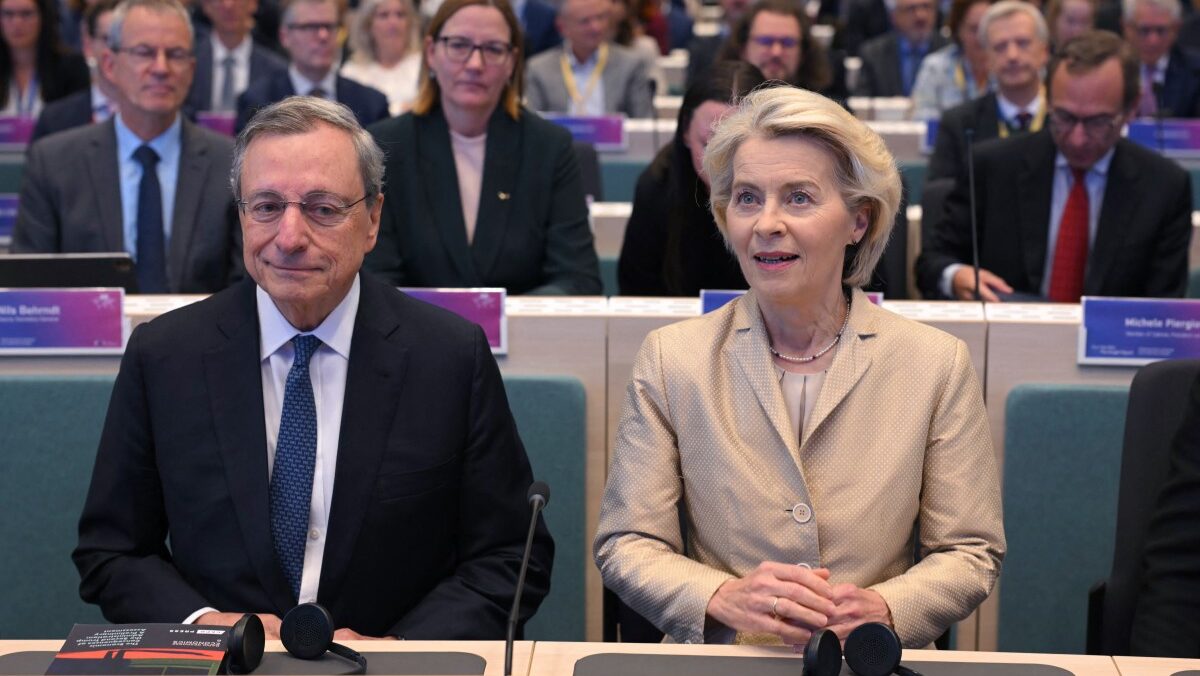
Seen here next to EU Commission President Ursula von der Leyen is Italian economist and former European Central Bank president Mario Draghi, whose proposal for “pragmatic federalism” would entail “the construction of a centralised state through the continued usurpation of competences by the EU in areas to which it has no treaty entitlement,” Jacek Saryusz-Wolski said.
NICOLAS TUCAT / AFP
Mario Draghi has said out loud what many in Brussels have long implied. Speaking at the University of Leuven, the former Italian prime minister and ex-president of the European Central Bank called for a gradual transformation of the European Union into a federation—what he labelled “pragmatic federalism.” Europe, he argued, must either become a genuine power or resign itself to being little more than a large market shaped by others.
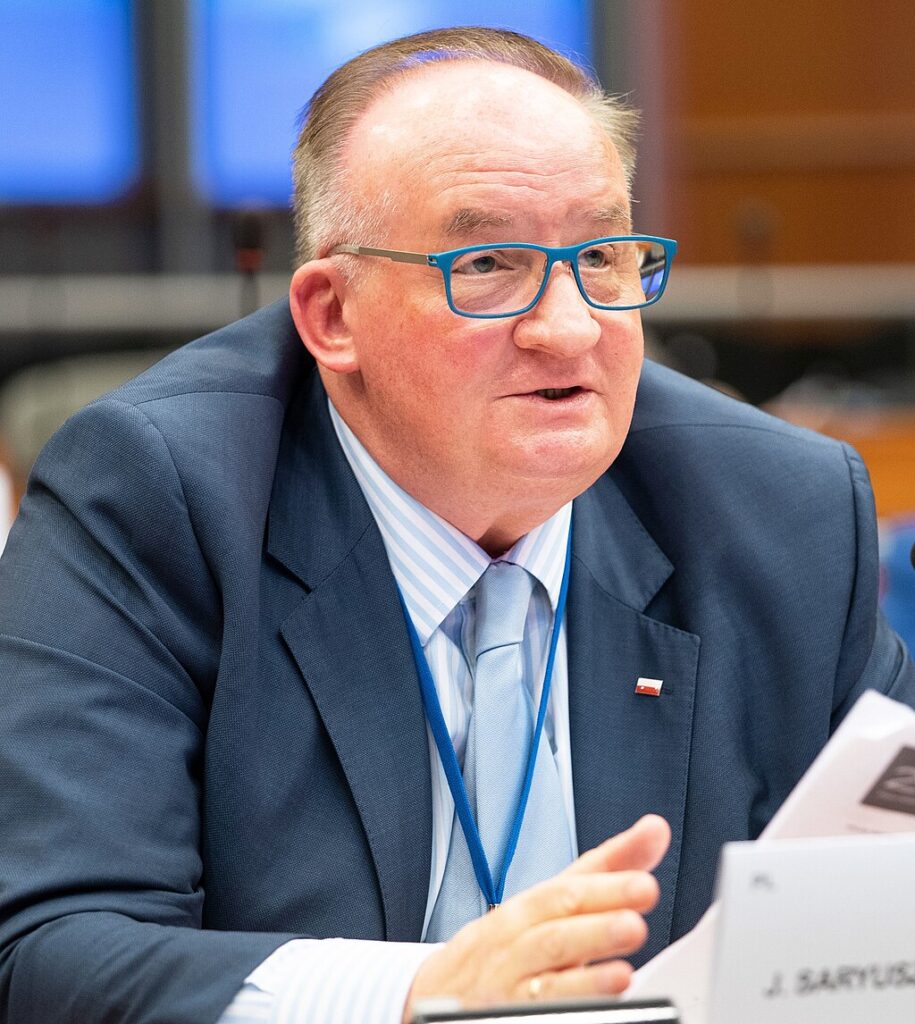
Federalisation, once dismissed by critics as a ‘conspiracy theory,’ is now openly advocated by one of the most influential figures in Europe’s technocratic elite. But does Draghi’s diagnosis of Europe’s malaise hold up—and would his proposed cure make the patient stronger, or merely more centralised and less democratic? We examine Draghi’s thesis with Jacek Saryusz-Wolski, a veteran EU insider, former vice-president of the European Parliament, Poland’s first Minister for European Integration and currently adviser to Polish president Karol Nawrocki.
It was not the first time that the idea of turning the EU into a state has been articulated openly. Similar notions appeared, for instance, in the CDU/CSU–SPD coalition agreement of a previous German government. Mario Draghi himself has spoken in these terms before. What makes this speech distinctive is twofold. First, it offers a comprehensive vision—a synthesis rather than a passing remark. Second, and more importantly, it comes at a very specific moment. Draghi explicitly anchors his argument in what he presents as an exceptional global conjuncture: geopolitical rivalry between the United States and China, economic turbulence, war, and Europe’s weakening industrial base. These challenges are framed as urgent pressures that allegedly leave Europe with no alternative but rapid institutional transformation. In other words, Draghi presents federalisation not as a political choice, but as a historical necessity. That framing is what gives the speech its particular weight.
Without exaggeration, Mario Draghi can be described as a guru of the Brussels elite. He is regularly mentioned as a potential successor to Ursula von der Leyen. More importantly, his diagnoses and prescriptions are listened to with great seriousness. He is scheduled to address the upcoming informal European Council summit on February 12, advising EU leaders on how to respond to the current situation. That alone demonstrates that this is not the voice of just another federalist intellectual. It is the voice of a man treated as authoritative and competent by Europe’s governing class.
I disagree fundamentally, starting with the language itself. The current EU system is not federal; it is anti-federal in its very design. In a genuine federation, constituent units are equal components of the whole. The EU, by contrast, operates on population-weighted voting, which structurally favours larger states. That is not federalism—it is hierarchy. What is being proposed resembles less a federation than a centralised entity with a hegemon and subordinate provinces, closer in spirit to the Second German Empire or even a feudal structure. That, however, is a preliminary point.
Substantively, the idea that all major problems can be solved by building a central state runs counter to both logic and historical experience. Europe’s problem is not an excess of decentralisation or deregulation. It is the opposite: too much centralisation and too much regulation. The diagnosis may be partially correct—the therapy is not. History offers ample evidence. Argentina’s recovery from economic collapse followed deregulatory rather than centralising reforms. Decentralisation and subsidiarity unlock economic potential; central planning suppresses it. Western Europe lacks lived experience of command economies. Central and Eastern Europe does not. We know what centrally managed, directive economic systems produce—and it is not prosperity.
There is a clear logical fracture here. Draghi claims that to strengthen Europe’s economy—now rebranded as ‘competitiveness’—we need a more centralised economic base. Yet trade policy is already an exclusive EU competence. And what has that delivered? Where power is most centralised, results are hardly impressive. To argue that the solution is simply ‘more of the same’ is intellectually incoherent. The claim that foreign and security policy require monolithic authority fares no better. The connection between such centralisation and economic revival is tenuous at best. Worse still, the entire concept is deeply anti-democratic. What is striking in Draghi’s speech is what is absent: any reference to democratic consent. There is no mention of asking citizens whether they want such a transformation. Democracy functions—however imperfectly—at the level of nation-states. The proposed experiment would hollow that out and replace it with governance structures at the EU level that lack genuine democratic legitimacy. This would amount to dismantling democracy where it exists and replacing it with technocratic rule. That is the essence of anti-democratism.
No. The primary driver of deindustrialisation is centrally imposed climate policy. Energy costs have skyrocketed, and industry is leaving Europe as a result. That is the root cause. Not insufficient federalisation.
The prescriptions in Draghi’s programme for rescuing the European economy are rooted in a neo-Keynesian approach: stimulating demand through the large-scale issuance of debt. This is a theory that is steadily losing ground and being replaced by what is commonly known as supply-side economics—policies aimed at stimulating and organising production rather than consumption. The American economy is clearly moving in this direction.
From the standpoint of economic doctrine, Draghi’s proposals amount to steering Europe back toward remedies that have already failed, while ignoring the profound shifts currently taking place in the global economy.
It is not realistic—it borders on charlatanism. Creating a European state with its own army is politically and socially unfeasible. There is no public consent for such a project, nor for the taxation it would require. By EU estimates, defence spending would need to reach around 10% of GDP over two to three decades to catch up. There is no appetite for that. Moreover, it is impossible to reconcile four objectives simultaneously: maintaining the welfare state, massively increasing defence spending, and continuing two extremely costly EU policies—climate and migration. German data suggests that migration policy alone costs several percentage points of GDP annually. Climate policy adds another heavy burden. You cannot finance all of this at once. Something has to give. Cutting welfare is politically impossible. Neglecting defence is strategically impossible. The only rational conclusion is that Europe must abandon its current climate and migration policies. Draghi refuses to make that choice.
We would be witnessing the construction of a centralised state through the continued usurpation of competences by the EU in areas to which it has no treaty entitlement—an open violation of Articles 4 and 5 of the Treaty. This power grab may occur abruptly, via treaty change, or incrementally, through what is politely termed competence creep, already visible across at least ten distinct fields.
First, the Union is beginning to strip member states of control over their own territory, borders and, ultimately, the ethnic composition of their societies. The migration pact, the expanding remit of Frontex, and policies amounting to population replacement all point in that direction. Second, the EU is encroaching on what has always been the fiscal monopoly of the state. Under a strict reading of the Treaties, this was until recently prohibited. Today, however, the Union proposes to ‘save itself’ by expanding so-called own resources—in plain terms, by levying taxes that were hitherto the exclusive prerogative of national governments. Third comes debt. The EU is borrowing on a massive scale and using this indebtedness as an extra-treaty instrument to steer national economic policies. The post-COVID recovery fund was the precedent; now this logic is being extended into defence policy through mechanisms such as SAFE. Fourth, there is the euro itself, within which a latent mechanism exists to coerce all member states into adopting the single currency—effectively a compulsory monopoly over the issuance of money.
Fifth, the Union intrudes into the state monopoly over energy policy. Through the Green Deal, it dictates the energy mix in flagrant breach of Articles 192 and 194 of the TFUE, which reserve that competence explicitly to the member states. Sixth, an increasingly politicised Court of Justice of the EU is being used to expand Union competences beyond the Treaties, on the false doctrine that judicial rulings may amend treaties and constitute an independent source of law. They cannot. Seventh, we see tentative steps toward breaching the national monopoly over intelligence services, with embryonic structures emerging within the Commission—without the consent of the member states.
Eighth, the Union is encroaching upon the very core of democracy: elections. The Judiciary Committee of the U.S. Congress has revealed that Brussels interfered in electoral processes in eight countries. Closely related is the mechanism of regime change via budgetary conditionality, embedded both in the Recovery and Resilience Facility and now in the SAFE regulation. Ninth, the EU moves into security and defence, through initiatives such as ReArm and SAFE, despite lacking both the political mandate and the material capacity to function as a genuine defence union. Tenth, and most ominously, it intrudes into freedom of speech and civil liberties. Matters once settled within national democracies are now regulated at the EU level. Under the pretext of ‘technical’ regulation of digital platforms, genuinely Orwellian practices of internet censorship are emerging. I refer here to the Digital Services Act and the European Media Freedom Act—the latter, incidentally, permitting the arrest of journalists in certain circumstances.
All of this suffocates European societies—socially and economically. Draghi’s answer is more of the same. That is precisely the opposite of what should be done. The Union should withdraw from these overreaches, not deepen them.