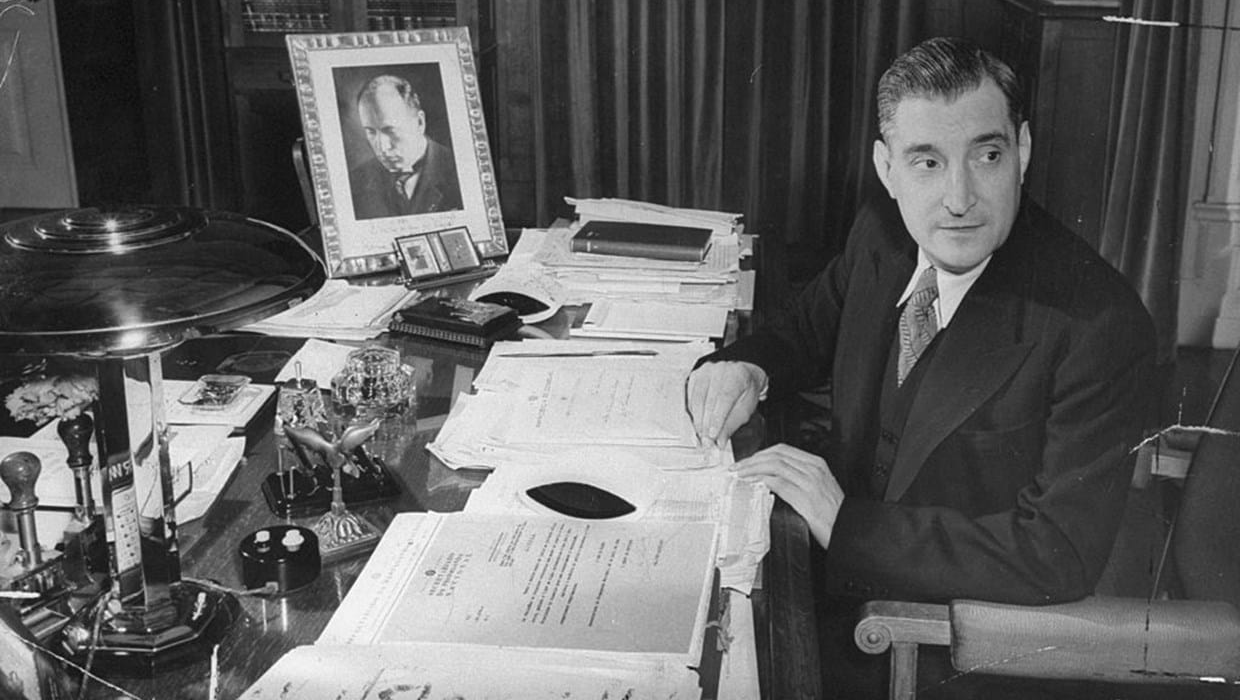
Tom Gerard Gallagher is a British political scientist and historian of modern Europe, best known for his work on nationalism, post-communist transitions, and ethnic conflict. He earned his PhD from the University of Manchester and taught for many years at the University of Bradford’s Department of Peace Studies. He is the author of Salazar: The Dictator Who Refused to Die, a biography of the man who ran Portugal from 1932 to 1968. More recently, Gallagher launched Portugal and the West—From British Ultimatum to Utopian Revolt, 1890-1975: Social Volatility, National Assertion, and Nervous Collapse.
On the occasion of the 52nd anniversary of Portugal’s ‘Carnation Revolution,’ Gallagher talked with europeanconservative.com‘s Rafael Pinto Borges about António de Oliveira Salazar, his Weltanschauung, the Portugal he led, and the Estado Novo regime he established.
In your biography of António Salazar, you argue that Salazar has been unfairly categorized alongside figures like Franco and Mussolini. What distinguishes Salazar’s brand of authoritarianism from fascism, and why does this distinction matter today?
António de Oliveira Salazar lacked the personality and the inclination to impose a regime of unlimited intervention and control on his country. The Estado Novo (New State) was an attempt to depoliticise society. It meant that the arsenal of control and coercion of the party-state totalitarian regime was absent. In order to continue in office as prime minister, it was his political skills, not the state’s means of coercion, on which he principally relied. He did not surround himself with ruthless individuals for whom human life was cheap, or acquisitive ones ready to seize property without hesitation.
Citizens enjoyed important levels of autonomy outside the political sphere. Contrast this, for instance, with the situation in my country where, within a short time of Keir Starmer becoming prime minister, there has been a battery of proposed laws designed to intervene in private life, often at the most profound level.
The justice system in Portugal was not normally viewed as a tool of the regime (although interventions occurred at times of crisis). Controversy has raged about whether censorship was justified. Salazar was in no doubt that it was (though some ministers opposed its retention). He thought the disastrous experiment with the rule of parties (and factions within them), which occurred between 1910 and 1926, meant that the price Portugal would pay for the ascendancy of urban radical factions was simply too high: the nation’s fate could not be left in the hands of parasitic full-time politicians.
Salazar’s opponents understandably magnify the repressive character of the PIDE (International Police for the Defence of the State). It recruited from the police and the army rather than from the regime’s core. In truth, the Estado Novo lacked a core of ideological ultras. The PIDE was aware of what would prove to be the successful conspiratorial movement of 1974, but did nothing because it was given no orders to act. By 1974, it is possible to argue that the regime was less political in character than many other ruling systems in Europe, west or east. It was presided over by an unlikely dictator, Marcello Caetano. He was a fastidious ruler, more preoccupied with scruples than many other leaders of the day.
It is possible to contend that Salazar’s rule wouldn’t have endured if he had been the totalitarian depicted by some of his opponents. He would have been isolated in the era of liberal democracies, which coincided with most of his 36 years as prime minister of Portugal.
Looking at the present and on into the future, I will probably provoke stupefaction in a few places when I dare to say that much of the West is replicating the wild and destructive conditions seen when radical secular experimentation reached its height in Portugal before and after World War I. In countries where unwise pro-open borders policies spill over into uncontrollable levels of conflict, they will be lucky to acquire leadership as restrained and pragmatic as that put in place in Portugal in the 1930s. Portugal enjoyed a soft landing compared to Spain, Italy, and Germany after years of ideological strife.
Instead of recurring denunciations of Salazar’s ‘fascism,’ perhaps it might be worth dwelling on why Portugal avoided bloodshed and tragedy after a long historical period when low-quality leadership had gravely weakened the country.
The muted or defensive reactions to your biography in Portugal, especially from the Left, were striking. Why does Salazar remain such a polarising figure in contemporary Portuguese discourse?
Six decades after his death, Salazar remains a dangerous and inconvenient figure for political forces who wish to popularise the idea that political life centres on a crusade between good and evil. The focus on ideological struggles and culture wars enables the Left to divert attention from its practical record when in power. Salazar, by contrast, preferred to be judged on his governing performance. He focussed on tangible matters at home when his attention could be drawn away from the peninsular and international crises which preoccupied much of his period of rule.
The Left has usually lacked an appetite for dealing with ‘bread and butter issues.’ Instead, it has staked its reputation on issues of principle and morality. But over and over again, this proves to be a camouflage. Its mission turns out to be one of acquiring power and distributing its benefits within its own ranks. This dissimulation makes its mission easier to accomplish. Perhaps even more than Hitler and Mussolini, Salazar was hated because he lacked this acquisitive urge. While it often seemed that totalitarians on the Left and the Right wish to politicise everything they touched, Salazar preferred to depoliticise life as much as possible.
For the Left, depicting Salazar in the darkest light became a necessity and remains one. Exercising sweeping power when Portugal experienced a revolutionary regime in 1974-5 backfired and destroyed the favourable image of the Left among those who had been willing to give it the benefit of the doubt.
On the defensive after 1975, the Left has used the education system and the subsidised state media to advance what it believes are the positive and negative forces in Portugal’s story. The specifics are nearly always side-stepped, but Salazar is seen as the principal ogre. There is an emphasis in the public discourse of ‘progressive’ Portugal in a perennial ‘anti-fascist’ struggle, as well as a relegation of the features of life that promote the conservative sense of self, which Salazar believed were needed to promote a patriotic outlook: heritage, religion, culture, family, hobbies, and the association with the land and the sea. These themes continue to have resonance for a great many people. They were not overlooked during the Estado Novo phase of Portuguese history; quite the opposite, in fact, but their importance could have been underlined more effectively than it was.
So it is necessary for the Left to make an inventory of Salazar’s failings and invariably exaggerate them. The goal for many on the Left is for the people to be converted to its own ideological priorities. If an activist spirit prevails, then it means that citizens are more inclined to overlook the malpractice, corruption, and abuses which have become associated with the time in office of several well-known recent prime ministers from the Portuguese Left.
Salazar’s rule lasted from 1932 to 1968, an unusually long tenure for a 20th-century leader. What personal qualities, strategies, or political circumstances enabled him to maintain power for nearly four decades?
He acquired stature because he graduated to being at the helm of the nation through the exercise of capabilities which no one else seemed able to display. This was especially the case during the early years, when Portugal was menaced by financial insolvency that would have led to the loss of the colonies unless matters were swiftly turned around. He was able to manage a contrasting ensemble of political forces and economic interests for a long period of time without succumbing to paranoia or simply burning himself out. He acquired enduring respect for the cool nerves and tenacious negotiating skills that he displayed during a succession of international crises.
When observing how the democratic world is harmed by endemic personal rivalries in the political sphere, it always surprises me that Salazar was at the centre of relatively few of these. He never shrank from taking tough decisions, but he sought to conciliate where possible, and political vendettas were infrequent. His lack of interest in acquiring wealth and status from politics must also have reinforced his credibility and reduced the volume of criticism that inevitably wells up when someone has exercised power for as long as he did.
Although Salazar’s regime owed its establishment to the 1926 ‘National Revolution’, you have described the man as a reactionary rather than a revolutionary. How did his deep-seated aversion to modernity shape Portugal’s development during his government?
The changes encompassing modernity have been well-summed by the historian Eugen Weber in his unjustly neglected work A Modern History of Europe (1971):
Between the 1950s and 1970s, western Europe passed through one of the greatest economic, social, and cultural transformations in its history. Never has the West’s economy grown so much so quickly. The way of life of the population underwent profound alterations not only due to the structural changes on the economy but as a result of the revolution in family life, relations between the generations, between sexes, and habits in general.
Salazar seems to have felt that this was a mirage, and that defects in the human character, as well as underlying instability in international affairs, would make this more comfortable time at best a relatively brief interlude in the span of human history. He didn’t think that the advance of both secularism and cultural relativism would usher in a more beneficial human state of affairs. He had been able to see how Portugal had been damaged by different waves of radical experimentation for over a century, ever since the Napoleonic invasion of 1807. He became a firm foe of liberalism because its adherents preferred shallow and performative forms of politics which often left the country weak and divided. Early in life, as an academic economist, he lost patience with the posturing of bourgeois radicals who were drawn from the small urban middle-class in a country where, in 1930, nearly 90% of the population, outside a few populated centres, were illiterate. Too often, elitist radicals were concerned with importing and imposing essentially niche doctrines from France rather than engaging with deep-seated problems bearing down on Portugal.
The collapse of the artificial world of the talking classes in 1926 did not lead to active persecution of the republican cause or its symbols. Portugal retained the flag and the national anthem acquired after the toppling of the constitutional monarchy in 1910. Salazar disdained the flashy and acquisitive politicians of the parliamentary era, but he had no interest in turning any of them into martyrs. He was not driven to establish an alternative set of ruling values in a reactionary’s answer to revolutionary progressivism. Instead, he was distrustful of the terms ‘right’ and ‘left’ and took his stand around a position of steady but unspectacular nationalism. If anyone from beyond the conservative camp were willing to join him in government service in defence of the national interest, they were usually made welcome.
The Estado Novo emphasized stability and traditional values over the mass mobilisation and ideological fervor typical of totalitarian states on the Left as well as on the Right. Was this a strength that prolonged Salazar’s rule or a weakness that ultimately led to the stagnation of the Estado Novo?
There was more merit in focusing on reconstruction and choosing to rebuild state institutions, such as the national savings bank able to fund public investments, than there was in building up a densely political power structure. The Corporative Chamber and the National Assembly functioned as deliberative bodies, which increasingly looked into national problems, rather than as arenas for political grandstanding. If Salazar had created a political apparatus, a lot of his time would probably have been taken up with managing ambitious and unruly politicians. As Nigel Farage is discovering in Britain right now, the national conservative camp has no lack of disruptors and prima donnas. The Blueshirts, a movement modelled on the main European fascist examples, caused Salazar a lot of headaches until it was dissolved in 1934. When the retreat of conservatism elsewhere in the West exposed his regime to growing criticism from the late 1950s, he ought to have concentrated on shorting up its political defences. But, although mentally lucid until illness forced him from power in September 1968, he was too preoccupied with safeguarding the ultramar (Portugal overseas), to devote much time to ideology.
Salazar’s economic policies stabilised Portugal’s finances early on and put the country on a path of intense industrialisation and modernisation—with an annual GDP growth rate of almost 7% in the ’60s—yet there are critics who blame him for Portugal’s backwardness.
Portugal was almost a failed state by 1930, the year when Salazar’s ascension to power became obvious. The poor social and economic indicators were almost unmatched in Europe.
It shouldn’t be forgotten how much of a watershed the 1950s were in long-term economic terms. The decade saw steady economic growth in which the state expanded its planning and regulatory role. Major housing developments and infrastructure projects also sprung up. The illiteracy rate, which had been 58% of 10 to 14-year-olds in 1930, fell to 3% by 1960. Similarly, the infant mortality rate for children aged one or below fell from just over 140 per thousand in 1930 to around 55 per thousand in 1970 (still far higher than the West European average, but a striking improvement). The economic historian Nuno Palma, in a much-discussed book called The Causes of Portuguese Backwardness, reckons that this was the decade that Portugal embarked upon accelerated economic growth for the first time in its modern history. Albeit under a controversial political order, the country drew much closer to the rest of Western Europe, representing “a great discontinuity in our history.”
Ironically, the rapid growth in living standards from the 1950s up until 1974 created a sceptical younger generation—particularly amongst families of officials and bureaucrats—who were tempted by the slogans and utopian solutions of the Left, and who obtained excitement from transgressing social norms.
In my view, Salazar would like to have been in a position to carry out more fundamental improvements. In 1968, he privately stated, “I’ve always been unlucky in government. I was never able to govern in peace, free from threats or external attacks, or grave crises, such as Ethiopia, the Great War of 39-45, and anti-colonialism nowadays. I was never able to concentrate our resources on constructing motorways, dams, or schools.”
What mattered for him was that Portugal should not go beyond its means in carrying out key policies. He even combatted guerilla movements in Africa during the 1960s on the cheap. It was more of a police operation than a full-scale war of insurgency.
Salazar’s insistence on retaining Portugal’s century-old empire—Angola, Mozambique, Goa—led to substantial international pressure on Lisbon by the 1960s. President Kennedy’s under secretary of state, George Ball, famously claimed that Portugal appeared to be “governed by a triumvirate consisting of Vasco da Gama, Prince Henry, and Salazar”; that is, that Portugal seemed obsessed by its own history and idea of grandeur.
I refrained from using this quote in my biography of Salazar as I thought it was a naive caricature by Americans who had no grounds for displaying a sense of superiority towards Salazar.
I’d go so far as to say that this particular quote sums up the parochial world-view of American public officials across the political spectrum before 1974 (with honourable exceptions such as Dean Acheson and Roswell Gilpatric). Until the woke turn of the Democratic Party, the American elite dwelt on the country’s heroic past perhaps far more than Salazar ever did. The successful struggle to remove colonial overlordship installed a tendency to look benignly on anti-colonial figures in post-war Middle-East and sub-Saharan Africa. Egypt’s Colonel Nasser was perhaps the most prominent beneficiary for what was deep-seated naivety about new George Washingtons springing up in the Third World.
During the 1956 Suez Crisis, the U.S. administration deliberately wrecked the influence of its Anglo-French allies in the Middle East, which did not turn out for the best. Pan-Arab nationalism soon proved violently disruptive for the regional order, softening up the Middle East for Soviet operations. But, mindful of his own country’s birth in a revolt against European overlordship, Eisenhower remained convinced of the worth of African nationalism as a firebreak holding back communist encroachments.
Through the 1960s, the Americans met their match in Portugal’s foreign minister, Franco Nogueira. He was frontal and defiant in expounding the Portuguese case. He argued that there was no groundswell of support in any of the Portuguese-administered overseas territories for independence; fundamentally, nothing had changed in the supposed new era of anti-colonialism: Portugal was simply facing an attack by wilful and predatory powers of the kind with which it had grown familiar through its long history, and what was in play was not altruism or a defence of racial justice, but power politics and the ideology of conquest.
According to one historian [William I Hitchcock, in his book The Age of Eisenhower: America and the World in the 1950s, ed. note], Eisenhower took a “stand against the British, French, and Israelis that was relentless, ruthless, and uncompromising.” His administration did not hesitate to block access to oil supplies from the Americas, and it undermined the British financial system until Prime Minister Anthony Eden reversed course.
Salazar privately wrote that the Suez crisis was “the most glaring case of the Western inability to conduct the world’s affairs that I have witnessed. A shame and a disaster.” When the full impact of the humiliation started to be appreciated, Marcelo Mathias, foreign minister in the late 1950s, told the U.S. ambassador that it was his view that American policy had been largely responsible for many of the setbacks which the Western world had suffered since the last war. He had earlier declared, in words that could easily have been spoken by Salazar himself, that America was “a nation without history” that blindly stumbled forward, “either driven by puritan idealism or by mercantile egotism.”
Multi-racial and pluralist societies were taking shape in Angola and Mozambique (particularly the former). This was an overt strategy of the Lisbon government. The Americans refused to heed the warnings that, with the departure of the Portuguese from Africa, there was a real danger of a relapse into tribalism. By 2013, nearly 40 years after the Portuguese left, Mozambique was placed 185th out of 186 in the UN Human Development Index for poverty.
Salazar’s foreign policy, including neutrality in WWII and defending the empire, was pragmatic yet controversial. What can it teach us about small nations navigating great power politics?
Small nations need to preserve their room to manoeuvre and their overall agency, and not assume the good will of bodies like the United Nations or the EU, or paramount powers like the United States, if they are pressured into handing over vital elements of sovereignty. It was in his bruising wartime dealings with the U.S. that Salazar was presented with the need to assert Portugal’s interests even if the consequences might be uncertain and painful.
To successive Americans who engaged with Portugal, Salazar was a pettifogging number cruncher who exaggerated his own importance, and a figure of little consequence in the great scheme of things. It could be said President Franklin Roosevelt’s wartime letters to him, brief as they were, displayed the manner of a real estate salesman keen to foster a favourable image but with designs on something important that the recipient of his blandishments possessed.
In October 1944, the senior British diplomat Sir Frank Roberts observed that Washington, over its demand to turn the strategically-placed Azores into a Gibraltar of the mid-Atlantic, was revealing “a predilection to treat the Portuguese as people of no importance and of ignoring the existence of the Anglo-Portuguese alliance.”
A year earlier, Anthony Eden, then British foreign secretary, had declared “It is important that the Americans should realize that modern Portugal, which for all practical purposes means Dr. Salazar, is not a second Guatemala, from whom anything which the Americans desire can be obtained simply by threats or bribes. … We know Salazar and the Americans do not.”
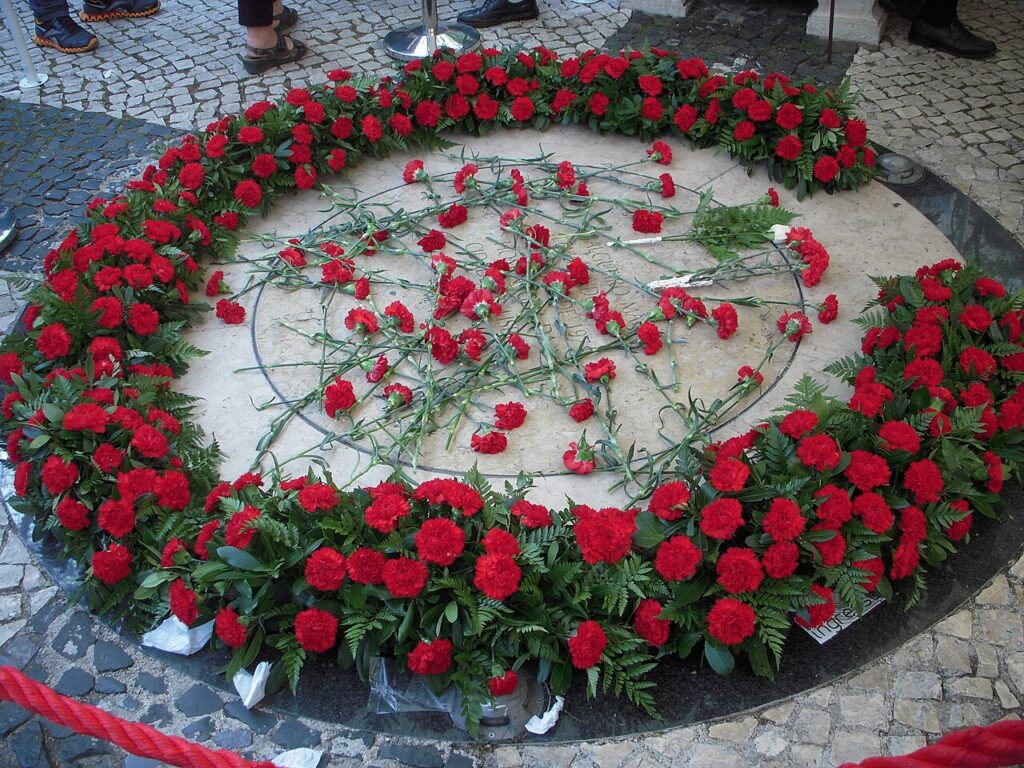
When the regime finally fell, 51 years ago, it seemed to simply dissipate. None fought for it; the Carnation Revolution was famously bloodless. A profound sclerosis had made the whole apparatus of power remarkably fragile. Why?
Marcello Caetano wanted to live a quiet, decent life in a world full of agitation and disruption. Caetano, and not only he, was driven by the need to appear nice, and to live down the implacable image of the regime. It meant that the regime’s coherence and sense of self-preservation was eroded. He and military figures like General António de Spínola failed to realise that engagement in war had enormously boosted the appeal of communist ways of thinking and acting among those who were most affected: the military. If the regime had realised the enormity of the danger, I think there would have been a concerted effort to avert it, probably through a form of controlled democratisation from above. In a world shifting leftwards, Caetano’s modified version of the Estado Novo was unable to find a coherent place, and thus he was pushed aside by a small but determined group of military malcontents.
In your research, what surprised you most about Salazar’s personal life: his frugality, his famously dry sense of humour, or his apparent lack of interest in public adulation?
Coming from a smallholding family in rural Portugal, it was hardly a surprise that Salazar possessed a frugal outlook and was content not to surround himself with opulence and possessions. What did surprise me was that, for someone who had the reputation of being reclusive, his door was open to numerous people. He perhaps met a broader cross-section of people on a regular basis than most conventional politicians in our own age. He was always a good listener, and the older he got, the more he seems to have enjoyed talking to a cross-section of visitors in the hope of broadening his knowledge about what was happening in the world.
He developed a strong rapport with Otto von Habsburg, the son of the last ruler of Austria-Hungary. British and continental politicians and diplomats (not all on the political Right), various royal figures, cultural personalities, and others reached out to him. Those in politics in the democratic camp who knew him were even prepared to come to his defence at times. He had his own circle of Portuguese friends with whom he regularly met. His dry sense of humour was a fatalistic one based on life’s vicissitudes—one which is often to be found among people with a background in the rural world, where sudden adversity is so often the norm. By contrast, humourless leaders abound today, perhaps because they have so little contact with real life.
Salazar was never going to try to re-engineer the human personality. He might wish to correct society after what he saw as a century of pointless and destructive liberalism, but his aim was to try and restore some of the core elements that had given Portugal a sense of equilibrium. He put across what was essentially a nationalist world view without bombast or histrionics and, as you say, did not look for adulation. He possessed humility to an unusual extent in a modern leader and would probably have concurred with the novelist Robert Louis Stevenson when he wrote: “Life is not designed to minister to a man’s vanity. He goes upon his long business most of the time with a hanging head, and all the time like a blind child.”
Salazar’s legacy remains polarising in Portugal, with some viewing him as a patriot, moderniser, and protector of the empire; others view him as an obscurantist dictator. What explains his enduring appeal among certain conservative circles today, both in Portugal and abroad?
For many, perhaps in surprising places like North America, Salazar stands out in an age of self-absorption and narcissism as a paternalist, ready to devote his life to the national cause. He possessed courage, a trait often entirely absent in contemporary political figures. He recognised there was a moral rot in the West. He was an early sceptic of globalisation. He was unimpressed by the need for Portugal to come under the sway of concepts like international justice. He was also unrepentant about always believing that the national interest should shape geopolitics, and remained convinced that international conventions were invariably designed to advance the interests of the most powerful nations.
Buffeted by time-consuming foreign policy challenges, he failed to transfer his own moral energy into national institutions, which would have given the conservative-minded in Portugal the strong possibility of overhauling and improving what had been built in the 1930s. His opposition to competitive elections means that Chega, the main political voice of conservatism in Portugal today, has distanced itself from the nature of his rule while sometimes expressing respect for his high personal standards while in government.
One point often made about Salazar—and one to which I personally subscribe—is that his historical legacy was forever tarnished by his disinterest in preparing what came after. His ‘après moi, le déluge’ mindset separates him from Franco, whose nomination of King Juan Carlos as successor prevented Spain from falling into anarchy, or de Gaulle, whose 5th Republic has survived to this day. Why didn’t Salazar make an effort to safeguard his regime, or at least the stability of the country, after he was gone?
Mark Steyn has remarked that “permanence is the delusion of every age” and perhaps Salazar felt that it was pointless for him to try and micro-manage what came after him.
He was well aware that the longstanding concern—about what arrangements he would make for a successor—was refusing to abate as he steadily grew older. His regime had grown into a markedly personal one without any elaborate political structures from which a succession could be arranged. He preferred to leave this responsibility to the Head of State, Admiral Thomaz. He was on the conservative wing of politics, but he stood above the factions. Of the likely candidates, Salazar said, “They will have to work to acquire credibility just as I had to do.” When pressed about the risks of a political vacuum after his removal from the political scene, he said, “I have my enemies, and they are not few. Whoever I propose would certainly also have his own enemies. Because he was a person suggested by me, he would also have mine. That’s great for the start of a political career!”
As in Spain, there was much talk of Salazar reinstating the monarchy under the House of Braganza that had been toppled in 1910. Why did Salazar not choose that path?
The monarchy had steadily lost ground since the Napoleonic invasions. The revolution carried out by urban liberals in the 1820s and 1830s left it without an aristocracy or a strong national church able to sustain it. Before his assassination in 1908, King Carlos I admitted there were few active monarchists in Portugal. For Salazar, it was a private attachment which, throughout his political career, he believed could not be restored as a ruling formula. Some of his most effective partners in the regime were republicans, and it would have been hard to avoid a schism if the political system was altered to suit a faction which only had minority appeal.
Faith played a significant role in Salazar’s worldview, particularly in his rejection of both atheistic socialism and unbridled, community-shattering capitalism. How did his Catholicism shape his policies, and does this offer lessons for leaders grappling with secularism today?
Salazar saw religion as the cornerstone of civilization from which morality, culture and laws sprang.
He had emphasised the role of the church as a pillar of nationhood as in a 1949 speech where he stated:
The Catholic religion was from the beginning a formative element of the soul of the Nation and a dominant trait in the character of the Portuguese people. In their travels around the world – discovering, trading, spreading the faith – this outlook prevailed without hesitation: Portuguese, therefore Catholic.
In the lead up to the signing of a Concordat with the Vatican in 1940, Salazar drove a very hard bargain for someone regarded as the archetypal Catholic dictator. Catholicism did not become the official religion as would occur in Spain, which, under Franco, was indeed officially a national Catholic state. Religion remained subordinate to the nation. Salazar was well aware that, in a country long torn by conflict involving clerical and secular republican interests, it made far more sense to play down his own steadfast Catholicism and instead emphasise the nationalist orientation of the Estado Novo.
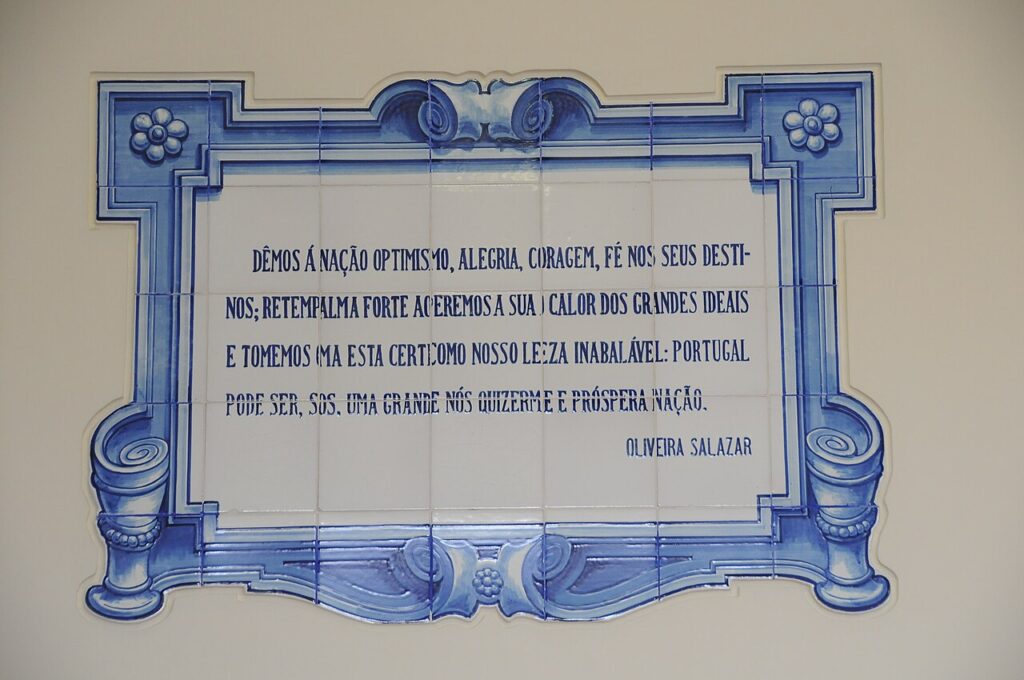
The universalist outlook to be found in Catholicism may well also have placed Salazar on his guard and prompted him not to restore all the rights taken away from the church by previous liberal governments. He knew that politics and individual ambition could get in the way of the church’s mission of trying to save human souls by preaching the Christian message. Salazar and those around him feared that church figures, not wishing to be left out of humanitarian initiatives that were being promoted by the United Nations and other world bodies, could drift into very unwise company.
His fears were borne out in the 1960s. There was a groundswell of church figures who wished to be conspicuous actors in a secularized world.Christian Marxism soon took off and various ex-Catholics who switched to the ultra-left drove the 1974-75 revolution in an ever more radical direction.
Salazar would probably have agreed with Aleksandr Solzhenitsyn when he observed in 1983: “Within the philosophical system of Marx and Lenin and at the heart of their psychology, hatred of God is the principal driving force, more fundamental than all their political and economic pretensions.” However, too many Portuguese, influenced by the leftward turn the church took during the papacy of Paul VI, became convinced that the church should act principally as an outpost of social justice.
Interestingly, once the negative features of the pre-1926 liberal regime became unmistakably obvious, a revival in faith occurred among parts of the middle classes. The same phenomenon is perhaps starting to be visible across the West, especially among the young, as the stark failings of ruling liberalism become impossible to conceal.
You’ve written about Salazar’s distrust of democracy and his belief in nationalistic, technocratic, elite rule. Do you see echoes of his philosophy in contemporary critiques of liberal democracy, perhaps from populist or traditionalist movements?
Salazar instinctively opposed protest politicians, people often with deep shortcomings who promoted disruptive causes. The Democratic Party of the lawyer Afonso Costa was the main pre-1926 example. It often acted as a state within a state and can perhaps stand comparison with the Democratic Party in America. It fostered an abusive climate against political foes as a permanent campaign tactic.
Radicalism in Portugal was an urban bourgeois phenomenon and Salazar always retained a certain scepticism about the ability of those Portuguese with wealth, status, property, and a liberal education to offer sound guidance to the nation. This is perhaps one of the reasons why he stayed on for as long as he did.
In the 1960s, Franco Nogueira, the politician with whom Salazar very much shared a common outlook, attacked those in the “cultural elite who know things and have theories but who ignore what is Portugal and don’t have feelings for it, wishing instead to take the country to ruin, and smash everything, unless the people heed their voice.”
Perhaps both men would have been taken aback by the direction of post-manufacturing capitalism in the West and the way that big corporate giants have allied themselves with the forces of nihilism. Progressive ideas meant to overturn conventions and replace them with apocalyptic ideas that downgrade the importance of mankind have received powerful commercial endorsement.
Salazar had encountered early forerunners of woke corporate capital when negotiating with the Americans during and after World War II. They were apostles of technical progress and economic innovation whose expertise and shallow ethics Salazar came to mistrust. He felt himself to be alone in an age of cosmopolitan philistinism, but he did not bend to what was newly fashionable.
I think it is understandable if national populists treat Salazar with at least wary respect. He distrusted international oligarchies, preferred to focus on national needs rather than grandiose and often impractical global goals, and was not addicted to militarism or violence.
The West seems increasingly to be in the hands of a diminutive, uncultured, childish, and utterly unimpressive political class. This is certainly the case in Portugal, but it is no less true outside it. Trudeau, Kallas, von der Leyen, Scholz—it would shock any man with a basic sense of history that these are the West’s leaders today. Doesn’t Salazar’s statecraft powerfully stand out in our political ‘little dark age’?
Increasingly, politicians lack real life experience due to the way they have been recruited. Disproportionate numbers now spring from the hot house atmosphere of academia, journalism, public relations, and full-time political activism. The numbers possessing useful skills or with experience in managing workforces, making things, rearing animals, growing crops, or serving in the military—perhaps never that high in some places—have slumped. It means that too many politicians depend on the state for status and income, rather than having a broader implantation in society. Such a stunted background deprives them of the background needed to display authority and nerve in the sudden crises which are erupting with increasing frequency. It means ruling politicians are inclined to appease the views of the loudest voices in venomous disputes over personal identity, and shrink from the task of appealing to solidarity across a fractured social and economic landscape. In not a few cases, it is hard to avoid the conclusion that ambitious politicians, keen to benefit from their careers and give little back, simply do not like human beings very much.
I suspect that Salazar’s conservative philosophy of life would have prompted him to respond in a different manner to the Covid emergency of 2020-22 than most contemporary Western leaders did. He never believed that the Portuguese should be cocooned from the normal rigours and unexpected difficulties of life. He was not an advocate of safetyism, the now influential view that citizens need to be shielded from a variety of risks and dangers previously regarded as unavoidable parts of human existence. It is quite likely that preserving a functioning economy would have been a strong priority. He knew that keeping hunger and want at bay required the Portuguese to remain a productive people. So it is hard to imagine him being a keen advocate of curfews and lockdowns of indeterminate length. He might well also have been surprised at the hectoring and abrasive tones leaders such as Emmanuel Macron in France, Keir Starmer in Britain, and Mário Draghi in Italy used towards critics opposing disturbing levels of state overreach.
Salazar was unafraid of defending his regime without parties and multi-party elections, but he was always careful to refrain from fueling bitterness in his public statements. He was rarely, if ever, confrontational, and he usually had no difficulty in admitting that his opponents were part of the national community, not outcasts. It is quite possible that the absence of a spirit of reconciliation in the pronouncements of Macron and others would have strengthened Salazar’s belief that, without strong institutional checks, the tendency in even well-known democracies is for them to evolve into a dictatorship of the majority (or nowadays the most favoured minority).
Salazar is likely to remain a figure of recurring interest because of the way that he conserved power as well as for the values which shaped his actions and beliefs. It is hard to draw as sharp a dividing line as it was in the past between his system of autocratic government and that of contemporary European democracies. Too many of them violated core elements of freedom during the pandemic and afterwards by failing to heed the warning of the third President of the United States, Thomas Jefferson: “There is no justification for taking away individuals’ freedom in the guise of public safety.”