Greece’s biggest YouTube history-related channel is run by a young intellectual, Nikolaos Pavlidis. Pavlidis’ YouTube channel is called “Practical Thinking” or @praktikiskepsi and has 163,000 subscribers. He is one of the country’s most well-known historians.
On his socials, Pavlidis addresses issues related to the history of Greece, Turkey, Europe, and the Middle East, as well as several other subjects. He has a B.A. in history and archaeology from the Aristotle University of Thessaloniki and an M.A. in Black Sea and Eastern Mediterranean Studies from the International Hellenic University.
Although Pavlidis was born and raised in Greece, his ancestors were from Pontus, a historically Greek region in northeast Turkey whose Christian inhabitants were exposed to genocide at the hands of the Ottoman Empire and the Turkish national movement between 1914 and 1923. Around 353,000 Pontic Greeks perished during the genocide.
Pontus (or Pontos) primarily means ‘sea’ in ancient Greek, often referring to the Black Sea (Pontus Euxinus). The Pontus region is a coastal area in northeastern Anatolia (modern-day Turkey) along the Black Sea, known for its Greek history and distinct Pontic Greek culture.
Pavlidis talked to europeanconservative.com about the Ottoman occupation of Greece, Turkey’s Pontic Greek genocide of 1914-23, and the Nazi invasion of Greece during WWII.
On March 25, Greece celebrated the 205th anniversary of their independence from the Ottoman Empire. What do you think were the most devastating consequences of the Ottoman occupation for Greece?
The Muslim Turkic conquest of the historic Greek-inhabited lands of Asia Minor (present-day Turkey) began during the 11th century A.D. and is symbolically marked by the 1453 sack of Constantinople by the Ottoman Turks.
During the 400 years of occupation of mainland Greece, which started in the mid-15th century (roughly 1453–1460), dozens of Greek uprisings against the Ottoman Sultan took place. [This occurred] until the 1821 Greek Revolution finally managed to liberate at least Central Greece and the Peloponnese from the Ottomans.
The main catastrophes the Greeks suffered during the Ottoman occupation are three, in my opinion:
- They lost their ability to organize and function as a modern state since they were banned from leadership positions;
- The Ottoman child-gathering (devshirme) and the Islamization of Greek populations were a major blow to Greek communities and practically constitute a form of genocide; and
- While the rest of Europe was modernizing and spreading the ideas of the Enlightenment, the Greeks stayed in the dark behind the borders of the Muslim Ottoman Empire for centuries.
You also specialize in the history of modern Greece. How did the Nazi occupation affect Greece during WWII?
The Axis occupation of Greece (1941-1944) is one of the darkest pages in Greek history. Almost 1,000,000 Greeks died from executions, genocidal practices, and hunger caused by the Italian, German, Albanian, and Bulgarian invading forces. Even worse, after the 1944 liberation, the whole of Greece was devastated: the Axis forces destroyed everything before they retreated from the country. On the other side, Turkey not only did not join the Allies in their struggle to stop the Axis as Greece did but maintained constant communication with the Germans, demanding the Greek Aegean islands. In June 1941, they even signed a treaty of trade and friendship with Nazi Germany.
Your ancestors are from Pontus. Can you briefly explain how Pontic Hellenism was almost completely destroyed?
My great-great-great-grandparents were merchants from the historically Greek city of Trapezounta in Pontus, present-day Northeast Turkey. The Empire of Trebizond was the last Greek-Orthodox remnant of the destroyed Byzantine Empire that the Ottomans conquered in 1461. During the dark ages of the Ottoman occupation that followed, the historic Greek land of Pontus was Islamized by force and through replacement migration by Muslim tribes from the Middle East and Central Asia.
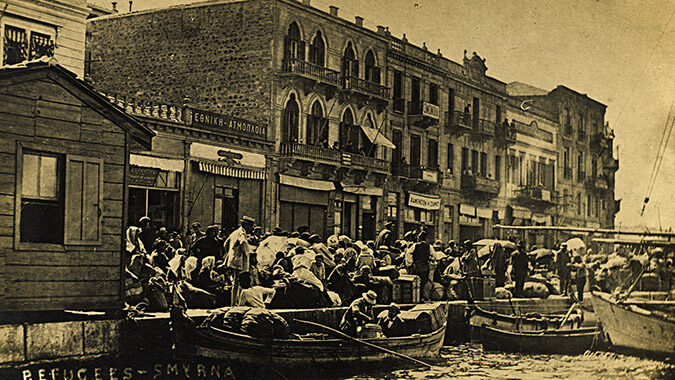
When World War I began in 1914, the Ottoman Turks began the forced displacement and eventually the genocide of the Christian populations of Asia Minor, including the Greeks of Pontus. The last Greeks of Pontus left after the forcible population exchange in 1923 between Greece and Turkey. Some of them arrived in mainland Greece as refugees, while others (like my grandparents) sought refuge in the Soviet Union. They later came to Greece after the 1991 dissolution of the USSR.
You and your family still speak the ancient Greek dialect of Pontus, Romeika. Is it an endangered language today?
As a child I learned to speak Romeika (the Pontic dialect coming from ancient Greek) from my grandparents. It remains the language I prefer to speak with my family at home. Unfortunately, Romeika is an almost dead dialect, since the Pontic Greeks who came to Greece after 1922 stopped speaking it long ago, and even the new generations who came after 1991 are beginning to forget it. Most of them just speak modern Greek like everyone else, a fact that personally displeases me. Our dialect is our culture and one of the few things that still connects us with our home, Pontus.
What is Turkey’s ‘blue homeland’ ideology about?
Turkey’s ‘Blue Homeland’ rhetoric bases its existence on the Turkish Misak-ı Millî. This is basically the national oath of the Turks from 1920, which aims to ‘liberate’ the lands that they consider ‘lost Turkish homelands’ in Greece, the Caucasus, or even the Middle East. Turkey, unfortunately, even today refuses to accept its past and, even worse, plays an imperialistic role in the Eastern Mediterranean, having invaded Cyprus, Iraq, and Syria with occupation armies while also threatening Greece with war almost constantly.
What should be done to honor the 353,000 victims of the Pontic Greek genocide?
The most crucial step for the Greek government to take for the remembrance of the genocided Greeks of Asia Minor is to fund the creation of a great central Greek genocide memorial, which will be used as a library and research center for the events of the genocide committed by the Turks.
Moreover, in this memorial, every diplomat or country leader that comes to Greece can visit and pay respects, exactly like the Armenians did for their cause in their capital city of Yerevan. Beginning with this step, everything else will find its path. We have great people in charge of the Pontic organizations inside and outside Greece, and our Pontic youth are energetic and courageous enough to achieve everything we need.
Throughout the centuries, many Greeks in Pontus converted to Islam or pretended to convert just to be able to stay in Pontus. Today their descendants are either unaware or in denial of this fact and live their lives as Muslim Turks. Do you think they can one day overcome their identity-related confusion or ignorance?
Accepting your ethnic and historical heritage is a great step for every thinking person. The destruction or Turkification of the indigenous cultures of Asia Minor after 1922, which followed the Christian genocide in Asia Minor, was a humanitarian and cultural disaster for the whole world. The modern citizens of Turkey should, like every normal person, accept their special identity and begin searching more about their real roots in the past. It is a pity that history is rewritten by Turkey, for denial of historical facts is not the right way to learn the truth.