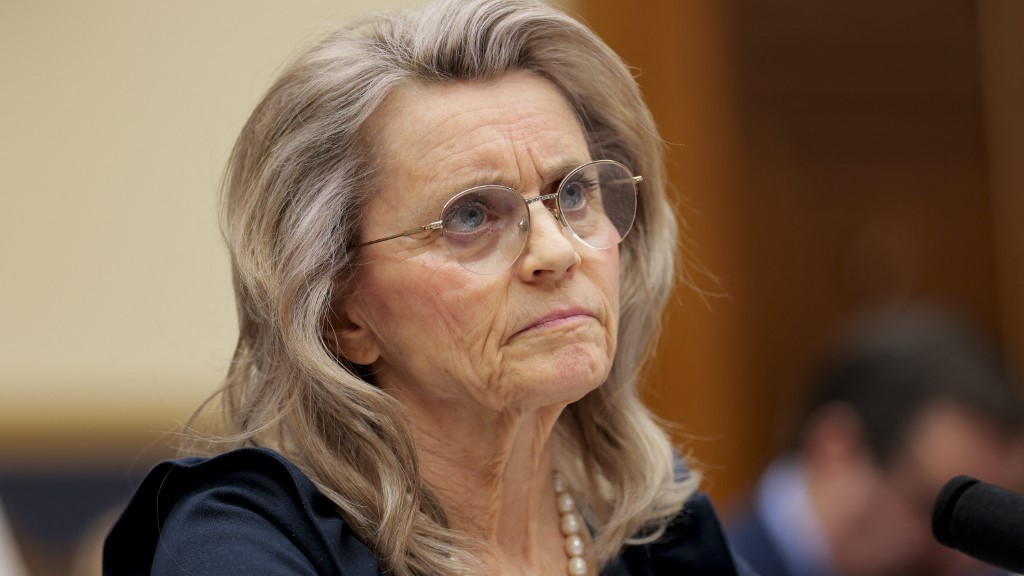
Member of the Finnish Parliament Päivi Räsänen testifies during a House Judiciary Committee hearing on “Europe’s Threat to American Speech and Innovation” on Capitol Hill in Washington, D.C., on February 4, 2026.
HEATHER DIEHL / GETTY IMAGES NORTH AMERICA / GETTY IMAGES VIA AFP
For years, Europe presented freedom of expression as one of its most recognisable political hallmarks. Almost a foundational principle: the right to express uncomfortable, even unpopular opinions, provided they did not involve violence or coercion. The problem begins when that principle collides with newer and more open-ended legal categories, particularly those linked to hate speech. That is precisely where Päivi Räsänen’s case begins.
The former Finnish Minister of the Interior, a medical doctor by training and one of the historic figures of Finland’s Christian Democratic movement, has spent nearly seven years immersed in a legal battle that has evolved into something much larger than a national judicial process. Räsänen was investigated, interrogated and eventually prosecuted for publicly expressing traditional Christian views on marriage and sexuality. The case originated from social media posts, public statements and a booklet written more than two decades ago for a church community. Two courts acquitted her. The Finnish Supreme Court, however, ultimately reached a different conclusion through a narrow three-to-two decision.
Räsänen is now taking her case to Strasbourg, where the European Court of Human Rights will have an opportunity to rule on a question that extends well beyond Finland. Because a judgment on Räsänen may ultimately be also about the future of public debate in Europe.
My case shows clearly that there is a crisis of free speech in Europe. Nobody should face years of criminal prosecution and be convicted for peacefully sharing their beliefs. Freedom of expression is endangered by “hate speech” laws that are highly subject to interpretation. These laws make it possible for states to silence dissent and censor those who disagree with prevailing social norms.
What happened shows the inherent flaws with the vague and subjective “hate speech” law that was used to charge and convict me. Over six years, my case was considered by 11 judges across three Finnish courts.
At the Supreme Court, I was convicted, in a narrow 3-2 ruling, of “hate speech” for the church booklet I wrote decades ago, peacefully expressing my views on marriage and sexuality. Thankfully, I was acquitted regarding my Bible tweet.
The fact that three judges in the Supreme Court came to a different conclusion on the same set of facts as the eight other judges who assessed my case (two at the Supreme Court and six from prior trials), and that I was convicted on that basis, shows just how broadly this legislation can be interpreted and the extreme danger this poses for free speech.
I would still say it was incorrectly interpreted in this case, as my expression was entirely lawful.
A free society cannot equate disagreement with a crime, yet in my case that is what “hate speech” laws have made possible. I was found guilty of “insult” for a publication in which I peacefully shared my Christian beliefs and stated explicitly that we are all equal before God.
My booklet did not cause any harm, and the Supreme Court admitted that it did not contain incitements to violence or “comparable threat-like fomenting of hatred.” And yet I was still criminally convicted, alongside Bishop Juhana Pohjola and the Luther Foundation Finland, who were criminalised for publishing the booklet.
In addition to free speech, religious freedom has also been central to my case from the beginning, when I was interrogated by the police for 13 hours about my Christian beliefs. At the Court of Appeal, the state prosecutor said concerning my tweet that my “interpretation and opinion” about the Bible verses I shared were “criminal”.
My case shows that “hate speech” laws have no place in a free society and that such legislation must be repealed in Finland and across Europe to protect the fundamental human right to freedom of expression.
The project of trying to criminalise “hate speech” is misguided and incompatible with free speech. These laws grant the state the power to define “hate” in line with a particular ideology rather than remaining neutral, and to punish those who disagree–like myself and many others across Europe.
It is a very unclear distinction. I was acquitted for my post because I was using religious language to respond to a relevant social issue. However, the court did not apply the same assessment to the booklet–which contains over 20 scripture references and was written to help members of my church understand the debate over the redefinition of marriage in Finland at the time. To justify my conviction, the Supreme Court isolated specific phrases from the broader context of the booklet, distorting its meaning.
If a 20-year-old booklet written for my church community can be criminalised on such obscure grounds, it should certainly raise concerns about how “hate speech” laws are being used to censor Christian views.
I am very concerned about the chilling effect on free speech that could be caused by my conviction. If a high-profile politician like myself can be made an example of and criminalised for peaceful expression, I think there is a real risk that ordinary citizens across Europe could feel afraid to voice their beliefs.
This is contrary to a free, democratic society, and I feel it is my duty to do everything I can to ensure this ceases to be a reality in Finland and across Europe.
Nevertheless, it is my hope that my case can have the opposite effect: that many people will have a renewed and deepened appreciation of the importance of free speech and feel emboldened to speak the truth no matter the cost.
I hope that the European Court of Human Rights will protect my own and every person’s right to freedom of expression. This right is protected under international law and is the foundation of any democracy. I pray that by overturning my conviction, the ECtHR will affirm the fundamental importance of free speech across Europe and prevent others from experiencing the criminal prosecution I have faced over the last seven years.
I am not alone in Europe in being punished for expressing my beliefs. Many European countries have ambiguous “hate speech” laws that are being used to criminalise peaceful expression. I am very disappointed that this has happened in Finland, and my conviction exemplifies a worrying movement against free speech in Europe–both at the state level and in EU legislation such as the Digital Services Act. My case is an important opportunity for the ECtHR to stop this dangerous pattern.
No state should be able to decide which beliefs can or cannot be peacefully expressed. In my case, the state has used “hate speech” legislation for this censorial purpose, demonstrating how these laws create a society in which fundamental freedoms are threatened, where people live in fear about what they can say, and where those who disagree with certain prevalent views are punished or silenced.
Across Europe, states are favouring secular and other perspectives over Christian beliefs. This is especially clear in my case, where a Christian understanding of marriage and sexuality has been censored for not aligning with modern secular ideas. This trend of rejecting and criminalising the Christian worldview is a tremendous act of civilisational self-harm, as the reality is that Christianity formed Europe. If the Christian roots of our societies are shunned, the fruit we have borne–liberty, universal human rights and dignity–will also wither, and the nature of Europe will transform for the worse.
European leaders must also ask themselves whether they still believe in upholding the freedoms of those with whom they disagree. I am convinced that the people of Europe do, and I hope that the ECtHR will affirm its longstanding precedent of upholding the right to free speech–the only way to preserve true freedom in our societies.