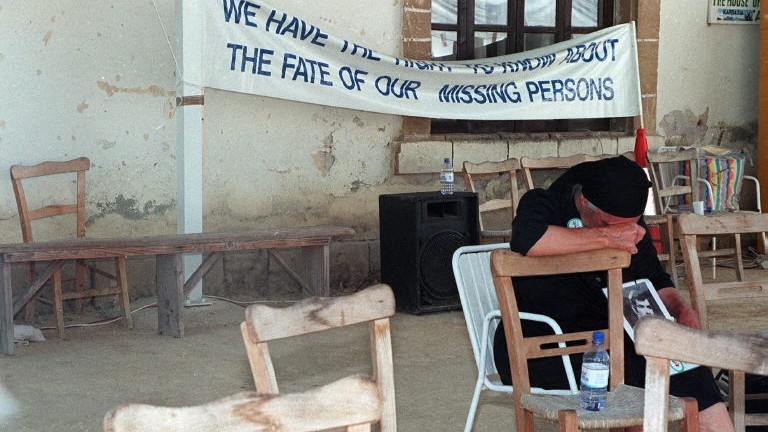
A lone Greek-Cypriot protestor cries during an anti-occupation protest in Nicosia, 20 July, on the 24th anniversary of the Turkish invasion of northern Cyprus.
JIHAN AMMAR / AFP
On July 1st, EU foreign policy chief Kaja Kallas, European Commissioner for Internal Affairs and Migration Magnus Brunner, and Commissioner for Enlargement Marta Kos travelled to Turkey. The purpose was to meet Turkish President Recep Tayyip Erdoğan and Turkish Foreign Minister Hakan Fidan.
“Türkiye is a key partner on security, migration, and energy, as well as an EU candidate country,” Kallas posted on X after meeting Erdoğan, adding that the country “is making a significant contribution to protecting NATO’s eastern flank.”
Europeanconservative.com spoke with Emmanouil Koulas, Head of Office to Greek MEP Afroditi Latinopoulou and Board Member of the Patriots for Europe Foundation, about Brussels’ stance on Turkey, Erdoğan’s expansionist foreign policy, and how mass migration affects Europe.
It was a courtesy call to a strongman. Officials dubbed it a “jumbo meeting,” as if scale were the story; however, the real story is that Kallas chose to praise Erdoğan’s regime days after Ankara banned protests outright and rounded up dissidents ahead of the NATO summit. She called Turkey a country “making a significant contribution to protecting NATO’s eastern flank.” Fine. It’s also a country whose president jails journalists at a rate that puts him among the world’s worst offenders, criminalizes criticism of his own person, and runs a judiciary that answers to the palace rather than the constitution. You don’t earn credit for guarding a border while running a police state behind it. Kallas didn’t need to flatter Erdoğan to discuss shared interests. She chose to. That choice tells Greek and Cypriot voters exactly where we sit on Brussels’ priority list: somewhere below pipeline deals and NATO photo ops.
Turkey invaded a sovereign European country in 1974 and has never left. Thirty-six percent of Cyprus, an EU member state, sits behind Turkish tanks and a puppet administration that no country on earth recognizes other than Turkey. That isn’t a “frozen conflict.” It’s an active military occupation which is in its sixth decade and is run by the same government who is now asking Brussels for EU membership candidate status. Ankara has spent decades shipping in settlers to alter the north’s demographics, stripping Greek Cypriot families of property they still legally own, and holding Varosha as a bargaining chip which dangles back and forth depending on its mood. Do that to a country outside the EU and everyone calls it an act of war. Since it’s Cyprus, because Turkey holds a NATO card and an illegal migration card, Brussels instead files it under “the Cyprus issue” and moves to the next agenda item. That’s cowardice wearing a diplomat’s suit.
Mavi Vatan isn’t diplomacy. It’s a map with our islands already colored as future Turkish territory, taught in Turkish naval academies as doctrine, not theory. This is a state rehearsing the annexation of land that its neighbors have held for millennia and calling this “good neighborly relations.” Turkish jets cross into Greek airspace on a near-weekly basis. Turkish surveys and naval vessels test our continental shelf whenever Ankara wants to send a message. Each time the message lands, then fades from the news cycle. It’s a deliberate, sustained pressure campaign against a NATO ally and EU member state. This is not posturing. Brussels stays quiet because Ankara holds two levers over Europe: an illegal migration tap that it can open or shut at will, and a seat on NATO’s southern flank which nobody wants to lose. So Greek sovereignty becomes an acceptable cost of managing Erdoğan’s temper. It isn’t acceptable. Dressing it up as neighborliness and a bilateral issue doesn’t make it so.
Slowly, and by design.
I’m Pontic Greek, a descendant of genocide survivors. This has been personal since the day I landed in Brussels, not just a policy line on a briefing note. Afroditi has tabled a resolution on the Pontic Genocide in the European Parliament almost every year since she’s been in office. It comes to her desk every 19th of May via the Foreign Affairs Committee, AFET: they decide whether it’s even worth a vote. Each time, AFET quietly shelves it. It is not important enough to schedule and simply expires without a single MEP ever going on record. That’s the trick. You don’t have to vote down a genocide resolution if you make sure it never reaches a vote at all. The EU recognized the Armenian Genocide a long time ago, rightly so. Yet the killing of 353,000 Pontic Greeks, by the same Turkish regime, in the same years, gets buried in committee, simply because Ankara would object to anything more. I’ve worked on commemorative projects with advisors from across Europe to keep this history alive regardless. This work matters to the descendants of Pontus who rebuilt their lives in Thessaloniki and across northern Greece. We will keep filing it every year until AFET runs out of excuses.
There’s a pattern to what Brussels ignores: usually anything without a loud microphone. We’ve pushed for real support (not just statements) for frontline states like Greece and Italy who absorb the first wave of illegal migration and are left holding the risk alone. We’ve raised the persecution of Christian communities who are hunted out of existence in Syria, Nigeria, and eastern Congo. Meanwhile European institutions stay strangely quiet whenever the victims of religious violence are Christian. Closer to home, Turkish fishing vessels operate inside Greek territorial waters as if the maritime border doesn’t exist. Nobody in Brussels treats that as the sovereignty violation it is. On Albania’s EU accession report, we got three amendments passed protecting the Greek minority in Northern Epirus, covering property rights, education in their own language, and political representation. This occurred inside a country asking Europe to fast-track its membership. None of this makes headlines. We keep raising it anyway.
First, border security isn’t optional. That means finishing and reinforcing the Evros fence in Greece, real-time surveillance, and a Frontex deployment with actual enforcement power, not just monitoring drones who film arriving boats.
Second, Greece needs to use the new EU Return Regulation aggressively: fast-track processing, safe-third-country returns, zero tolerance for asylum procedures used as a backdoor.
Third (this is where most of my own work sits), security should come home to our cities. Border policy means little if urban crime tied to illegal migration keeps rising unchecked in neighborhoods where people are supposed to feel safe. Brussels needs grassroots pressure, not promises from the top down. Greece has absorbed more than its share this past decade. Protecting our borders means protecting our people. No apology needed for saying so.
Brussels has never expressed concern: admitting it would mean admitting decades of illegal migration and “integration” policy came up short. The numbers themselves aren’t disputed as they are from Belgium’s own statistics office: only 22% of Brussels residents have a fully Belgian background. Pointing that out isn’t extremism, it’s arithmetic. I live this reality as a foreigner in this city, so I know integration when it actually works. The problem here is scale which outruns assimilation. Is this the fate awaiting other capitals? Without a change of course, the answer is yes. This is why the fight matters now, not after the numbers are locked in. Athens and Thessaloniki aren’t there yet. I intend to keep it that way by pushing for those border security and integration standards which Brussels won’t apply to itself.
It should be a wake-up call for the whole continent, not just Britain. Lowe’s inquiry includes survivor testimony spanning 149 local authority districts, demonstrating decades of organized child sexual exploitation that authorities buried out of fear of being called racist. That isn’t conspiracy thinking. It’s institutional cowardice which aligns with earlier official reviews like Rotherham’s. Now we have the fuller context. What strikes me most is how familiar the pattern is. Narratives protected instead of children, generation after generation. This isn’t only a British story either. The same reflex keeps repeating across Europe. If EU institutions showed even a fraction of the urgency they reserve for other causes, this would already be top of the agenda in Strasbourg. Instead: silence. Every parent, in Thessaloniki, in Rotherham, in any European city, deserves authorities who protect children before they protect reputations. That shouldn’t be controversial.
Ideology overriding reality. Decades of post-national utopianism convinced parts of the European Left that enforcing borders (even against people who’ve committed violent crimes) feels like a betrayal of principle rather than basic public safety. There’s electoral math in it too. Certain voting blocs are politically indispensable to specific parties and confronting crime inside those communities risks that support. Also there’s an inherited guilt reflex, carried over and projected onto migration policy, as though enforcing the law equals repeating historical injustice. The result is leaders who’ll defend the abstract principle of open borders more fiercely than they’ll defend their own citizens’ safety. People notice this contradiction. It’s a big part of why support for parties willing to say “enough” keeps growing, election after election, city after city.
Barely, and that’s the polite version. National governments keep getting overruled or bypassed by a Commission who treats subsidiarity as optional. Look at how farmers’ protests were handled across the continent, or how migration policy was hashed out in Brussels corridors long before national parliaments ever saw a real vote. The EU was supposed to be sovereign nations cooperating by choice, not a supranational body dictating downward. People feel this gap. Trust in EU institutions is at a record low across the continent. This is not without reason. When voters choose stricter borders at home and Brussels quietly works around it, that’s managed democracy, not representation. I didn’t get into this work to gracefully manage decline. I got into it because somebody has to keep insisting Brussels answers to citizens instead of the other way round.
Yes, and not the cosmetic kind. Real, structural reform. The EU should work as a Europe of sovereign nations cooperating on trade, security, and shared problems, not a federalist project quietly centralizing power in Brussels while pretending otherwise. That means safeguarding national vetoes, especially on illegal migration and foreign policy. It also includes subsidiarity that actually means something instead of a word used as decoration, and an end to unelected bodies quietly rewriting member states’ demographics and security policy without real consent. I’ve spent enough time inside these institutions to watch how far the decision-making has drifted from the people who live with the consequences. Reform also means accountability. When a commissioner’s decision wrecks a farming sector or floods a border region, somebody should answer for it instead of hiding behind committee consensus. Patriots across Europe are building this alternative, country by country, and it’s gaining ground because people are tired of being governed by people they never elected.