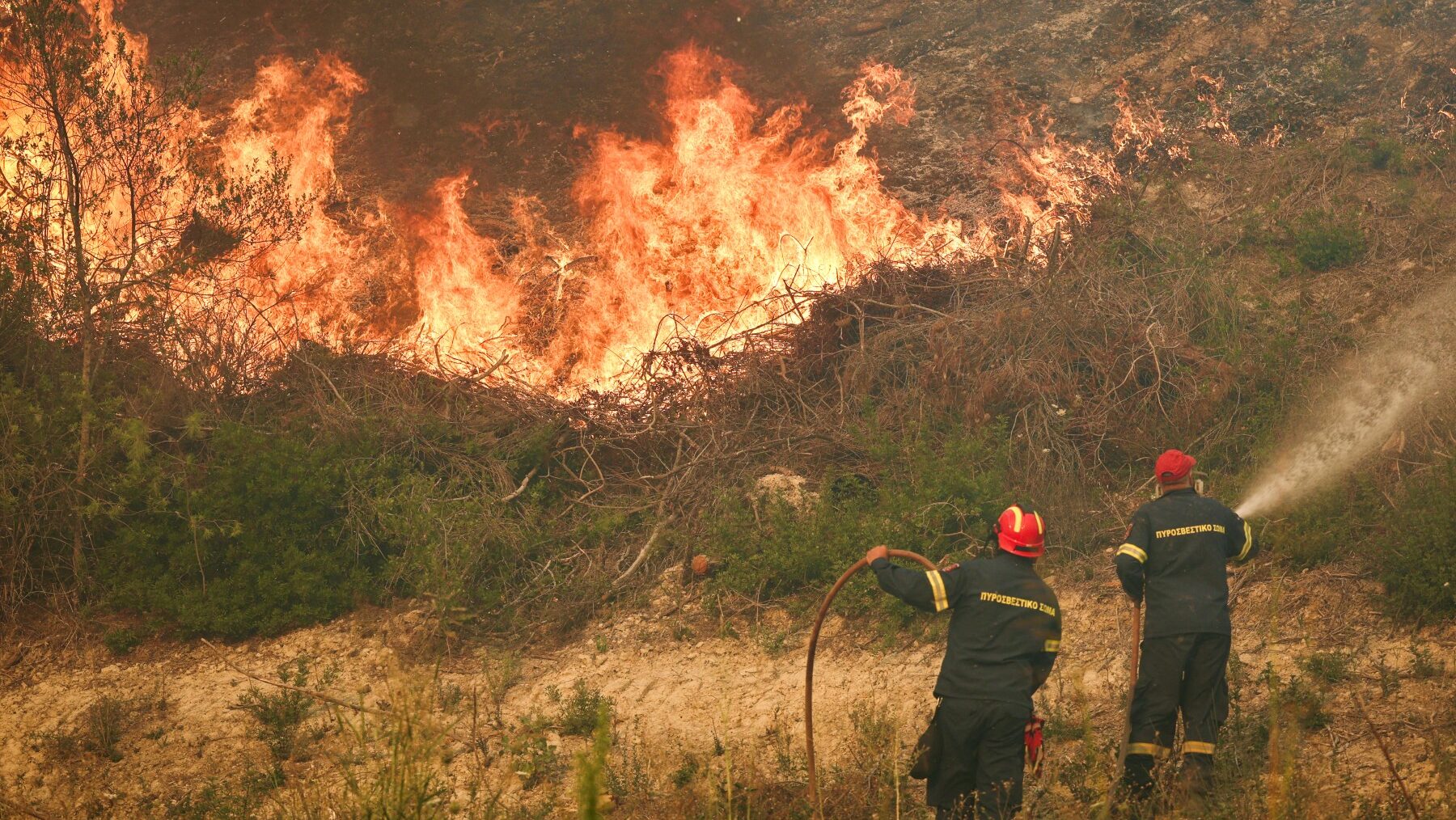
Every summer, huge areas of Greece, including forests, burn.
According to the European Forest Fire Information System (EFFIS), approximately 30,000–32,000 hectares had burned in Greece by mid-August 2026. That is roughly 74,000–79,000 acres, with the figures continuing to change as further fires occurred.
One single event—the Attica–Boeotia megafire of July 31–August 4—reportedly burned about 11,000–11,200 hectares in just 91 hours, according to the National Observatory of Athens’ FLAME team.
Over the 2006–2025 period, EFFIS estimates Greece’s average annual burned area at approximately 50,000 hectares—roughly 0.38% of the country’s total land area every year.
Dr. Marie-Athena Papathanasiou is an international environmental lawyer who has worked extensively on environmental governance and policy in Europe and Greece. She answered the questions of europeanconservative.com regarding Greece’s wildfire crisis.
What exactly is burning in Greece? Are we talking only about forests?
No. The destruction is much broader than forests in the narrow sense.
Wildfires consume a mixture of:
- Forests and woodland;
- Scrubland and natural ecosystems;
- Agricultural land, olive groves, pastures, and abandoned fields;
- Wildlife habitats and areas of important biodiversity;
- And increasingly, the wildland–urban interface, where homes, businesses, and infrastructure are located close to or within highly vegetated areas.
Fires are also reaching populated areas, forcing evacuations and destroying homes and businesses. The recent Salamina fire, for example, resulted in fatalities, evacuations, and damage to homes. Tragically, firefighters and helicopter pilots have also lost their lives during this summer’s firefighting operations.
So when we talk about tens of thousands of hectares burned, we should not think simply of a number on a map.
Who is starting these fires? Is it mainly arson?
We should be careful not to assume that every fire is the work of an arsonist.
The causes identified or investigated in 2026 include negligence, such as machinery sparks, prohibited agricultural activity, barbecues, and fires originating at waste sites. There are also cases of suspected deliberate arson.
But a particularly serious issue is the role of infrastructure failures, especially faults involving the electricity distribution network, overhead power lines, and private electrical connections. There have also been investigations into whether deficiencies in the installation, operation, or maintenance of other energy infrastructure may have contributed to particular fires.
According to preliminary findings referred to in the public debate, electricity-grid faults may account for a disproportionately large share of the total area burned, despite representing a relatively small proportion of ignition incidents.
That is a crucial distinction. A country can experience many relatively small fires caused by individual negligence, while a small number of infrastructure-related fires under extreme conditions can produce catastrophic destruction. The question, therefore, is not simply how many fires start but why certain fires are allowed to become catastrophic.
Have arrests been made?
Yes. By mid-August 2026, Greek authorities had reportedly made approximately 280–300 arrests for fire-related offences since the beginning of the year. The majority reportedly concerned alleged negligence, with a smaller number involving suspected intentional arson. Significant administrative fines have also been imposed.
However, an arrest or an investigation does not establish guilt. Individual criminal responsibility must ultimately be determined on the basis of evidence and through due process.
But this raises a larger question: is arresting an individual worker, technician or local official sufficient to establish true accountability when there may have been systemic failures behind the disaster?
So where should accountability end?
In my view, it should not automatically stop with the last person in the chain.
If catastrophic fires repeatedly result from known and recurring risks—aging overhead lines, inadequate maintenance, weak enforcement of fire-season restrictions, poor vegetation management, or neglected firebreaks—then the investigation must ask whether those failures were foreseeable and preventable.
Criminal responsibility and systemic accountability are not the same thing. If the underlying risk was known, recurrent and potentially the result of years of inadequate investment, maintenance, supervision or enforcement, the inquiry should follow the evidence up the chain.
We should be asking: Was the risk known? Had similar failures occurred before? Were warnings ignored? Was adequate maintenance carried out? Was sufficient investment made to prevent a foreseeable disaster?
The same principle applies to electricity infrastructure, waste management, and privately operated energy installations.
Should infrastructure operators bear more of the cost when their failures cause fires?
This is one of the most important questions.
Would infrastructure operators invest more seriously in prevention if they were required to bear the full economic and environmental cost of fires caused by preventable failures in their networks?
Professor Yannis Spilanis of the University of the Aegean has raised this broader issue in the public debate. The fundamental question is whether those responsible for infrastructure should be required to internalise the real cost of environmental damage resulting from failures that could have been prevented.
Take vulnerable electricity lines. Modernising the network—and, where technically and economically justified, undergrounding particularly high-risk lines—can be expensive. But the real comparison is not between the cost of investment and doing nothing. It is between the cost of prevention and the cumulative cost of repeated failure.
A catastrophic fire can destroy forests, agricultural land, homes and businesses while generating costs for emergency response, evacuations, compensation, restoration, flood protection, and years of environmental damage.
If a preventable infrastructure failure is ultimately established as the cause of a fire, it is legitimate to ask whether reducing that risk would have cost substantially less than the resulting destruction. The same principle should apply to private operators where failures in installation, operation or maintenance are established through proper investigation.
As an environmental advocate, please explain the consequences of these fires beyond the immediate loss of trees.
The consequences are far greater than the immediate loss of trees. The environmental, economic, and social damage can last for decades.
Environmentally, fires destroy forests, wildlife habitats, biodiversity and agricultural land. Severe fires can damage the soil, making it less fertile and more vulnerable to erosion.
Once vegetation is destroyed, heavy rain can produce severe runoff, flooding, and landslides because the burned landscape is less able to absorb and retain water. Ash and sediment can also enter rivers, reservoirs, and eventually coastal and marine ecosystems.
Repeated fires are particularly dangerous because ecosystems may not have enough time to recover before they burn again. Over time, a mature forest can be transformed into degraded shrubland or, in the worst cases, a much more barren and degraded landscape.
What is the economic cost?
The cost goes far beyond firefighting.
Wildfires destroy homes, businesses, infrastructure, olive groves, and agricultural production. They can also damage tourism, local economies and property values.
For Greece, where tourism is a major pillar of the economy, this is particularly important. Tourism depends not only on hotels and beaches but also on landscape, forests, biodiversity, and Greece’s image as a safe and attractive destination.
There is also the growing issue of insurance. Repeated catastrophic fires can increase insurance costs and, in high-risk areas, potentially make adequate cover increasingly difficult or unaffordable—particularly for poorer households and small businesses.
The State then faces enormous and recurring costs for emergency response, compensation, restoration, flood protection, and rebuilding. These liabilities place pressure on public budgets and can crowd out investment in the very prevention measures that could reduce future losses.
Many losses are also impossible to quantify accurately. What is the monetary value of a centuries-old forest, a destroyed ecosystem, or a landscape that sustained a community’s tourism, identity and way of life?
That is why calculating only the cost of extinguishing a fire dramatically understates its true economic impact.
What about health and local communities?
The health consequences should not be underestimated. Wildfire smoke can aggravate respiratory and cardiovascular conditions, while ash and fine particulate matter can affect air quality over wide areas.
Over time, repeated wildfires can also undermine rural livelihoods and regional development, especially in areas already facing depopulation. Agriculture, forestry, and tourism may become less viable, businesses close, and land is abandoned. Abandoned land can accumulate highly flammable vegetation, increasing the risk and intensity of future fires.
Can the damage be reversed?
Partly—but not always.
Mediterranean ecosystems have some capacity to regenerate after fire, and recovery can occur naturally in many cases. But recovery may take decades.
Planting trees alone does not recreate a mature forest or restore a complex ecosystem and lost biodiversity. A centuries-old forest is not simply a collection of trees; it is an intricate living system.
Where fires are particularly intense, repeatedly affect the same area, or severely damage the soil, ecosystems may reach a point from which they cannot fully recover.
That is the greatest long-term danger for Greece: the cycle of repeated fires. More fires degrade the landscape, leaving ecosystems with less time to regenerate and making future fires potentially larger and more destructive. At some point, an ecosystem can cross an ecological threshold and fail to return to its previous state.
What, then, is the central lesson for Greece?
Greece cannot simply rebuild after every summer and consider the problem solved.
It needs to treat wildfire policy as a permanent national resilience strategy, not as a three-month emergency that begins when temperatures rise.
This means much greater investment in prevention: better forest and vegetation management, fuel reduction, protection of soils and watersheds, properly maintained firebreaks and access roads, management of abandoned land, more resilient critical infrastructure, better land-use planning, and stronger enforcement and accountability.
None of this means Greece should weaken its firefighting capacity. On the contrary, given the country’s extreme fire risk, it needs a strong and well-equipped firefighting force.
But firefighting and prevention are not alternatives.
Firefighting saves lives and property once disaster has already begun. Prevention determines how often that disaster occurs—and how large it becomes.
Ultimately, Greece does not merely need to count the hectares after every fire. It needs to establish what burned, why it burned, whether the disaster was preventable and who was responsible at every level.
The question is not simply how effectively we extinguish the next fire.
The question is whether Greece will finally invest enough to prevent the next catastrophe from becoming inevitable.