Freedom is truly in a bad state in a country where the news that a regularly planned party congress was able to take place, despite massive threats against it from an activist class, is greeted as good news. It is surely also in a bad state if popular cartoonists face cancel culture and threats to their livelihood simply for being too sympathetic to the populist Right.
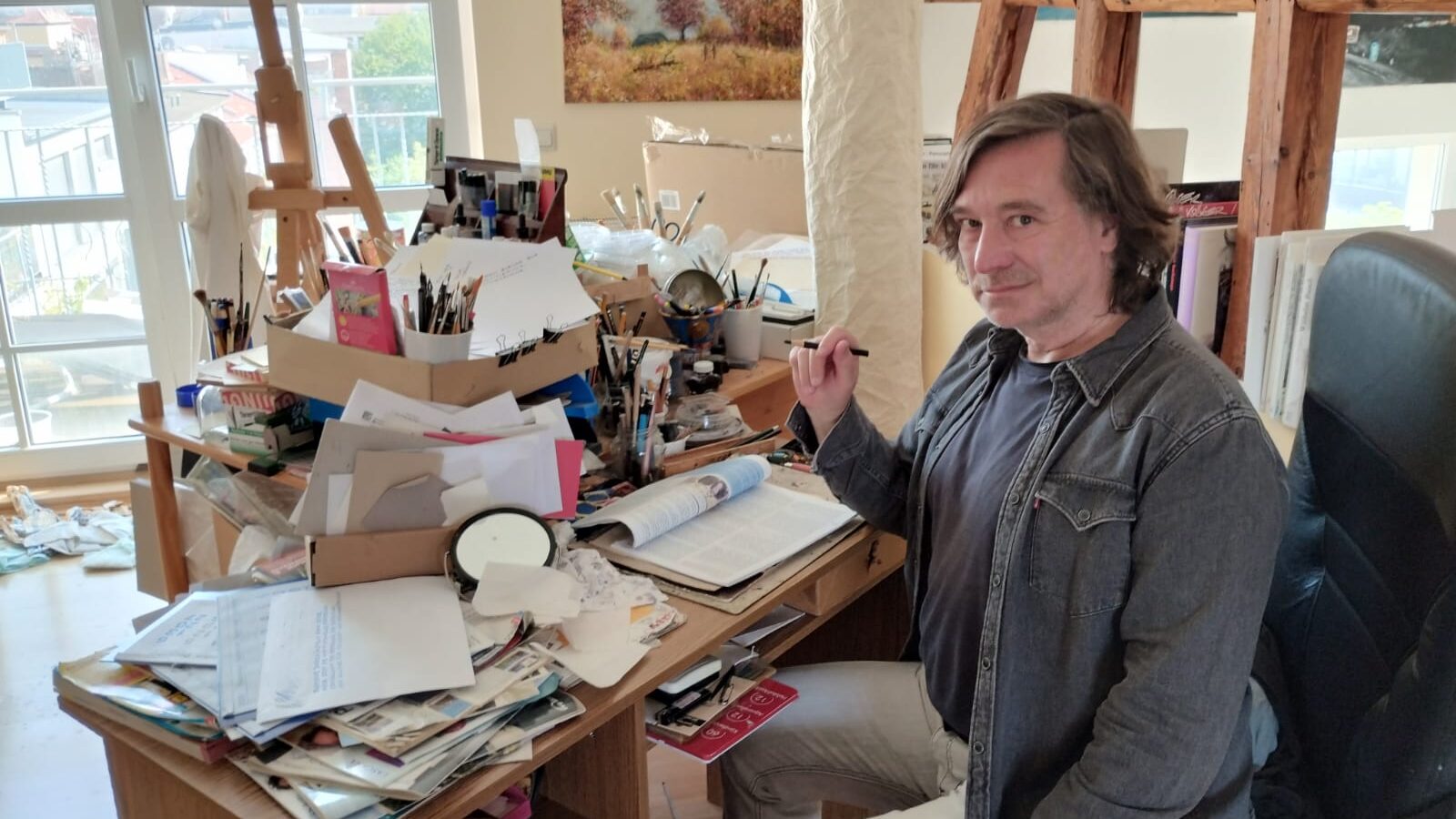
The cartoonist is Bernd Zeller, whom I met just days before the AfD party congress was set to begin, in Jena, in Germany’s eastern state of Thuringia, a few kilometers from Thuringia’s capital, Erfurt (which hosted the AfD congress).
Yellow vests hanging from window sills and balconies in the small university town caught my attention. What did they mean? “Resistance to the Other Party—the big opposition whose congress they want to stop,” Zeller explained when I asked him.
Zeller is one of Germany’s best-known caricaturists and the author of several satirical books. Highly successful in his field, he has drawn and written for major publications ranging from Titanic and Spiegel Online to the popular “Harald Schmidt Late Night Show,” where he worked as a gag writer from the mid-1990s until 2014.
But the satire business has grown hard in our age of cancel culture.
For Zeller, the real break came after he drew cartoons for the AfD’s membership newspaper between 2020 and 2022. Even before that, though, his humor was regarded in many established circles as ‘quirky’ at best—and often as overly provocative, even offensive.
And they were right: it is, and was, exactly what good humor and good satire are meant to be (i.e., they challenge the status quo, and highlight societal flaws). Take, for instance, his “Official Autobiography of Osama bin Laden,” published in 2007, which astutely skewers the German establishment’s self-loathing and the strange fascination certain left-liberal-green quarters hold for Islamism.
In the book, the infant bin Laden plays with Barbie dolls onto which he straps explosive belts. He also carries out honor killings: “One of my sisters—he has so many siblings that one loses count—was born naked. In doing so, she adopted a lifestyle that I not only reject but am entitled to put an end to,” he says. Later, as an established terrorist, he travels to Germany, only to find that his life story is met with understanding, even fascination. Everything is done to avoid “fueling prejudices,” and his new German and integration teacher falls in love with him after he calls her a “German slut.” At university, he becomes a “cult host” on campus radio.
Unsurprisingly, the book went largely uncommented on at the time in the German mainstream media (only Die Welt published a review).
His political crime novel Lost Merkel, published in 2013—at the height of Merkel’s popularity after the euro crisis and the year she was re-elected with a near-absolute majority—fared little better. In it, the former chancellor is kidnapped, only to prove that there really is “no alternative” to her. In the end, she turns out to be a vampire, but nobody notices. In one of the best scenes, the protagonist, hired to “find Merkel,” observes a demonstration organized by the self-declared “tolerant” against the “intolerant,” where one protester carries a banner reading “Smash Intolerance.”
Looking at the book now, thirteen years after its publication, as hysteria mounted ahead of the AfD party congress, it reads as a strikingly prescient description of a certain mindset. In Erfurt too, it was the self-declared ‘tolerant’ who blocked streets and called for the AfD to be banned.
It is that same mindset Zeller captured in another one of his booklets, The Language of the Green Reich (2019), in which a young woman declares, “We do not align ourselves with a good cause. We are the good cause.”
Good satire always hits a nerve. But Zeller denies being a born rebel. “I’m being pushed into this role,” he says. The truth, he insists, is that he’s merely a cartoonist doing his job. If he has rubbed up against the mainstream, it’s because, as he puts it, “I am not a court artist; I am an artist of the people.”
His method is that of the inverted aphorism, which captures the full contradictoriness of a statement: someone says something, and he then imagines what kind of person would say such a thing.
His refusal to join the ‘humor industry’—where, as he notes, the money still is—has naturally exposed him to cancel culture. It seems all the more malicious, then, that an article about him in a magazine he once co-founded declares the publication is distancing itself from him because he is supposedly on the political Right. The same goes for the frequent mention of his work for the AfD; Zeller says he took the commission simply because he is a caricaturist—just as he had previously drawn for the left-wing Neues Deutschland and the liberal Friedrich Naumann Foundation.
“A political cartoon is a barometer of freedom—that’s why dictators hate it,” the Venezuelan cartoonist Rayma Suprani once said. True enough, and the more repressive the situation becomes, the more material there is for the cartoonist to work with.
Zeller, who stresses that he draws only cartoons he genuinely likes (“I’m not corrupted”), has had plenty to work with in recent years. There’s the one from the COVID lockdown era, in which a smiling chancellor unveils a new study: “The study was produced by experts who subsequently all retained their positions.” Or the one following a string of terrorist attacks, in which one man remarks, “There actually aren’t that many potential terrorists. It’s usually the same guy.”
Language is a recurring subject for Zeller—particularly the government’s growing clampdown on ‘hate speech.’ There’s the cartoon in which one man tells another, “Some people, for example, say ‘Claudia Roth.’ That’s not hate speech, of course. But the way they say her name…” (Roth is Germany’s former minister of culture and a particularly unpopular member of the Green Party.)
For Zeller, there’s no mystery as to why he’s been shunned by some co-cartoonists and editors. Most of them, he says, share a certain mindset: “What bothers them is when people think differently than they’re supposed to. It’s a tactic the Left has consistently pursued for decades.” This, he explains, is also why resistance to the mainstream and the establishment has—at least historically—run stronger in Germany’s former east than in the west. People in East Germany recognize the tactic. They know it well. They knew, for instance, exactly what they were supposed to think—and not say—whenever the official line was something like “The banana harvest in our Saxon mountains wasn’t quite as good as expected this year.” Those in the West, he believes, have only had to learn this in recent years—during the COVID pandemic, for example, when criticism of government measures was treated as a taboo.
The AfD party congress was able to start on time. But there was violence. Teams of journalists from Apollo News and Junge Freiheit were attacked and chased through the streets (one video shows a young team member kicked as he fell to the ground).
The congress started punctually partly because delegates arrived so early—some reportedly as early as 4 a.m.—that they reached the venue before protesters could block the roads. There was also a massive police presence.
There was a bizarre spectacle involving a network calling itself Widersetzen (“Resist”), which organized the anti-AfD protests in Erfurt and looked as if it could have stepped straight out of one of Zeller’s cartoons. At what was billed as a ‘press conference,’ the network’s leadership defended the attacks on journalists. Asked to comment on the ugly scenes, the group’s spokesperson—a ‘trans woman’ (that is, a man)—said, “Fascists with a press card are still fascists.”
There was plenty of hysteria too. Months before the event, a rumor circulated that lent the protesters’ anti-fascist credentials extra weight: the congress dates (July 4–5) were supposedly no coincidence, but carefully chosen to coincide exactly with the 100th anniversary of the second NSDAP Reich Party Congress in Thuringia (July 4, 1926). It has since emerged that it was not the AfD but the venue—the Erfurt Exhibition Centre—that set the date, since its halls are typically booked out well in advance. Don’t be surprised if Zeller turns this into a cartoon about left-wing conspiracy theories soon.
“What is satire allowed to do? Anything” is the famous dictum of Kurt Tucholsky, the anti-fascist writer who died in Swedish exile in 1933. His insistence that satire should recognize no artificial boundaries, even at the risk of offending contemporaries and those in power, is often quoted by German liberals eager to burnish their own anti-fascist credentials.
But these borrowed anti-fascist credentials today go hand in hand with calls for more censorship, not less. The list of topics supposedly off-limits for satire keeps growing: it can’t include jokes about Muslims, it shouldn’t mock ‘Corona victims,’ and it certainly won’t do if it delegitimizes the government.
The new fake anti-fascism is directed against a significant number of citizens (the AfD came out as the largest party in Thuringia’s state election in 2024, managing 34.3% of the votes). In its call to ban the state’s most popular party, in its attack against journalists, and in its embrace of cancel culture, it has also become the new authoritarianism. It’s good to know that some satirists are still holding out against the trend—there will be plenty more work for Bernd Zeller to do.