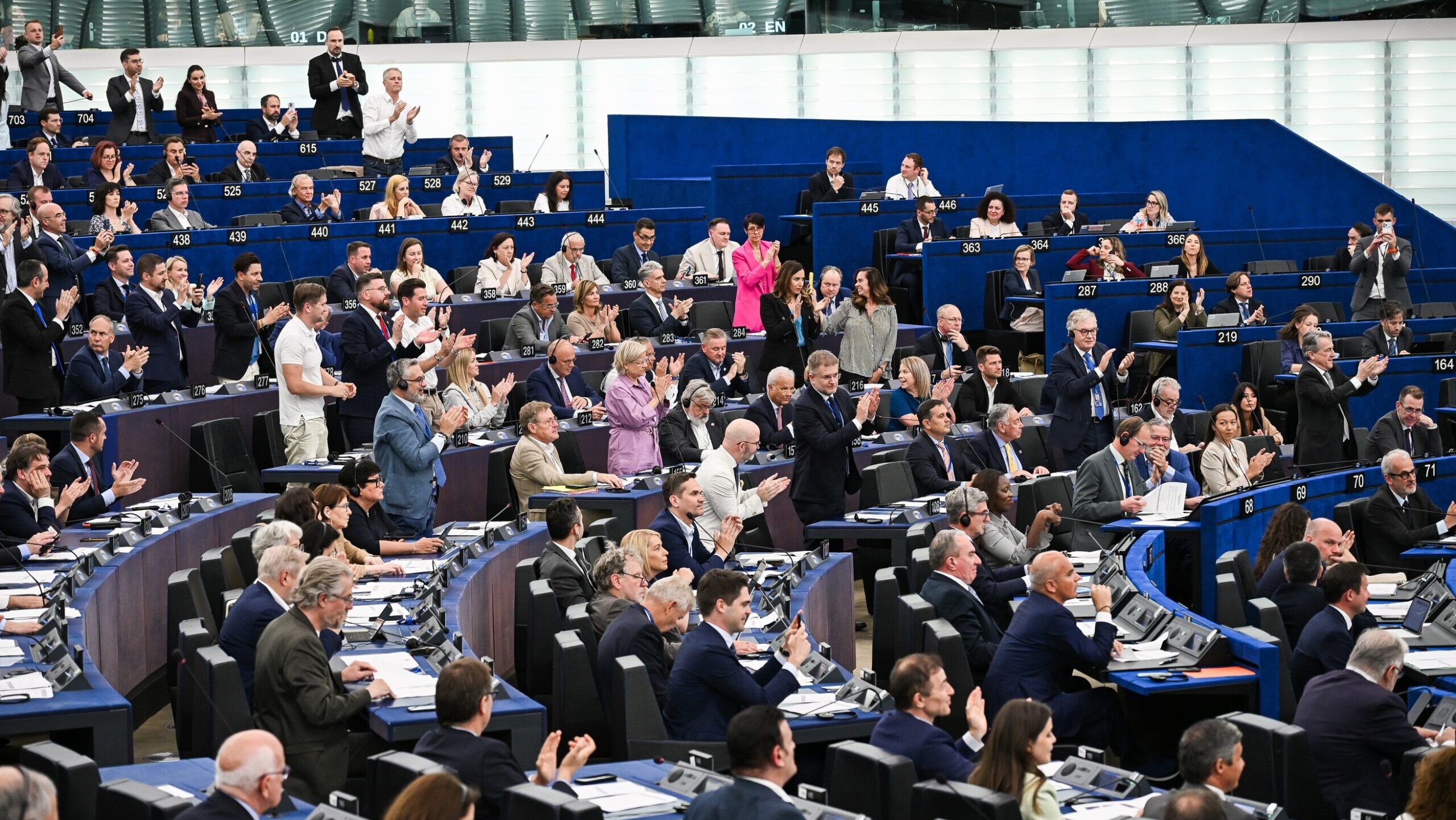
Christian CREUTZ © European Union 2026 – Source : EP
The announcement of the European Parliament’s final vote on the Return Directive was met with a burst of jubilation in the chamber, where energetic cries of “Send them back” rang out, reflecting the MEPs’ enthusiasm at having succeeded in passing the first genuine measure to seriously restrict immigration at the European level. On the opposite side of the chamber, MEPs responded to these exclamations with vigorous—though minority—cries of “Shame on you.”
The choice of words is not insignificant; some even see it as a foreshadowing—still a fantasy at this stage—of remigration.
Through a number of key measures, the directive drastically changes the landscape for the management of illegal immigration. Previously, an obligation to leave the territory remained a national decision. From now on, thanks to the Return Regulation, these decisions may be converted into a ‘European Return Order’—an obligation to leave European territory.
The maximum detention period for irregular migrants is quadrupled, up to 24 months, with the possibility of a further six-month extension.
The Return Regulation lists a number of other measures that may be taken: body searches, property searches, the obligation to remain contactable during the procedure, the recording of biometric data, house arrest, and the obligation to report regularly… Finally, the Return Regulation establishes a framework for EU member states to sign agreements with third countries that agree to receive individuals subject to a return decision.
This outpouring of enthusiasm did not go down well with everyone. Fabienne Keller, a French Renaissance MEP, made a fool of herself in the European Parliament by denouncing the right-wing “celebratory evening” organised by a few MEPs on the terrace of one of the parliament’s buildings, following the vote on the Return Regulation for rejected illegal migrants—a measure which, Keller argued, “will send families with children to camps.” Her statement, in which she lambasted a “political drinking spree,” was met with boos and prompted a call to order from the chair on the grounds that no breach of conduct had taken place.
On the Left as well as in the centre, the prevailing mood was one of exaggeration and dramatisation. Abir Al-Sahlani, a left-wing MEP from the Renew group, said she had never felt “as unsafe in Parliament as she did after the vote.”
It is true that the MEPs’ symbolic reaction marks a real turning point in the mindset of the political class at the European level. For a long time, the EU has been a brake on the implementation of more selective migration policies. This remains the case on many issues, particularly asylum. But we are witnessing a major shift, one that is being openly acknowledged. From a political standpoint, as a result of this vote, the European Union can no longer be invoked as a convenient excuse for inaction that satisfies the imperatives of political correctness.
Several right-wing politicians have spoken out in favour of this vote. Italian Prime Minister Giorgia Meloni described the result as a “great success.” In France, MEPs welcomed a convergence of interests between their respective groups, despite their differences on other issues. François-Xavier Bellamy, for the EPP, Marion Maréchal, for the ECR, and Sarah Knafo, for the EDN, hailed it as a victory for the united right.
For Marion Maréchal, this success on the battlefield of illegal immigration must not overshadow another objective: that of achieving a drastic reduction in legal immigration, which, she points out, currently affects 62 million people across Europe—a figure almost equivalent to the population of a country like France.
She thus wishes to emphasise that, whilst this symbolic moment has been widely shared on social media, there is still a long way to go towards achieving effective border control—both at the European and the national level. Above all, in the member states, European endorsement will not mean automatic implementation of the directive, as some social media users fear; they see this, at the very least, not as a “legal turning point,” but as the start of a “paradigm shift.” A first step, but just a step.