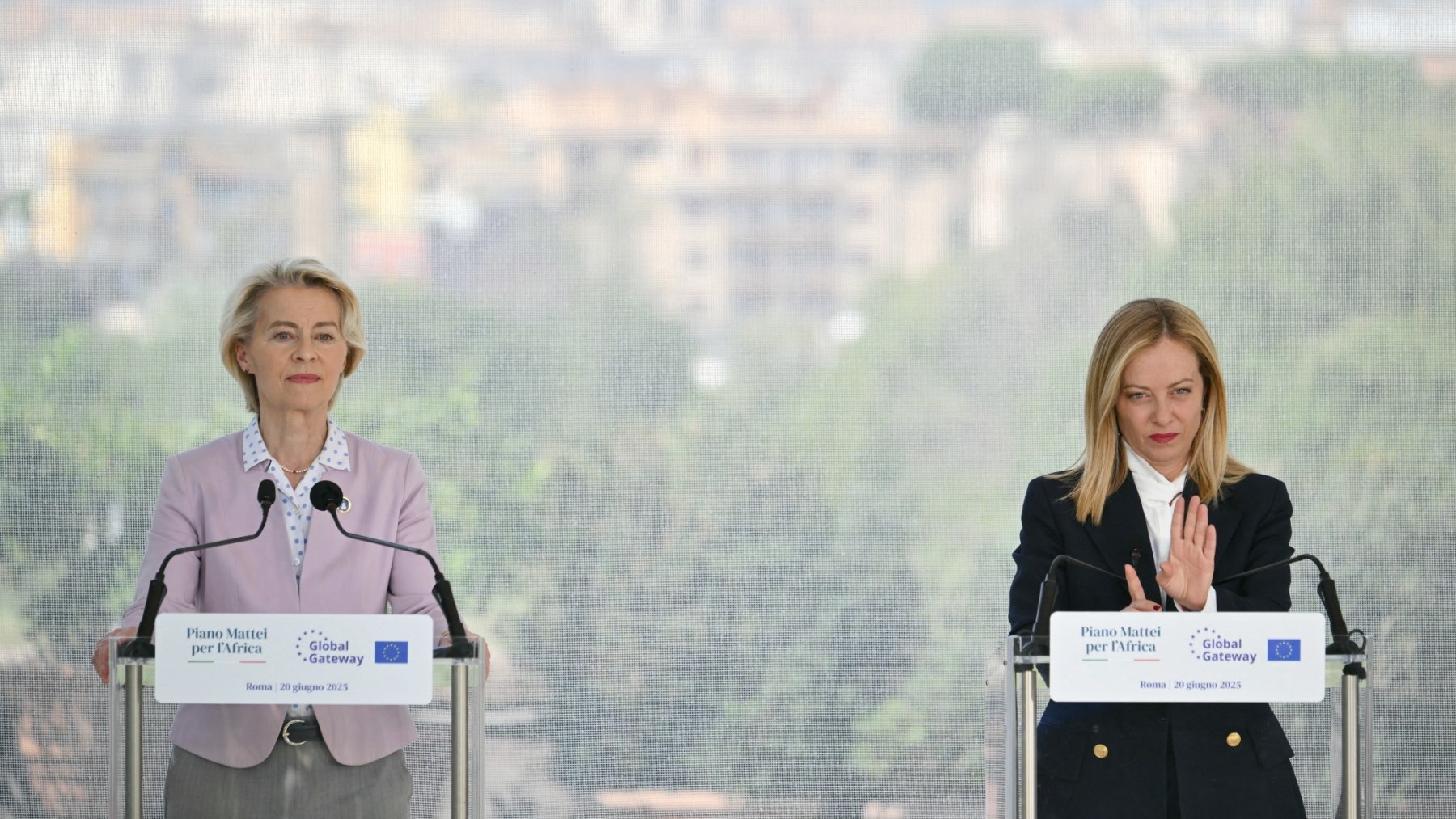
Italy’s Prime Minister Giorgia Meloni (R) and European Commission President Ursula von der Leyen attend ‘The Mattei Plan for Africa and the Global Gateway: A common effort with the African Continent’ summit in Rome on June 20, 2025.
ALBERTO PIZZOLI / AFP
The European Commission published criticism of the Italian government for reducing excise duties on fuels on Wednesday, June 3rd.
Rome’s emergency actions are designed to mitigate the rising energy costs driven by the U.S.-Iran war. The Commission considers such measures as “untargeted” and “too broad.”
The Italian government calls for fiscal flexibility when dealing with spiking energy costs. Prime Minister Giorgia Meloni wrote to European Commission President Ursula von der Leyen requesting she endorse such an approach. Unlike with defence spending, Brussels has kept quiet on the issue.
In contrast, the Commission timetabled presenting its country-specific recommendations on Wednesday, which is likely to include the recommendations that Rome should
ensure that any measures taken to mitigate the impact of the hike in energy prices are temporary, targeted at protecting vulnerable households and addressing the needs of energy-intensive firms, preserve incentives for energy savings while ensuring that their fiscal cost is compatible with the recommended expenditure paths.
Like the International Monetary Fund, Brussels opposes any “untargeted” reductions in excise duties on fuels, an emergency measure now deployed in Italy but due to expire on June 6th.
Meloni‘s counter-proposal is to expand the ‘national escape clause’—another extraordinary measure brought in last year exempting defence spending from the European Union’s framework of fiscal constraints.