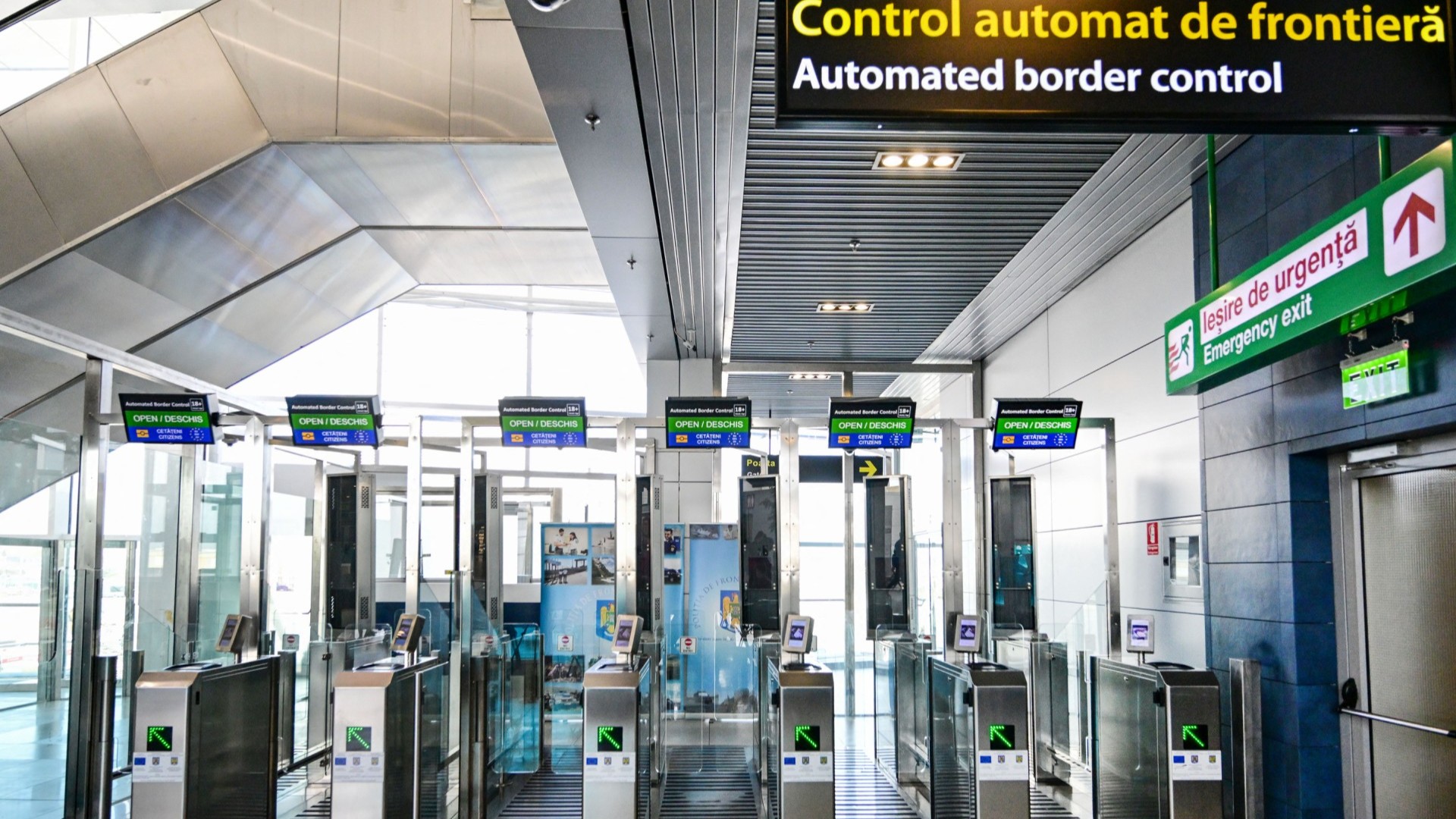
Newly installed non-Schengen automatic border control gates are pictured at the Henri Coandă International Airport in Otopeni, Romania, on March 28, 2024.
DANIEL MIHAILESCU / AFP
The European Union has launched a new biometric border control system for non-EU travellers entering the Schengen Area.
The system, known as the Entry/Exit System (EES), requires travellers from outside the EU to register fingerprints and a facial photograph alongside passport details when crossing into the Schengen Area. The rollout is taking place across all 29 participating countries, though implementation is being phased in gradually due to operational challenges at some border points.
Under the new rules, biometric data will be collected the first time a traveller enters the system and stored for future verification. Passports will eventually be replaced by digital records, reducing reliance on manual stamping by border officials.
The EU says the system is designed to improve border security and streamline travel procedures over time, although early stages have already led to reports of longer queues at airports and transport hubs, particularly during peak travel periods.
The launch comes after years of failed border management. The 2015 migration crisis exposed weaknesses in the existing EU framework, and since then, pressure on external borders has remained high.
A recent report by the International Centre for Migration Policy Development (ICMPD), suggests that tighter border controls and external agreements have not reduced overall mobility. Instead, they tend to redirect movement towards alternative and often longer and riskier routes. The report also notes that further tightening of controls is expected to reshape travel patterns in 2026, without significantly reducing overall movement levels.
However, data from Frontex shows that while irregular crossings into the EU fell in 2025, migration routes have continued to shift rather than disappear.
Alongside EES, the EU is also preparing to introduce the European Travel Information and Authorisation System (ETIAS) in the coming years, which will require visa-exempt travellers to obtain pre-travel authorization online.