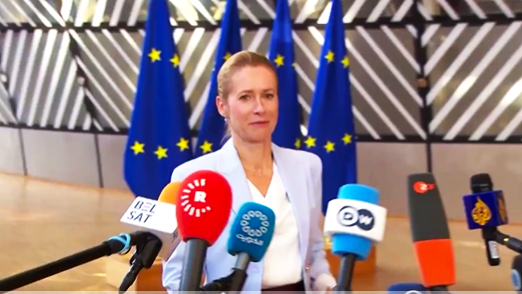
EU foreign policy chief Kaja Kallas talks to reporters on July 13, 2026
Screenshot from the video of Kaja Kallas’s doorstep published on @kajakallas on July 13, 2026
Ahead of the European Union’s Foreign Affairs Council meeting, foreign policy chief Kaja Kallas took to X (Twitter) to announce the bloc’s latest punitive measures, claiming that Brussels is sanctioning Russia “at speed and scale.” According to Kallas, the newly approved designations, combined with the upcoming 21st sanctions package, will add 250 individuals and entities to the EU’s Russia blacklist. She described the move as the largest single round of individual designations since Moscow’s 2022 invasion and the largest-ever cyber sanctions package designed to target the “financial backbone” of the Russian war machine.
We’re sanctioning Russia at speed and scale.
— Kaja Kallas (@kajakallas) July 13, 2026
Today’s measures, together with the upcoming 21st sanctions package, will add 250 individuals and entities to the Russia sanctions regime.
This is our biggest round of individual designations since Moscow’s 2022 full-scale invasion,… pic.twitter.com/zjWxbrbunH
Despite Kallas’ confident rhetoric that “every measure weakens Moscow’s ability to wage war,” the announcement comes amid growing skepticism across Europe. Critics point out that the previous 20 sanctions packages have largely failed to cripple the Russian economy or halt military operations in Ukraine. Russia has successfully adapted to Western trade barriers by rerouting energy exports to Asian markets, establishing elaborate sanctions-evasion networks, and converting its domestic economy to a wartime footing. The fact that Brussels is already drafting its 21st package is viewed by critics as an admission that the previous multi-year effort has been highly ineffective.
In her doorstep address, Kallas also outlined a broad and complex agenda for the Foreign Affairs Council, highlighting the limits of the EU’s leverage on multiple global fronts. Alongside the Russian sanctions, ministers discussed establishing a platform to support civilian detainees in occupied Ukrainian territories, maritime security initiatives in the Black Sea, and a new partnership mission for Armenia.
However, with European resources stretched thin and key diplomatic efforts in regions like the Middle East and Sudan failing to yield decisive results, the bloc’s reliance on seemingly symbol-heavy sanctions lists will hardly move processes aimed at resolving armed conflicts forward.