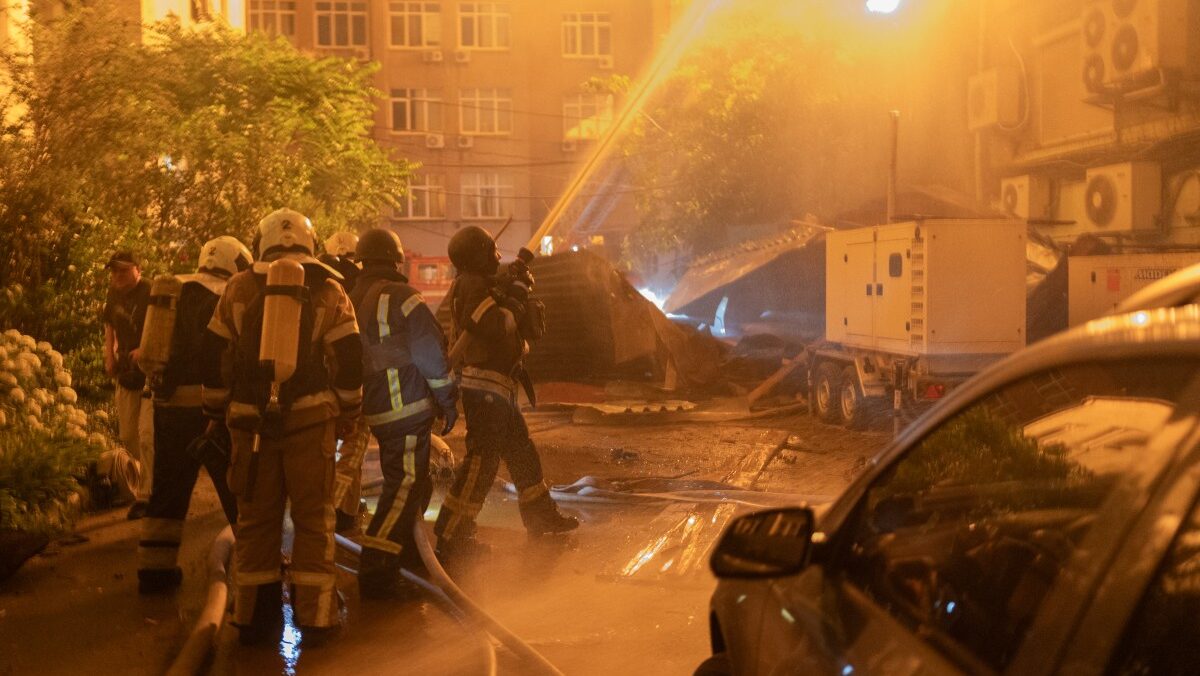
Ukrainian firefighters battle a blaze after Russian drone strikes hit Kyiv during an overnight air attack on July 2, 2026.
Roman PILIPEY / AFP
EU foreign policy chief Kaja Kallas has called for more military support for Ukraine and tougher sanctions on Russia after Moscow’s latest missile and drone attack on Kyiv, even as repeated rounds of sanctions have failed to bring the war any closer to an end.
Kallas reacted to the overnight strikes by saying that “words of condemnation” would not stop Russia’s attacks on the Ukrainian capital. She argued that only continued military support for Ukraine and greater pressure on Moscow could do that.
Words of condemnation alone will not stop attacks on Kyiv. Only sustained military support for Ukraine and increased pressure on Moscow can do that.
— Kaja Kallas (@kajakallas) July 2, 2026
This week, the EU has started disbursing €6 billion under the €90 billion support loan to strengthen Kyiv’s defences.
Today, I…
Her statement came after a Russian missile and drone attack that killed and injured dozens of people in Kyiv. The city declared a day of mourning as rescue workers continued searching through the rubble. The pattern of the war has become familiar: Russia launches strikes on cities and infrastructure, Ukraine asks for more air defences, and Brussels responds with more military aid and sanctions.
Kallas also said she would propose sanctions against more companies linked to Russia’s military industry. She said the aim was to increase the cost of every attack until Moscow “understands it cannot win.” She also noted that the EU has started paying out €6 billion from a €90 billion loan package to support Ukraine’s defence and government finances.
The problem for Brussels is that this approach is no longer new. The EU has imposed sanctions on Russia since 2014, after the annexation of Crimea, and greatly expanded them after the full-scale invasion of Ukraine in 2022. The measures now cover banks, oil and gas, aviation, dual-use technology, diamonds, media outlets, oligarchs, companies in third countries, tankers linked to Russia’s “shadow fleet,” and suppliers of drones.
The sanctions have had an impact, although not in the way Brussels often suggests.
Russia no longer trades with Europe as it once did. Oil and gas revenues have fallen, trade has become more expensive, and access to Western technology has become more limited. In 2025, Russia’s budget deficit reached 2.6% of GDP, while oil and gas revenues fell by 24%. The International Monetary Fund expects Russia’s economy to grow by just 1.1% in 2026. Its economy has clearly been weakened.
But it has not collapsed.
Russia has redirected much of its trade towards Asia, sold discounted energy to China and India, and supported growth through heavy military spending. Its economy is now less efficient, more closed, and more dependent on the state, but it continues to function. It also still has vast natural resources, strategic depth, and a large military-industrial base.
A comparison with China shows the limits of sanctions. China’s economy is far larger, with the IMF forecasting nominal GDP of around $20.85 trillion in 2026 and growth of 4.4%. Russia is much smaller, but it still has major energy reserves, raw materials, military production, and territory. China offers industrial scale, while Russia brings strategic depth. The EU has tried to pressure both countries through sanctions and regulation, but that approach can only go so far.
The EU has reduced its dependence on Russian gas, but only by paying more for alternative supplies, including liquefied natural gas from other countries. It has gained greater political flexibility, but not full energy independence. Replacing one supplier with another is not the same as achieving sovereignty.
Kallas is right that condemnations alone do not stop missiles. But the question remains whether each new package of sanctions is bringing the war any closer to an end, or simply managing a long conflict with a country that Europe may one day need to trade with again.