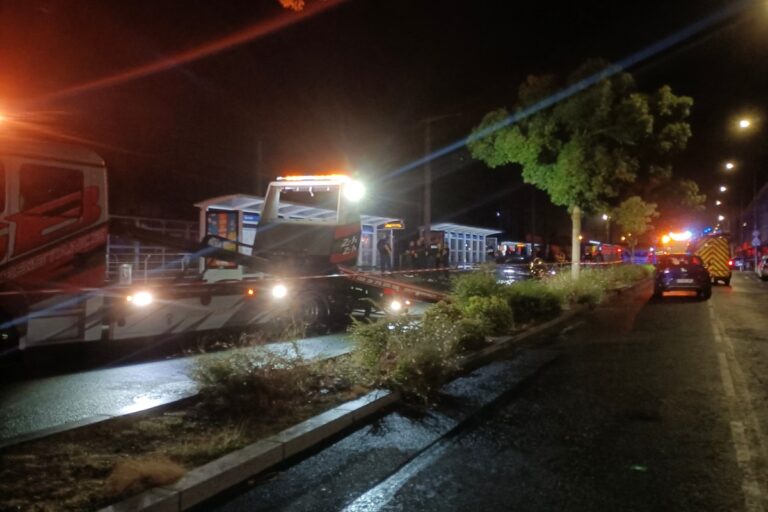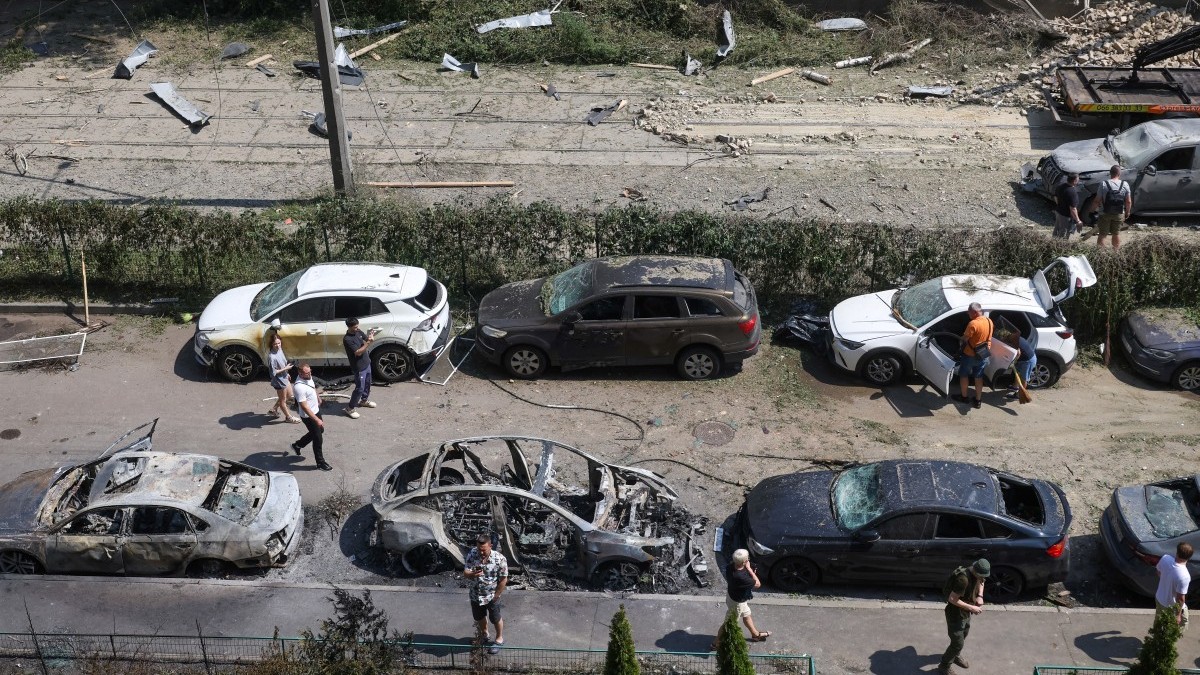
People walk past damaged cars parked in a street following missile strikes in Kyiv on July 19, 2026.
SERHII OKUNEV / AFP
Russia carried out one of its largest aerial assaults on Ukraine on Sunday, July 19, launching a relentless five-hour bombardment that targeted the capital city of Kyiv and other major urban centers.,
Reportedly, the strikes killed at least eight people across the country, including four workers at a postal terminal in the suburbs of Kharkiv, and left dozens injured. The Ukrainian military described how its air defense systems successfully shot down 18 out of 41 missiles—including hypersonic Zircon and Iskander models—and intercepted 108 of the 125 drones deployed during the assault.
The devastation continued into Sunday evening as Russian missiles targeted maritime transport in the Black Sea. According to the Ukrainian navy, a civilian cargo ship carrying grain was struck by Russian missiles, killing five crew members. President Volodymyr Zelensky condemned the overall offensive as an escalation of terror, while additionally confirming that guided missiles had hit residential areas in Kherson, Sumy, and Zaporizhzhia. The intensifying air campaign has placed renewed pressure on Kyiv’s international partners to accelerate the delivery of advanced anti-ballistic defensive systems to protect civilian population centers.
In response to the onslaught, Ukrainian forces launched coordinated long-range drone strikes of their own, targeting key Russian energy and logistical assets. Zelensky confirmed that security services successfully struck three oil depots in the Stavropol region and damaged three Russian ‘shadow fleet’ oil tankers in the Black Sea.
Additionally, Ukrainian UAVs struck two major warehouses belonging to Russia’s largest online retailer, Wildberries, in the Moscow and Tambov regions, killing eight workers. Kyiv justified these actions by asserting that the targeted facilities were being utilized to supply sanctioned components for military drone production and to finance Russian aggression.