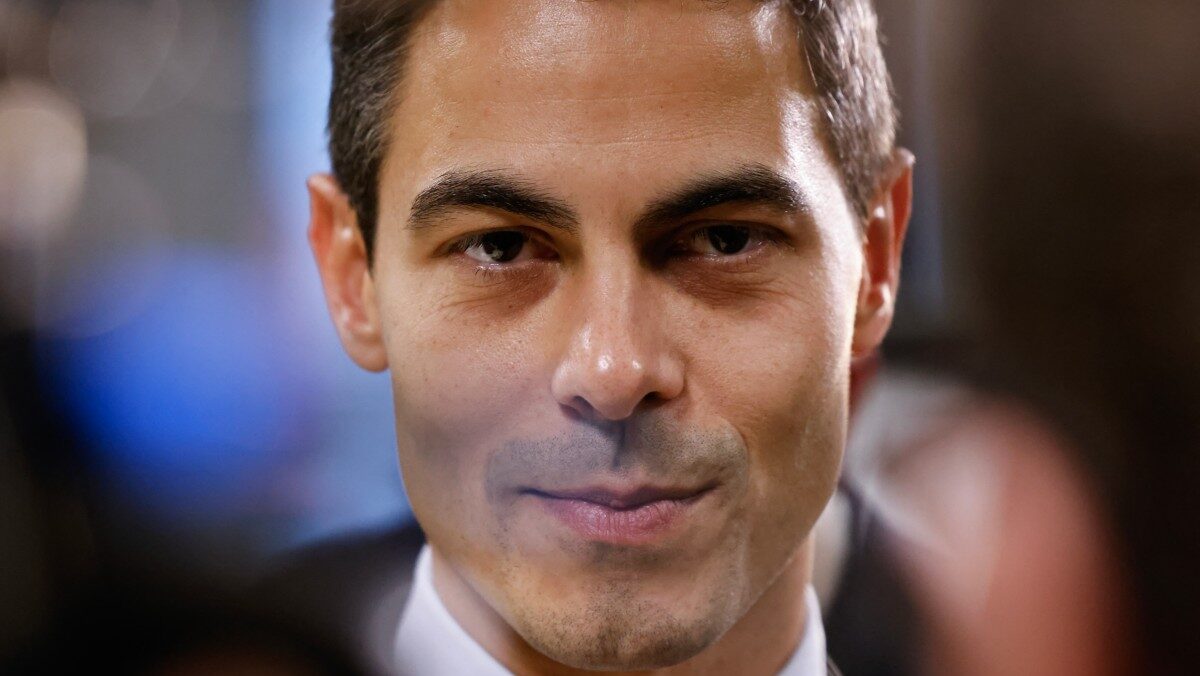
New Dutch PM Rob Jetten has his work cut out for him and is already facing criticism for his handling of an internal scandal.
SIMON WOHLFAHRT / AFP
The new Dutch minority government led by Rob Jetten was officially sworn in today. The cabinet is formed by Jetten’s progressive D66, the liberal VVD, and the Christian Democratic Appeal (CDA), and begins its term under difficult circumstances. Public trust is low, political divisions are sharp, and several sensitive dossiers are already threatening the stability of the coalition.
According to a recent poll by EenVandaag, only 32% of voters say they trust the new Jetten cabinet. That figure is notably lower than the 42% trust level with which the previous Schoof cabinet started a year and a half ago. At that time, the coalition did have a parliamentary majority. The current cabinet does not, making it dependent on ad hoc support in parliament.
Trust levels differ strongly between voter groups. Of the voters supporting the coalition parties, VVD voters are the most sceptical, with just 45% expressing confidence in the new government. Many of them say they would have preferred a majority coalition including an additional right-wing party such as JA21. Voters of D66 and CDA are more cautiously optimistic. They often describe their support as giving the cabinet “the benefit of the doubt,” while also warning that the VVD could prove an “unstable factor” within the coalition.
Rob Jetten himself starts his premiership with a personal trust rating of 41%. That is significantly lower than the figures recorded by his predecessors at the start of their terms. Mark Rutte began with 51%, while Dick Schoof entered office with 57% trust. Respondents acknowledge Jetten’s “positivity and vision,” but many also point to what they see as a weak handling of his first major crisis.
That crisis involved party colleague Nathalie van Berkel, who withdrew first as state secretary of finance and later as an MP after false information on her CV came to light. Critics argue that Jetten should have acted more decisively. One VVD voter told EenVandaag: “He did not act strongly and not as a leader. He should have sent her away immediately instead of leaving that decision to her. A false start.”
Confidence in VVD ministers is also mixed. Dilan Yeşilgöz enjoys relatively high trust among VVD voters in her role as minister, with 84% support, compared to 75% as party leader. Still, many respondents are critical of the internal reshuffle involving Yeşilgöz and party colleague Ruben Brekelmans.
The decision to move Brekelmans from his position as minister of defence has been widely questioned. Nearly two-thirds of respondents say he should have stayed where he was. “He knows the people,” one VVD voter said. “In times like these you should not change course. Yeşilgöz would have been better suited at Justice.”
The formation of Rob Jetten’s cabinet has already been overshadowed by controversy, as a proposed D66 cabinet member has withdrawn over a résumé scandal. Nathalie van Berkel, who had been nominated as state secretary at the Ministry of Finance, stepped aside after De Volkskrant revealed that her CV contained inaccuracies about her educational background. The newspaper reported that Van Berkel listed studies she never completed and implied a higher level of education than she actually attained, including on her LinkedIn profile. After being questioned, she corrected her CV and soon after withdrew her candidacy for the cabinet position. In a written statement, Van Berkel said the debate had become a distraction from the cabinet’s work and stressed that it was never her intention to misrepresent her education. Intended prime minister Rob Jetten described her decision as a “brave and courageous” one, saying it followed careful discussions.
Additionally, several D66 ministers are facing controversies. Jetten himself carries political baggage from his time as minister for climate and energy (2022-2024). His tenure was marked by massive spending programmes, including a national climate fund exceeding €35 billion. According to his own calculations, an additional 28-billion-euro climate plan would reduce global warming by just 0.000036 degrees. The Netherlands Environmental Assessment Agency warned that the effectiveness of many measures was uncertain. Additionally, costs for offshore wind connections also rose sharply, with estimates increasing by around €40 billion, partly passed on to households and businesses.
Another contested appointment is Sjoerd Sjoerdsma, the minister for foreign trade and development cooperation. Known for sharp rhetoric, he previously accused right-wing broadcaster Ongehoord Nederland of “inciting terrorist crimes” and asked during a debate on Ukraine, “Is this the Kremlin’s spokesperson speaking?” He also became involved in controversy over alleged political interference in a public broadcaster documentary about former D66 leader Sigrid Kaag, allegations he dismissed as “slander.”
Lastly, the nomination of Sjoerdsma is seen as a risk, as China has never lifted the sanctions imposed on him. Those sanctions were introduced in 2021 in response to European measures over the alleged genocide of the Uyghur minority, after Sjoerdsma, then a D66 MP, supported a motion labelling China’s actions as genocide. Although Beijing lifted sanctions in 2025 against several members of the European Parliament and one organisation, Sjoerdsma was not included, and Dutch government sources confirm China has never informed The Hague that he was removed from the list.
Another controversial pick is Lieutenant General Eleanor Boekholt-O’Sullivan as the new minister for Housing and Spatial Planning. Despite her high rank, she has been criticised for limited operational experience. In 2024, she drew attention after failing to answer a basic question about tank crews on television. Within defence circles, she is known for a strong focus on diversity and inclusion, which has drawn internal resistance. Her name also surfaced in a debate on possible conflicts of interest after she handed command of Eindhoven Air Base to her husband in 2018, a move that critics said created at least the appearance of impropriety.
Hans Vijlbrief, designated minister of social affairs, also remains a divisive figure due to his role in closing the Groningen gas field. Critics argue that the decision sacrificed energy security and hundreds of billions in revenue at a time of high energy prices and economic uncertainty, while supporters emphasise safety concerns due to the danger of earthquakes involved with gas production. Lastly, the new education minister, Rianne Letschert, has sparked debate with proposals for strict gender quotas in academia.
Beyond personnel issues, the cabinet faces major policy disputes. Right-wing parties BBB and JA21 have voiced strong criticism of the new Box 3 tax reform, which taxes unrealised gains. They warn of “taxation on paper profits”, limited loss compensation and the risk of capital leaving the country. Although the law has passed the lower house, it will be reviewed again and evaluated after three years.
Immigration policy is another fault line. Asylum laws drafted under former minister Marjolein Faber risk failing in the Senate due to doubts within the CDA. At the same time, D66 has signalled it will vote against the same laws in the upper house, despite endorsing their implementation in the coalition agreement. That tension underscores the fragile nature of the minority government.
With low trust, internal disagreements and controversial ministers, the Jetten cabinet begins its term under intense pressure. Whether it can survive depends not only on parliamentary arithmetic but also on its ability to restore confidence and manage divisions that are already clearly visible.