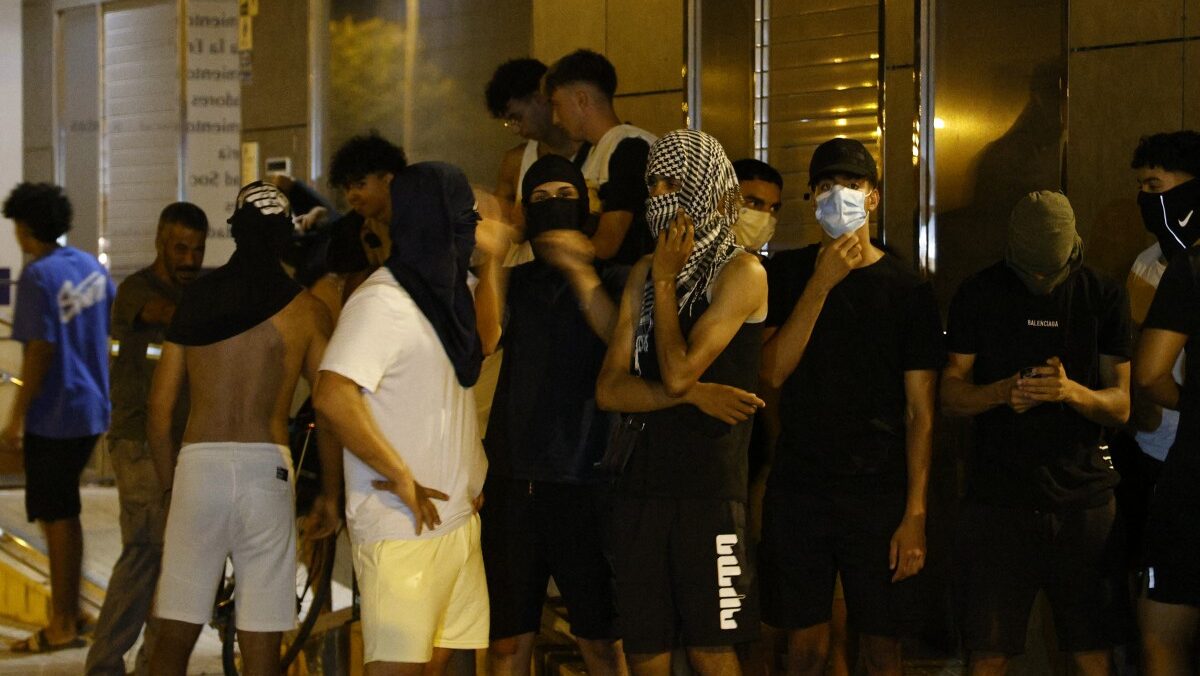
Residents wearing head coverings and face masks congregate in the street following three days of unrest in Torre Pacheco, in eastern Spain on July 14, 2025.
Stringer / AFP
The Spanish town of Torre Pacheco (Murcia) has now endured almost a full week of nightly riots following the brutal assault of an elderly man by Moroccan immigrants. What began as an isolated violent incident has spiraled into a sustained atmosphere of confrontation between Spanish locals and groups of young Maghrebis, many of them armed with bats, crutches, sticks, and chains.
The flashpoint of the unrest was the beating of Domingo, a 68-year-old resident, who was attacked from behind while walking near the cemetery. That assault was the spark that ignited a long fuse, fed by months of insecurity, thefts, threats, and growing tension between locals and an increasingly aggressive and unrestrained immigrant community.
Since then, Torre Pacheco has experienced nights of sheer terror. Scenes keep repeating: bottles being thrown, flares and firecrackers used as weapons, looting of small businesses, and direct clashes with the National Police’s riot units, which are overwhelmed. The Civil Guard has arrested more than 14 people, three of them—Moroccan youths aged between 19 and 22—for involvement in the assault on the elderly man, but the violence continues. In fact, many residents report that the only ones still patrolling the streets are organized immigrants who have taken control of certain neighborhoods.
Amid the chaos, troubling information has begun to circulate: several police sources claim that groups of radicals from other European countries—specifically from Romania and Italy—have been allowed entry, apparently to “balance forces” and provoke a direct confrontation with the immigrants. These are said to be informal agreements between mid-level security officials and foreign ultras—militant soccer fans—allegedly tolerated by the Interior Ministry to “let them vent their rage on each other.”
Such strategies reveal a level of institutional negligence bordering on complicity and suggest a deliberate instrumentalization of the immigration conflict to divert media attention. All of this is happening just as Pedro Sánchez’ government is besieged by multiple judicial cases involving corruption, illegal financing, and influence peddling.
The perception among residents is unanimous: they feel abandoned. Mayor Pedro Ángel Roca’s calls for help went ignored until the situation became unsustainable. Only then did the Interior Ministry deign to send reinforcements. But it was already too late. The authorities have lost control, and the social fracture appears irreversible.
Meanwhile, associations like JUCIL, a vocal and active police union, warn that the seeds of violence tied to immigration have already been sown, and that without immediate reinforcement of personnel and resources, such episodes will repeat in other towns. The Civil Guard estimates a shortfall of 17,000 officers needed to adequately cover the national territory, and says the shortage of resources is as serious as the lack of political will.
Torre Pacheco is, today, a mirror of what can happen when public safety is sacrificed on the altar of political calculation. This violence didn’t arise spontaneously. It has been tolerated, fed, and even channeled as a distraction. The question now is not whether this will happen again, but when and where. Many are already saying: “There will be more Torre Pachecos.”