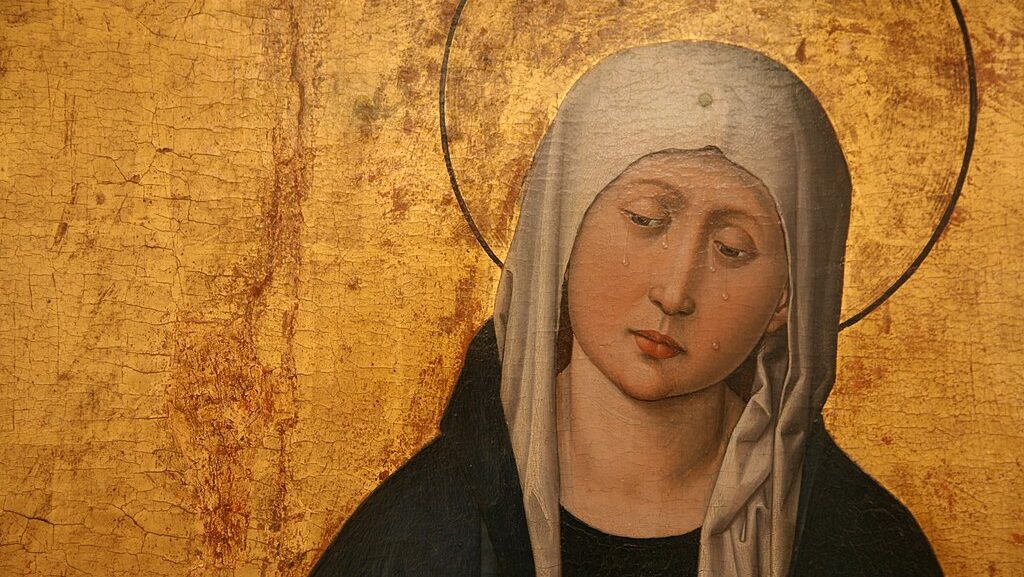
Virgin Mary as the Mater Dolorosa (Sorrowful Mother)
Unterlinden Museum, CC BY 2.0, via Wikimedia Commons
“Christianophobia”—understood as hostility, discrimination, or violence directed against Christian people and symbols because they are Christian—is a phenomenon that is becoming increasingly visible and serious across Europe. A report published by the European Centre for Law and Justice (ECLJ) on December 1st highlights an often underestimated reality: the rise in anti-Christian hate crimes—physical, legal and social—profoundly affecting the religious freedom and daily lives of Christians on the continent.
The ECLJ and the Observatory on Intolerance and Discrimination against Christians in Europe (OIDAC) have compiled data showing that no fewer than 2,211 anti-Christian crimes were committed in 2024, including 274 physical assaults, across a panel of 35 European countries studied.
These acts include a wide range of violence: from vandalism to church desecrations, arson to direct threats, and even serious physical assaults. One of the most striking tragedies was the murder on September 1st of a Christian in Lyon, Ashur Sarnaya, who was killed because of his faith while witnessing live on social media—a murder met with silence by the media, except for conservative and Christian platforms.
This level of aggression is not an isolated phenomenon but part of a growing trend in recent years, reflecting a worrying increase in anti-Christian violence in Europe.
The ECLJ report establishes a typology of anti-Christian acts, which shows the extent of the phenomenon. Vandalism is the most common form of hostility. Churches and religious symbols in public spaces are regularly targeted with graffiti, upside-down crosses, or damaged or broken statues. A significant proportion of the acts consist of arson attacks on places of worship, often without any explicit claim of responsibility. Desecrations are on the rise: many sacred places are intentionally defiled, undermining the spiritual dimension of religious buildings, without provoking public outrage. Crosses, reliquaries, and other sacred objects are stolen or destroyed, depriving communities of their symbolic heritage. But the most serious issue remains the increase in interpersonal threats and violence: worshippers, priests, and religious leaders are targeted by intimidation and physical attacks, including attempted murder.
This diversity of attacks shows that Christianophobia is not limited to isolated incidents: it manifests itself through repeated attacks on believers, their places of worship and their practices, giving the impression of the beginning of systematic persecution.
The ECLJ report highlights several factors that explain this rise in hostility towards Christians. Secularisation and militant secularism explicitly target the Christian faith. In some countries, a strong secular culture tends to reject any public expression of Christian faith, considering religious symbols as obstacles to a ‘neutral’ society. Ideological extremism thrives on this secularisation, which has become an integral part of European societies. Far-left groups, often opposed to the traditional values associated with Christianity, contribute to the stigmatisation and marginalisation of believers. But Christians are also victims of violent religious radicalisation on the part of certain Muslims, who are responsible for serious physical attacks, victims of ‘holy war’ or jihad.
These factors combine to create a climate in which hatred towards Christians can become commonplace, be underestimated or, too often, go without an adequate institutional response.
One of the key points of the report is the significant underestimation of the actual scale of the phenomenon. Many Christian victims are reluctant to report anti-Christian acts for fear of being accused of seeking to victimise themselves or of ‘stoking tensions.’ Furthermore, the public authorities themselves tend to ‘undercount’ these acts, as some do not fall within the official categories of ‘hate crime.’ For example, in Germany, only attacks recognised as ‘politically motivated’ are officially recorded, thus excluding a large number of religiously motivated acts.
Beyond physical violence, the report highlights a widespread marginalisation of Christians in the public sphere. They suffer from restrictions on religious freedom. In some contexts, religious practice is hampered by implicit prohibitions or administrative sanctions for behaviours as simple as praying silently near a public institution. At the social or professional level, Christians may be sanctioned or marginalised at work or in social circles because of their beliefs, particularly when these are perceived as conservative (on issues such as family, abortion, etc.). This sometimes more subtle form of discrimination plays just as important a role as explicit violence in creating a climate of intolerance and exclusion.
The ECLJ’s report is particularly useful, but it comes up against an institutional limitation, particularly at the European level: the absence of a specific mechanism to recognise and combat Christianophobia as a distinct form of religious hatred. Unlike other forms of religious hatred, such as antisemitism or Islamophobia, there is no European coordinator dedicated to combating anti-Christian hatred. This means that despite the documented scale of the phenomenon, institutional responses often remain fragmented and insufficient. Data also show that Christianophobia tends to be marginalised in general anti-discrimination strategies, contributing to a certain political invisibility of the problem.
To address this rise in anti-Christian hatred, the ECLJ report makes several concrete recommendations:
These measures aim to ensure that Christians can exercise their fundamental rights without discrimination or violence. Dechristianisation has now made them one minority among many. Worse still, they are a minority that now has even fewer rights than others.