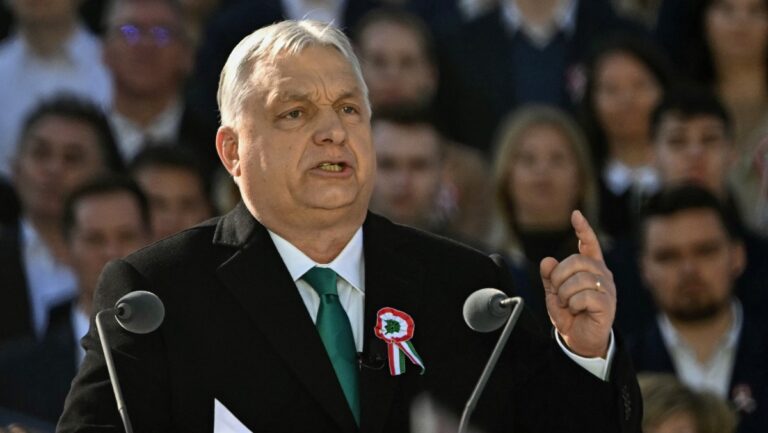
Republika Srpska President Milorad Dodik.
Photo: Milorad Dodik on Facebook, 6 December 2023
The 1995 Dayton peace agreement that holds together Bosnia and Herzegovina has never seemed as fragile as now, raising questions about whether it will live to see its thirtieth anniversary.
On Wednesday, April 23rd, Bosnia’s central State Investigation and Protection Agency (SIPA) attempted to arrest Milorad Dodik, the president of Republika Srpska (RS), the Serb-speaking federal entity encompassing about half of the country, the public broadcaster RTRS reported on Thursday morning.
The SIPA officers attempted to arrest Dodik after he arrived in East Sarajevo, which is under RS control, unlike the western part of the capital. The operation failed when the state police decided to withdraw after being warned by heavily armed RS counter-terrorist forces traveling with the president that they would use force to defend him.
“The SIPA officers today tried to execute the court’s order and arrest [Dodik],” a spokesman for the agency confirmed. “They talked to the members of the RS police who warned them they would use force and so prevented them from executing the orders.”
Dodik compared his treatment to that of “an al-Qaeda suspect,” and reminded the SIPA agents that they had no jurisdiction in Republika Srpska and that it would be unwise to challenge the local security forces. Protected by his armed entourage, the president was free to travel back to the RS capital, Banja Luka.
Serbian president and Dodik’s long-time ally Aleksandar Vučić has not issued any public statement yet, but previously expressed strong support for his RS counterpart and slammed the arrest warrant against him as “shameful, illegal, and undemocratic,” warning that executing it would risk wider regional destabilization.
Tensions in the country are at an all-time high since Bosnia’s highest court sentenced the president to one year in prison and banned him from public office for six years back in February for “undermining the constitutional order” by defying the authority of Bosnia’s UN High Representative, Christian Schmidt.
According to the Dayton Agreement, which ended four years of bloodshed in the early ‘90s, the High Representative oversees the Council of Presidents, Bosnia’s highest executive body, consisting of a president for each nation: Bosniaks, Croats, and Serbs.
The current dispute began in 2023 when the Bosniak-Croat majority in the Constitutional Court decided to change the rules and allow for sessions and decisions without the presence of their Serb counterparts. The purpose of the move was to bypass the Serb judges’ boycott of the court’s approval of the High Representative’s top-down, unilateral amendments of the criminal code, regarded by the RS as illegitimate.
The Srpska parliament retaliated by voting to suspend the court’s rulings and stop publishing the peace envoy’s decrees in the region’s official gazette, both of which are Dayton requirements. The central government in Sarajevo then replied by criminalizing non-compliance, which eventually led to February’s court ruling and the subsequent arrest warrant for Dodik.
Defiant as ever and enjoying wide support from the RS parliament, the president refused to acknowledge the ruling and pledged to remain in his post. He also suspended the state police, judiciary, and security agencies and banned them from operating on RS territory. With the Serbian part now technically severed from the Bosniak and Croat-dominated Federation (FBiH), Dodik declared that Bosnia, as the world knew it, “no longer exists.”
Western media and politicians invariably portray Dodik solely as a separatist who’s ready to reignite the civil war to preserve his power. Earlier this month, the European Commission condemned Dodik’s actions and warned that “any attempts to break up the country [were] unacceptable,” while the EU Parliament called for sanctioning the president and his top officials.
In contrast, Dodik repeatedly stated—including in our exclusive interview—that he prefers preserving the Dayton agreement as it was initially intended and addressing the High Representative’s more recent power grabs within the existing framework. “Peaceful separation,” he said, would become an option only after all attempts for dialogue with FBiH fail, but avoiding the renewal of the conflict remains RS’s priority.
The same cannot be entirely said about the EU and the Bosnian central government, which keep escalating the situation. Last month, Brussels announced a significant expansion of the EUFOR peacekeeping mission in the country as a “proactive measure,” while Sarajevo’s latest attempt to forcefully arrest the democratically elected president of half the country will not help reconciliation either.