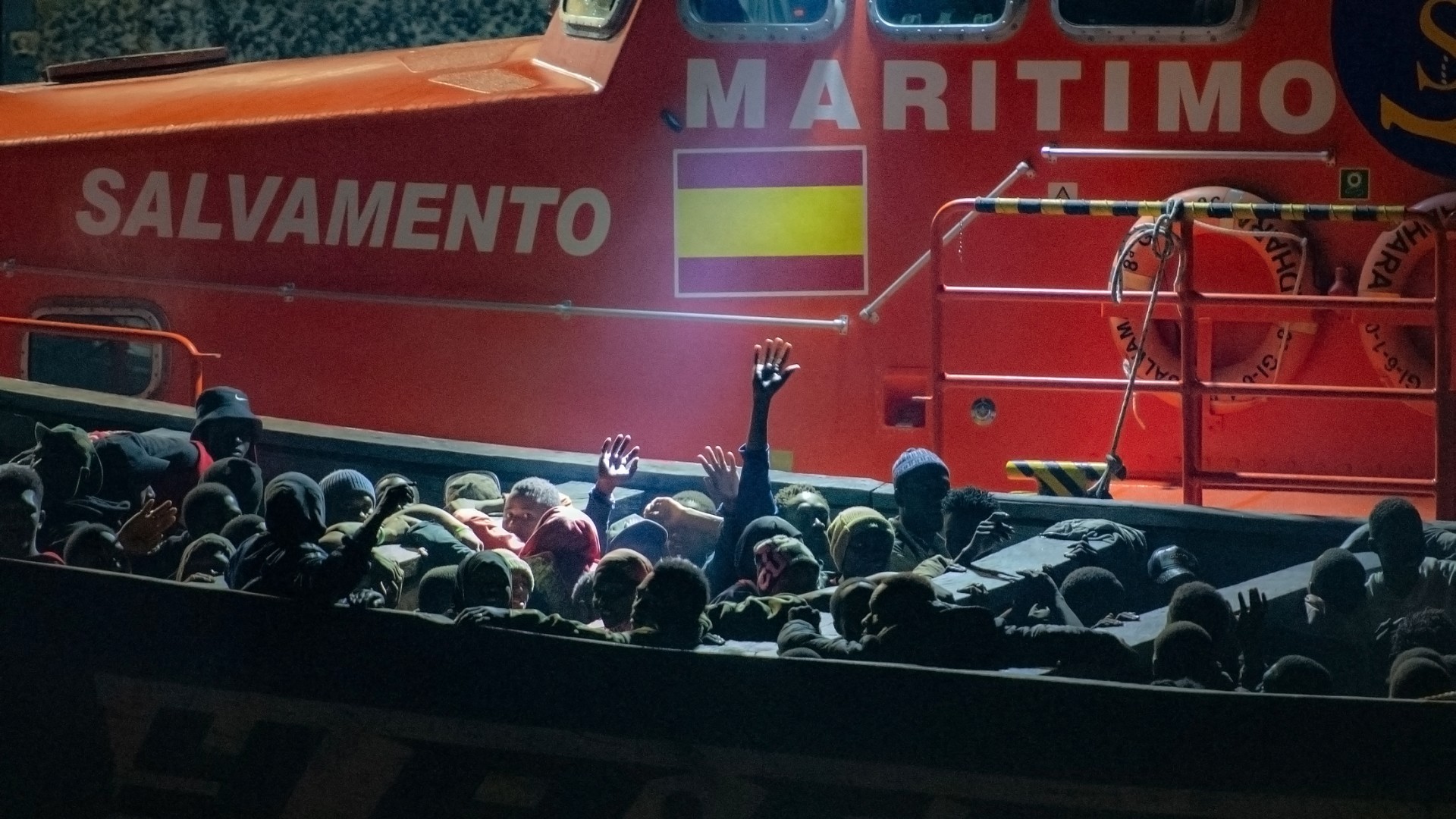
Migrants wait to disembark a boat that arrived early on September 22, 2024 at La Restinga port, after being rescued by the Spanish Salvamento Maritimo (Sea Search and Rescue agency) Salvamar Adhara vessel, off the Canary Islands.
ANTONIO SEMPERE / AFP
The leak of the preliminary report of the European Parliament’s Committee on Petitions mission to the Canary Islands, carried out last year, has once again put the management of the southern Atlantic border in the spotlight. The document notes the “disproportionate” pressure borne by the archipelago and supports a greater role for the European Union on the migration route.
Based on that political backing, the Canary Islands government has once again urged Pedro Sánchez’s executive to immediately request the deployment of Frontex ships, aircraft and drones in waters near the islands.
However, the request does not imply a paradigm shift in migration policy. Sources close to President Fernando Clavijo acknowledge that the European reinforcement would serve as “real support in rescue tasks and in the orderly management of flows,” but it would not mean an effective closure of the route.
In practice, it is about expanding the means to intercept and transfer more migrants, not about setting a limit on arrivals. In other words, strengthening the dynamic already in place. The opposite of what would be the logical solution to the problem raised.
The immediate context is the warning of an imminent wave of small boats from Mauritania. According to coordination services on the ground, departures could increase in the coming weeks.
The regional executive stresses that the decline recorded over the past year was partly due to EU diplomatic pressure on the Mauritanian authorities. If that containment weakens, the route could reactivate forcefully.
The European report endorses the thesis that the Canary Islands need more EU resources. What they will be used for is another matter.
In September 2024, the head of Frontex himself offered up to 3,000 additional agents for border operations during a hearing at the European Parliament. Nevertheless, to date the central government has not formally requested a stable deployment of vessels in the area.
At the same time, the Canary Islands executive questions Moncloa’s narrative regarding the relocation of unaccompanied foreign minors. Although the Spanish government has stated that “more than 1,000 minors” have been transferred to mainland Spain, official sources in the Canary Islands specify that 813 have effectively left through different channels and that only 373 correspond to the international protection system for asylum seekers whose departure was ordered by the Supreme Court almost a year ago. As of today, 4,004 minors remain under the guardianship of the regional government.
With the exception of VOX, Spain’s political parties have eracted cautiously to the document’s claims that includ the bombshell fact that nearly half of those tested registered as “unaccompanied minors”in the Canary Islands turned out to be adults.
The Popular Party—the main opposition party—reacted on social media platform X with a brief “it was impossible to know.”
No se podía saber. pic.twitter.com/Srgw6Kgqou
— Partido Popular (@ppopular) February 26, 2026
However, the PP has supported Coalición Canaria’s policies in the islands and has aligned with the Socialists in key decisions against VOX. Moreover, at the national level, it was one of the parties that backed initiatives for the mass regularization of irregular immigrants ultimately carried out by the PSOE.
They now seek to make people believe they have nothing to do with the immigration problem, one of the most decisive electoral factors today not only in Spain, but also one of the causes of the unstoppable rise of patriotic parties.
From VOX, the head of its delegation in Brussels, Jorge Buxadé, has been particularly blunt. “More than 50% of those supposed minors are adults,” he recently stated, denouncing what he describes as “the black hole into which the Canary Islands border has turned for massive and uncontrolled immigration in Europe.”
🗣 @Jorgebuxade desde Salamanca:
— VOX 🇪🇸 (@vox_es) February 26, 2026
"PP, PSOE y Coalición Canaria saben que más del 50% de los supuestos menores que entran por Canarias son mayores de edad".
"El PP ha admitido su entrada masiva y las consecuencias se perciben en todas y cada una de las ciudades de Castilla y… pic.twitter.com/IvdMv3au2B
According to Buxadé, after age determination tests, 92% of those from Morocco are not accepted by their country despite existing return orders. In his view, “PP, PSOE and Coalición Canaria knew” the scale of the problem and had allowed the archipelago to function as a “logistical hub” for redistribution to mainland Spain.