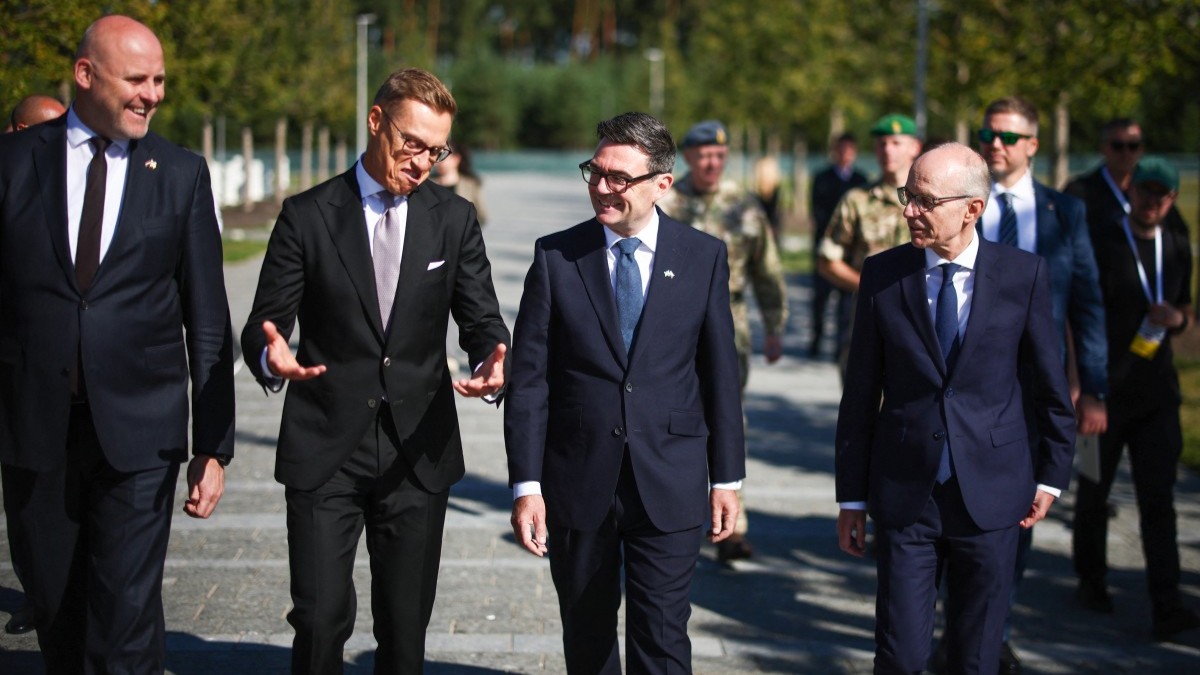
The ‘Coalition of the Willing’ is meeting again in Kyiv this Monday with the usual agenda: more weapons, more sanctions against Russia, and new security guarantees for Ukraine.
The meeting, symbolically held on Independence Day, brings together more than 30 countries and is co-chaired by the United Kingdom, France and Germany.
Volodymyr Zelensky has put a number on the table. Ukraine wants at least 300 additional interceptor missiles before winter. According to the Ukrainian president, Kyiv received 675 Patriot interceptors in 2023 and 364 in 2025, while it expects just 264 during 2026, precisely as Russia has intensified its use of ballistic missiles and drones.
The decline explains the urgency, but it also sums up a contradiction that has accompanied European policy for the past four years: every summit promises to turn political support into military capability, and the next one begins by discussing how to fill the same gaps.
There has been some concrete progress. London has authorised the sharing of classified information on British-made components to facilitate their production in Ukraine, while France has promised to accelerate air-defence deliveries. Either way, Kyiv remains dependent on Western systems to intercept certain Russian missiles that its own defence industry cannot neutralise on its own.
The cost of aiding Ukraine’s war effort is falling increasingly on Europe. The European Commission puts total support from the EU and its member states to Ukraine since the start of the invasion at €220.2 billion, including €88.7 billion for military and defence capabilities. On top of that comes a €90 billion European loan to cover budgetary and military needs in 2026 and 2027.
The other major discussion once again concerns security after a possible ceasefire. Since January, the coalition has been working on a European multinational force, air and maritime support, protected storage facilities, training, and a U.S.-led monitoring mechanism.
In July, governments said that the force was ready to operate once hostilities had ended. When that might happen is another question.
Yet the political architecture continues to run ahead of reality.
There is still no ceasefire, the guarantees do not amount to NATO’s Article 5, and many of the commitments will still have to go through national procedures. The decisive question—what exactly Europeans would do if Russia attacked again—continues to depend on decisions that have yet to be defined.
Alongside that external dependence lies a problem that is much harder to replace with money: soldiers.
The Telegraph published an article this weekend on the growing presence of women in Ukraine’s Armed Forces and quoted a female combatant who supports extending an Israeli-style mobilisation system to women. Ukraine now has more than 75,000 women serving in its Armed Forces, more than 55,000 of them as military personnel.
For the moment, there is no compulsory mobilisation of women. Ukrainian law continues to keep women’s wartime service voluntary. The issue nevertheless reveals how far the country’s demographic and military pressures have gone.
Even before the war, Ukraine already faced one of Europe’s most severe demographic problems. The United Nations puts its fertility rate at around 0.9 children per woman in 2024 and warns that, without profound changes, the population could fall towards 29 million by 2040. That would be more than a quarter below its level at the start of the war.
Europe can send missiles, loans, and new declarations of solidarity. What it cannot produce at a summit is the population Ukraine is losing. And after four years of meetings, that is increasingly becoming the strategic constraint that nobody seems willing to accept.