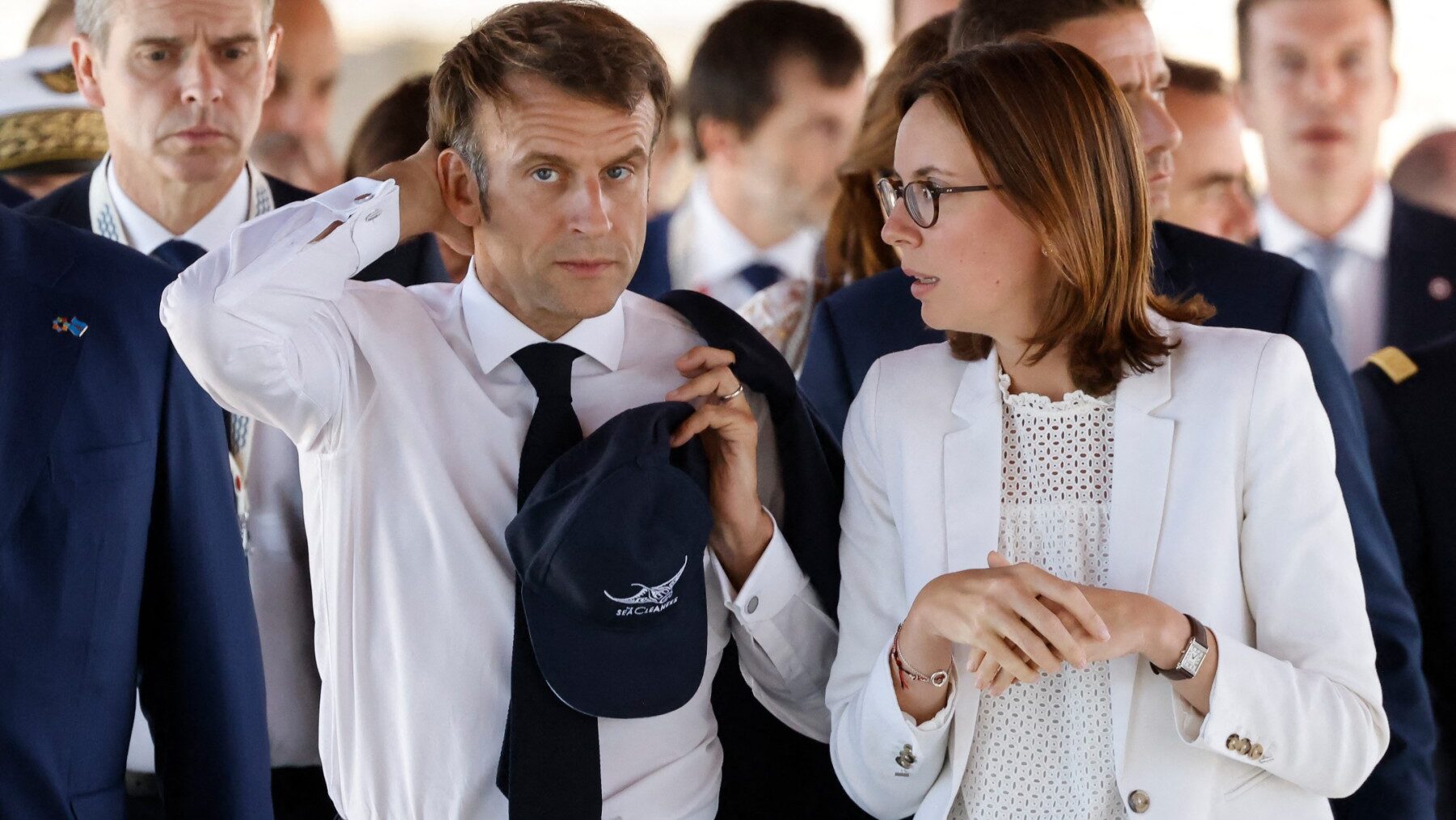
France’s President Emmanuel Macron (L), holding a cap offered by the NGO The SeaCleaners and French Ecological Transition and Territories’ Cohesion Minister Amelie de Montchalin (R) walk in the Lisbon Oceanarium, in Lisbon on June 30, 2022, as part of the UN Ocean Conference.
LUDOVIC MARIN / AFP
If one is to believe the European press, Hungary’s ‘Orbán system’—in place for 16 years and, in the telling of the media, marked by patronage and corruption—has finally come to an end with the April 12 elections, a result seen by establishment media as a cause for celebration. Meanwhile, for nearly ten years now, France has been experiencing the joys of a ‘Macron system’ without anyone batting an eye. As the next presidential election approaches, the scramble for privileges and public office has never been more intense within the French president’s inner circle.
It is a universal practice for a leader to seek to place their close associates in positions of responsibility and to allow them to benefit from the associated advantages. But at what point does this common practice become suspect and warrant condemnation?
For several months, as the second term of Emmanuel Macron—who first became president of the French Republic in May 2017 and was re-elected in 2022—draws to a close, changes in posts and appointments have been accelerating in strategic roles at the highest levels of government, and they have not gone unnoticed.
In February 2025, the reshuffle began with the appointment as president of the Constitutional Council—a major state body responsible for ensuring laws comply with the French constitution—of Richard Ferrand, one of Macron’s longest-serving loyalists, who was implicated in a scandal involving corruption and illegal conflict of interest, which led to him stepping down from his ministerial post in 2017 shortly after his appointment. His election, secured by a single vote, caused quite a stir due to a career marred by allegations of corruption and legal cases that, conveniently, never came to fruition.
A year later, in February 2026, another appointment attracted attention: that of Amélie de Montchalin as the first female president of the Court of Auditors, the supreme body for auditing public accounts. She, too, was very close to Macron and, at the time of her appointment, was the incumbent minister for public accounts, which made the appointment unusual: she moved directly from the government to an institution responsible for overseeing the state’s actions. In effect, she found herself assessing budgets that she herself had prepared, notably those for 2025–2026. Special recusal procedures have been put in place to avoid conflicts of interest, but despite these largely cosmetic precautions, the appointment has caused consternation and clearly constitutes an infringement on the court’s independence, a fact glossed over by alluring arguments: the first appointment of a woman to this post, the appointee’s youth, and so on.
No sector is spared. Rumours are swirling around the highly coveted post of governor of the Banque de France. Its president, François Villeroy de Galhau, tendered his surprise resignation in February 2026, after 11 years at the helm of the institution, but 18 months before his term was due to end in 2027, i.e., after the presidential elections. His resignation has a very tangible consequence: it allows Macron to appoint his successor, thereby placing yet another loyalist in the role—who will thus be in post when the new president takes office in May 2027. Among the names being mentioned is that of Emmanuel Moulin, currently in the strategic post of secretary general of the Élysée.
Finally, there is the case of the post of human rights defender. The term of the current one, Claire Hédon, expires in the summer of 2026. It is up to President Macron to propose a successor, who must then be approved by parliament. Since March 2026, the name of Éric Dupond-Moretti, former minister of justice, has been circulating persistently, but no official appointment has been made at this stage. Given his closeness to Emmanuel Macron, and his involvement in a case of illegal conflict of interest whilst he was a minister, his appointment would reinforce the pattern that has emerged since the appointment of Richard Ferrand. Although Dupond-Moretti was eventually acquitted by the courts, strong suspicions of unethical conduct still cling to him, further tarnishing the image of Macron’s associates chosen to hold public office.
Among the opposition on both the Left and the Right, these appointments are causing outrage. For Rassemblement National MP Jean-Philippe Tanguy, Montchalin’s appointment is a genuine “scandal”, intended to “cover up the ruin of the public finances.” Among Les Républicains, there are accusations of a “drift” aimed at “transforming a supervisory authority into an appendage of power.” Paul Cassia, professor of public law at the Sorbonne, has filed a legal challenge against the former minister’s appointment, with the support of the anti-corruption association Anticor. “If this were to happen in Orbán’s Hungary, it would make every democrat’s hair stand on end,” the legal expert remarked with a certain clarity. On April 17th, the appeal was dismissed by the Council of State. The state apparatus is defending itself pretty well.