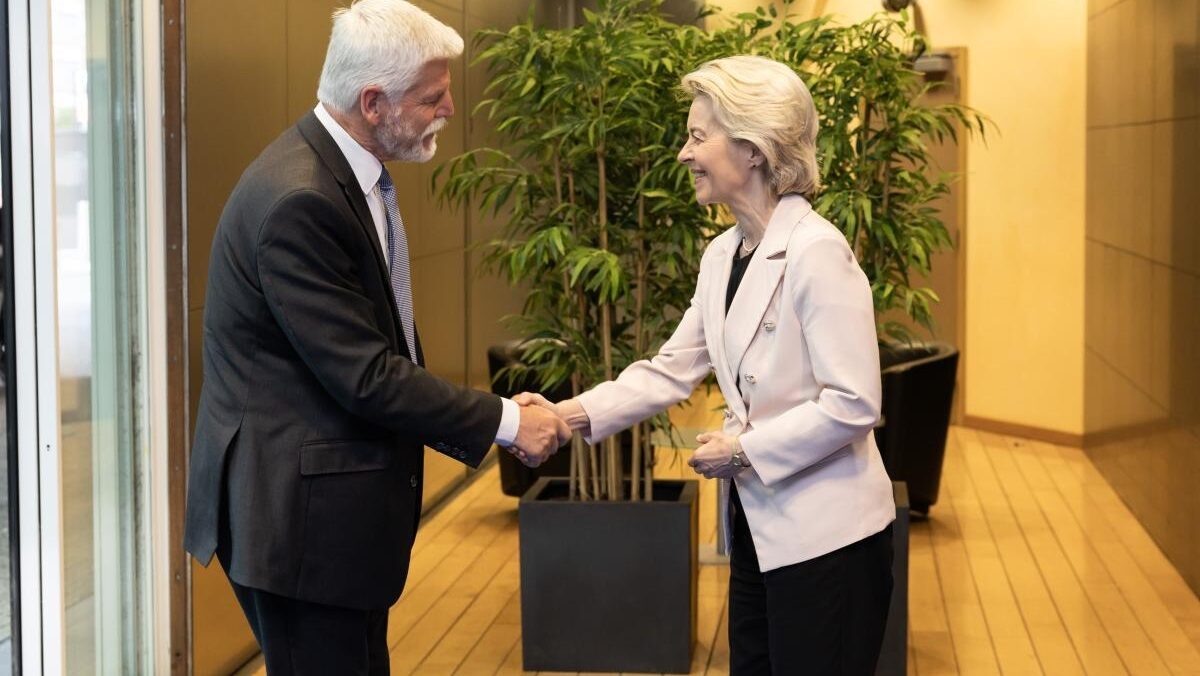
Czech president Petr Pavel with EU Commission president Ursula von der Leyen.
European Commission
Czech president Petr Pavel has said he supports the creation of a ‘United States of Europe,’ arguing that deeper integration is the only way for the bloc to remain a global power. Despite the Czech Republic shifting in a more sovereigntist direction since Prime Minister Andrej Babiš (ANO/PfE) returned to power last December, the country’s incumbent president and former army chief Petr Pavel is sticking to the Eurofederalist script.
In a recent debate, Pavel revealed that he fully supports the idea of an entirely centralized, federal EU, in which the current nation-states have less power vis-à-vis Brussels than a U.S. state has to the federal government. Pavel, just like the mainstream Brussels elite, sees ‘more Europe’ at the cost of national sovereignty as the solution to all the geopolitical challenges today.
“I have emphasized the idea of a United States of Europe several times as probably the only solution for Europe if it wants to remain relevant on the world map,” Pavel explained.
“It is still becoming clear that the following period—which will not be short—will be the period of global powers. And Europe can only be a global power if it speaks with one voice.”
There’s a reason this language (like “speaking with one voice”) is familiar. Commission president Ursula von der Leyen and others in her mainstream elite frequently use these phrases when advocating for more power to Brussels at the expense of member states.
These arguments are also gaining momentum as Brussels pushes for another round of treaty reform, with federalist-leaning figures aiming to take a major—and potentially irreversible—step toward deeper integration by the end of the decade.
Concrete reform proposals were already endorsed by the European Parliament at the end of the last term, and the current mandate, running until 2029, is expected to begin implementing them—paving the way for one of the biggest power grabs in EU history by 2030. Negotiations over the €2 trillion record EU budget for 2028-2034 have also just begun, which, if successful, will provide the financial foundation for this project.
As in the past, these efforts are framed around the pretext of external threats, geopolitical challenges, and global crises to facilitate yet another round of power grabs. Pavel makes a similar case, pointing to energy and security to justify why member states should give up their sovereignty to Brussels.
“We can no longer look endlessly across the ocean when it comes to ensuring security. Just as we cannot look east when it comes to energy security, but we must finally stand on our own two feet and take care of ourselves,” said Pavel. “And that means we have to come to an agreement here in Europe.”